
 Write a comment

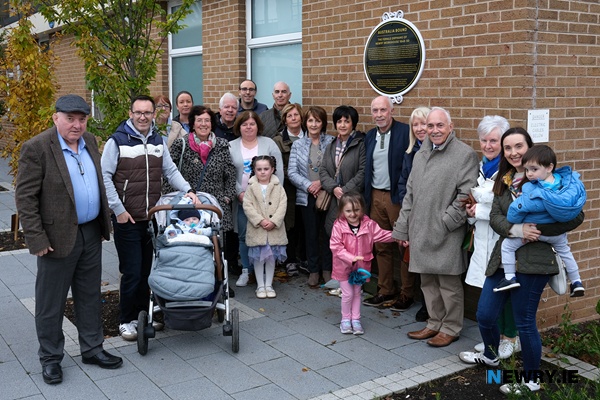
The unveiling of a commemorative plaque at Daisy Hill Hospital will serve as a lasting memory to the 35 female orphan girls who emigrated from Newry Workhouse to Australia between 1848 and 1850. The journey was arduous, a three month journey covering 14,000 miles by sailing ship.

Hugh McShane who was responsible for the event spoke about The Earl Gray Scheme, which facilitated the emigration of over 4,000 Irish female orphans, with 35 of the girls coming from Newry Workhouse. The ceremony aimed to remember these girls, who became nation builders in Australia, and their descendants now number over a million people.

Daisy Hill Hospital is built on the site of the original Newry workhouse, which was opened in December 1841.
McShane explains "These girls left Newry workhouse between 1848 and 1850, just that two year period. It was very short period this scheme actually operated, for a new life in Australia, and at that time it was 14,000 miles away and a three month journey by sailing ship. So it was a very long journey coming from Newry which was the only place that they knew, the only place they had any life experience in, to this distant land that they basically knew nothing about."
McShane welcomed Martin Moore who had organised an event earlier that day at the Paupers Graveyard remembering babies who died at birth or in their infancy. He thanked the Southern Health Trust and James McArevey, Michael McCaul signs and others for their roles in helping commemorate the girls and the impact of the Great Famine, which claimed a million lives and led to another million emigrating.
Explaining how the girls ended up in Australia McShane said "Australia, don't forget, was part of the British Empire. It originally was basically a dumping ground for people who were found guilty ofvery menial crimes a lot of the time. But by the 1840s the 1850s it had become a much more sort of affluent and prosperous society with a lot of business people, big farmers, and they were really looking for young women to populate what was then South Australia. There were lots of men, of course, because they formed the majority of so called convicts who went to Australia. But they needed to bring young women over, partly to rebalance the population, which was eight to one in favour of men."
Four thousand girls arrived on 20 ships over a two year period coming from different parts of Ireland as due to the famine the workhouses of Ireland were bursting at the seams by 1847. "Newry workhouse was built to accommodate 1000 people. It was one of the bigger workhouses in Ireland. In 1841/ 1842 when it opened there were about 400 in it, people didn't want to go into it. But by 1845/1846 the population of Newry workhouse had jumped to 1500, it was vastly overcrowded, so that was another reason why they needed to try and identify young females who would leave the Newry Workhouse and would go to Australia." said McShane.
Most of the 'inmates' as they were called didn't come from the town of Newry. They came from the outlying district including Camlough, Hilltown, Mayobridge, Warrenpoint, Cranfield and Kilkeel.
McShane explained "We know very little about them. They drifted into obscurity. They went to work in cities. They went to work on farms. Some of them did very well. One of them, for example, married a gold prospector because there was a gold rush in Australia in the 1850s, and did very well and actually lived into her 90s. A lot of them we don't know about."
Reflecting on the time he added "I think when, when you say a million people died, it just slips off the tongue so easily, doesn't it? But when you think about it, it was an absolutely horrific scandal of the time, something that I think still resonates with Irish people, and that's why Irish people are so generous when it comes to famines in all different parts of the world. But I suppose when we sit back on the comfort of our homes nowadays, we forget the conditions that people in Newry lived in in the 1840s and hopefully this ceremony today and this plaque will be a reminder to people of the relative affluence in which we live compared to our ancestors."
See the Hugh McShane History Facebook page for more