Write a comment
Professor Kurt Hubner was in Newry last week meeting with business people, economists and political representatives to explain the findings of his research document Modelling Irish Unification and the professor stated unequivocally that an EU exit means borders.

The peer reviewed report found that a united Ireland could benefit the economy here by some €36 billion over the first 8 years.
Professor Hubner, whose expertise is in the area of European integration in the context of the global political economy, explained the findings of his report, how they were calculated and the ground breaking model that was used.
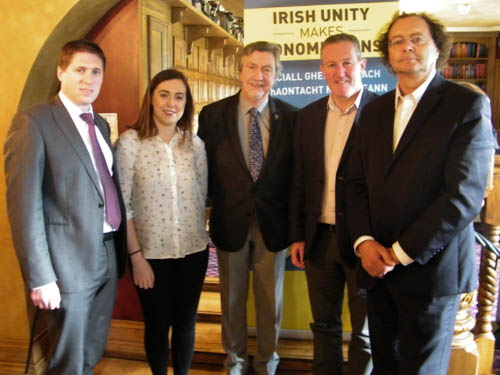
Commenting on the upcoming Brexit preparations Prof Hubner said "Let me be absolutely clear, Brexit will bring back borders. If no special provision is made for Northern Ireland then borders are inevitable. No serious expert in the field of European integration will tell you otherwise," he said.
When asked if an EU exit had made his study irrelevant he said the opposite was true.
"Quite the opposite, it is more relevant than ever. Prior to the Brexit vote this was an academic study, an intellectual theory, now it is on the agenda, it is a very real question that needs answered," he said.
"The study itself is not about Brexit, it is about the economic feasibility of uniting Ireland and the consequences of doing so. To fully understand the implications of Brexit you would need to do a study specifically on that issue. However, if you were to do such a study, for it to be realistic it must be based on the costs of non unification.
"If you look at the issue dispassionately and from a purely economic point of view, the only realistic conclusion for Ireland is unification. So the question for Northern Ireland is now 'what do we do?' If you don't go for unification the economic costs are extremely high. Any study into Brexit for Northern Ireland would have to be called The Cost of Non Unification."
Professor Hubner said he had been slightly taken aback by the reaction of some to his report.
"I came at this from a purely academic and economic point of view, I have no stake in the constitutional position of Ireland, so I was initially taken aback by the reaction from some people," he said.
"The report has no political or social elements, it is purely about the economic consequences of reunification. So I was surprised to get some very angry emails from people and even certain politicians, when presented with the report, they would not question the content or the outcome they would ask questions about who funded it and who requested it. I got the impression that no matter what they were presented with they would have rejected it, had I explained it 10 times they would not have accepted the finding, but I have yet to see an economic retort or response to the study.
"Similarly, I found even among Irish colleagues, other professors and academics, there was a reluctance to look at the unification issue. It is still in many ways a trauma or a very sensitive subject, which possibly explains why it took an outsider to carry out this research."
Mr Hubner was in Newry as part of a tour of Ireland, presenting his report to politicians, business leaders and economists across the country. He has been on national media and presented his findings to both Stormont and the Oireachtas.