 Write a comment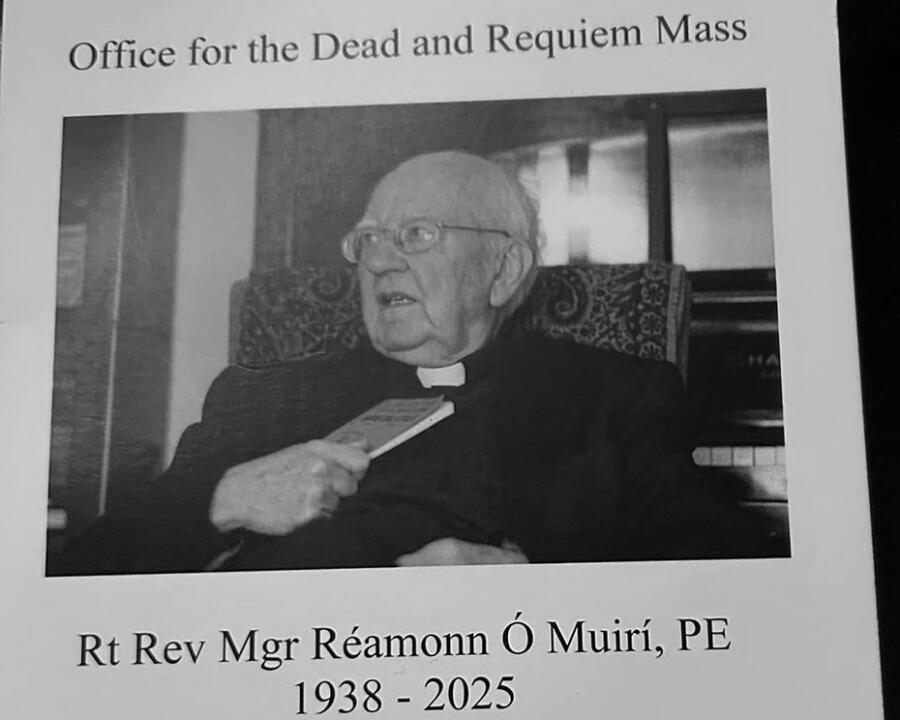
When Internment without trial was introduced in August 1971, Fr Raymond Murray, then a curate in Armagh, feared the very worst. His training as an historian warned him that the British reaction to civil unrest would move with the same harsh colonial instinct is it did in the Mau Mau rising in Keyna in the fifties. The brutal treatment of the interned, notably the related ‘deep interrogation’ regarding the Hooded Men episode confirmed this, and projected an age of undercurrent state involvement as violence soared.
From that time, and as chaplain of the women’s prison in Armagh from 1969, he made an immediate decision along with Fr Denis Faul of Dungannon and others that they would become totally involved in confronting abuses of human rights and dignity from all sources, state and paramilitary. The church must take a leading pastoral and publicity role, they concluded, and stand up for the people in their time of plight and despair. They kept Cardinal Conway informed who also maintained a daily record of what was happening on the ground.
Over the next 25 years they relentlessly produced articles and lectures and pamphlets on aspects of the Troubles including Fr Murray’s own major books- Hard Time Armagh Gaol 1971-1986, The SAS in Ireland, and State Violence Northern Ireland 1969-1997. He was at the very forefront of many major events such as giving critical evidence at Strasbourg in the case the Irish Government brought against the UK over the Hooded Men. He was the first to publicly assert the innocence of the Birmingham Six, the Guilford Four and the Maguires, and he along with concerned solicitors and politicians worked ceaselessly through the long disappointments until all the cases were overturned. Fluent in Irish, German and French, he lectured constantly on all these matters in various countries throughout Europe, as well as Ireland, Britain, the United States and Canada.
Raymond Murray was born in Newtownhamilton in 1948 to Vincent and Kathleen Winifred Murray (née Marsh) and went to the local primary school followed by the Abbey CBS in Newry and St Patricks Armagh. He did his BA in Maynooth in 1958 at the age of 19 in Irish and History, was awarded Bachelor of Divinity in 1961, did an MA in 1964 at QUB and his PhD in 1993 at QUB on the work of Art Bennett (Art Mac Bionaid) (1793–1879) scribe, scholar and poet in Irish, born in Ballykeel, Forkhill.
He was ordained priest in 1962 and in his pastoral career served as Curate St Teresa’s Parish Belfast 1962-62: Curate Clonoe, County Tyrone 1963-63; Chaplain Good Shepherd Convent, Newry County Down 1964-65; Curate Monasterboice, County Louth 1965-67; Curate St Patrick’s, Armagh 1967-1985; Administrator, St Patrick’s Cathedral Armagh 1985-1993; Chaplain, Womens Prison Armagh 1967-86; Sabatical year Nurnberg, Germany and Rome Italy 1993-94; Assistant Acting Parish Priest Killcluney, Assistant in Derrynoose 1994-95; Parish Priest Moneymore 1995-96; Parish Priest Holy Trinity Cookstown 1996-2007; Retired, to Armagh city and voluntary pastoral activity. He and Fr Faul were made Domestic Prelates through Cardinal Daly in 1995 with the title monsignor.
But his well recognised contribution to human rights is merely one aspect of an immense life-long contribution to history, culture and the arts at local and national level and of course his on-going pastoral work as curate and later Adm. of the busy parish of Armagh. Nor should it be forgotten the enormity of the will power involved in staying on top of so much for so long.
The promotion of history had always attracted him to Seanchas Ard Mhacha, Journal of the Armagh Diocesan Historical Society which was founded at a meeting of clergy and laity from the Archdiocese of Armagh on May 1953. It was led by an tAthTomas O Fiaich, professor of modern history in Maynooth and first editor. The stated objective was to promote the education of the public by the study of history, both ecclesiastical and secular of the Archdiocese. Fr Murray had contributed may articles before becoming editor of this annual publication 1986, a position he held for 27 years consecutive years.
It was a massive undertaking. The organisation involved in editing and producing a 400 page book involving ten and more serious articles was immense. For example, the 2008 edition contained 11 high quality researched and written articles by different writers- each negotiated by the editor- including for example St Malachy and the introduction of the Cistercian monasticism in the Irish church, Marie Therese Flanagan: Irish links with Santa Maria dell’Anima in Rome, Feargus Ó Fearghail: The Richardsons of Bessbrook; A Quaker linen family, John Bradley: John Vallely,1908-1985, Brian Vallely: Patrick’s Ireland, Local Topography in the Tripartite Life, Seán Barden; The Emergence of the Irish Episcopal Conference 1788-1882, Pádraig Murphy.
Each volume also contained a series of reviews, numerous photographs, details of the contributors, a very extensive chronicle, diocesan events of the year in question, preparations for publication, invitations, a launch event and general contribution- a year’s work in itself. He took part in the annual pilgrimages organised by the Historical Society to the various sites in Europe created by medieval Irish monks and to places related to historic Irish emigration.
The Cardinal O Fiaich Library and Archive was largely his initiative and driven by him, a natural extension of the Diocesan Historical Society. He strongly felt that a purpose built home was needed not merely for the academic papers and books of the late cardinal, but for the ever growing body of related works of Irish and local history, of local literature and language development, writings and lectures on the growth of the GAA and road bowls, aspects of Irish and local culture, and the historic Irish-European dynamic. Also very much in his mind was the great medieval school of Armagh from the sixth to the ninth century when Ireland was last a European centre of intellect and art, and the Cardinal O Fiaich library, which was officially opened in May 1999 by Cardinal Brady, was seen as a direct descendent of that inheritance.
Accordingly, it represented the filling of a long time cultural and artistic absence, and afforded an overall renewed sense of status, potential, belonging and destiny. In keeping with the historic status as a city of learning, it provided Armagh with a second such major library alongside the established Archbishop Richard Robinson Library, founded in 1771.
Among the treasured collections are the papers of Micheline Kerney Walsh regarding her extensively researched archives in Paris and Madrid and other places in Europe and involving unique material on Irish families on the continent from the 16th to the 20th centuries. This included 250,000 documents regarding Ireland’s place in Europe. It also houses a huge body of original material such as the history of Northern Ireland before and after partition. The library now holds over 40,000 published volumes, 500 on-going periodicals and well over a million documents and attracts visiting researchers from across the world. It notably contains a superb collection of material involving the growth of the GAA at club and county level. Many local histories and sporting writings from all over Ulster in particular have found a permanent home in the library and on-going extensive lectures and exhibitions on all aspects of Irish life a major feature are well established. Mons Murray’s own huge collection of archives, papers, books and the many joint publications of himself and Mons Denis Faul are also housed there as are his major works including The Burning of Wildgoose Lodge 2005, History of Archdiocese of Armagh and the minutes related to organisations such as The Irish Franconian Society, Association for Legal Justice 1971-1980 and Relatives for Justice 1990-2002, of which he was a founding member and chairman.
He is recognised as one of the outstanding Irish language poets of modern times. His collection Lampaí Dearga won the Oireachtas Prize for poetry in 2005. This followed two earlier acclaimed collections, Athphreabadh na hÓige, 1964, and Arán ar an Tábla 1970. He argued that the intensity of poetry in any language was more related to revelation than it was to the philosophical. He claimed that the specific concentration applied to poetry went directly to the deepest unconscious memories, and that this made the difference. Moreover, he held that the actual tone of vowels and consonants varied from language to language and that construction and form was largely shaped to cater for these variations. So highly acknowledged are each of his collections that several students in the South have created their Ph.D theses on aspects of his poetic works.
His late brother Fr. Patsy, who served in New Zealand, was a member of the All-Ireland winning Armagh minor team of 1949. So it was no wonder that Mons Raymond was a full blooded supporter of Armagh in both good times and bad, and readily gave of his opinion. He also wrote extensively on Road Bowls and was an active member in its on-going promotion.
Fellow curate and historian in Armagh for 18 years, Fr. Peter Kerr, a native of Carrickmore, told how Mons Murray was a boundless champion of the downtrodden and forgotten in the parish and beyond.
“Day and night, year after year, people from the parish and beyond came to the door or rang up regarding relatives who had been lifted by the police or British army, or victimised in some way by the Troubles. Nobody was ever turned away and he always worked to find a solution. He had a rare kindness of heart and a warmth that never, ever wilted. He never stopped working. Often when the rest of us in the Parochial House were retiring for the night he would still be at his typewriter. He was also a great wit and great companion, ever at ease and natural when meeting people
“But he didn’t get it easy. He was often threatened by sinister phone calls, by letters, verbal assaults, threats and bullets in the post. But nothing could deter him from his mission. His immense intellectual gifts and learning enabled him to concentrate on several fronts at the one time, civil rights issues, history issues and pastoral issues. He was always alert to what was happening in politics and human rights, local and universal.
“His deep faith inspired and strengthened him. He was daily driven by the call of the gospel, the key to his life, notably the lines of Matthew 25/40- ‘I was hungry and you gave me food, a stranger and you made me welcome, sick and you visited me, in prison and you came to see me……As often as you did it to one of these, my least brethren, you did it unto Me.’ ”
“One of the last public masses he celebrated was for a group of pilgrims in the ruin of the old Franciscan Abbey in Armagh. The Franciscans had been associated with Armagh from 1241 and in 20 years, with the help of Patrick O’ Scanlail, Archbishop of Armagh, the monastery was built and served as a place of Catholic worship until it was taken over in 1264. The Monastery was dissolved by Henry VIII and by 1551, it was being prepared as a place to billot Queen Elizabeth’s army. How fitting it was that the priest who spent 45 years ministering to the people in Armagh should be the celebrant on this historic occasion.”
Eugene Reavey of Whitecross said that of all the individuals who related to him following the murder of his three brothers in 1976, Mons Murray had the greatest warmth and approachability. He described him as ‘a super intelligent person’ who knew what was happening on the ground more than anyone else. “Some years ago I went to visit him in Armagh about developments regarding justice for my brothers, and he gave me a full two hours of his time, explaining everything as he saw it.”
As an historian and in the immensity of his general contribution and publications, he is the equal of his great mentor, the late Cardinal O Fiaich. If he was given ten talents in this life, he returned it ten-fold. He has left behind him an imposing history of the times, one of Ireland’s finest cultural libraries, a great body of Irish language poetry, a vast dynamic of historical articles in the Seanchas Ard Mhacha and most of all, an inheritance of pastoral compassion and assistant to thousands throughout the Troubles, that he was there for the people in their hour of need.
In a word, he belongs to the company of the very greatest down all the ages who have adorned the historic name of Armagh.
Monsignor Raymond Murray 1948-2025