 Write a comment
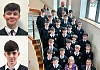
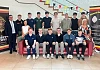
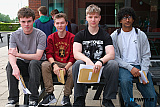
 Eoin Lane and Oisin McKinley from Abbey Christian Brothers School, Newry took First Place in the Junior Group Award in the Biological and Ecological Science section at the BT Young Scientist of the Year Exhibition in Dublin last week. The pair also received a Junior Display Award.


Their project entitled A study of the Resource Holding potential of the Red Beadlet Anemone attracted a lot of interest at the Ballsbridge event.
The pair were the only Newry representatives at this years 50th Anniversary Young Scientist Exhibition.
In all, almost 1,165 students from 32 counties covering 550 projects from 210 schools nationwide competed for the title of BT Young Scientist of the Year won this year by Paul Clarke, aged 17, from St Paul’s College, Raheny in Dublin who took home the top prize for his project entitled “Contributions to cyclic graph theory.
Paul was presented with a cheque for €5,000, the opportunity to represent Ireland at the 26th European Union Young Scientist competition taking place in September and a brand new trophy. As this year’s winner, Paul will also win a once in a lifetime trip to Silicon Valley in California, home to some of the world’s biggest technology corporations, to meet BT’s Innovation team, and will enjoy a hosted tour of leading enterprises and meet business leaders from the world of science and technology.
Colm O’Neill, CEO, BT Ireland said, “When we set out last year to plan for the 50th BT Young Scientist & Technology Exhibition we wanted to make sure that this was our most exceptional event to date. I’m delighted to say that it has exceeded all of our expectations. Over the past three days we have had some of Ireland’s brightest, most creative and positive young people astound us with their ideas for a better future and we have been greatly impressed by the high standard of these entries.
He added, “Over the years the exhibition has proven to be an important launch pad for the next wave of entrepreneurs, academics, scientists and technologists; people who will be fundamental in addressing the global skills shortage. For that reason, we cannot underestimate the importance of this exhibition in encouraging our young students to pursue careers in science and technology. I would like to congratulate every single student who participated this week and of course to Paul on his enormous achievement. If our past winners have taught us anything, it’s that this award could change his life.”
Speaking about the winning entry, Professor Tom Laffey, judge in the Chemical, Physical & Mathematical Sciences category said: “Graph theory is an area of pure mathematics which studies properties of linkages and networks. It has applications in several areas including computing, molecular structure, neuroscience, search engines, engineering etc. In this project Paul makes a profound contribution to the study of graphs. He identifies key concepts and provides the methodology to apply them to some long-standing major problems in the subject with great success.”