 Write a comment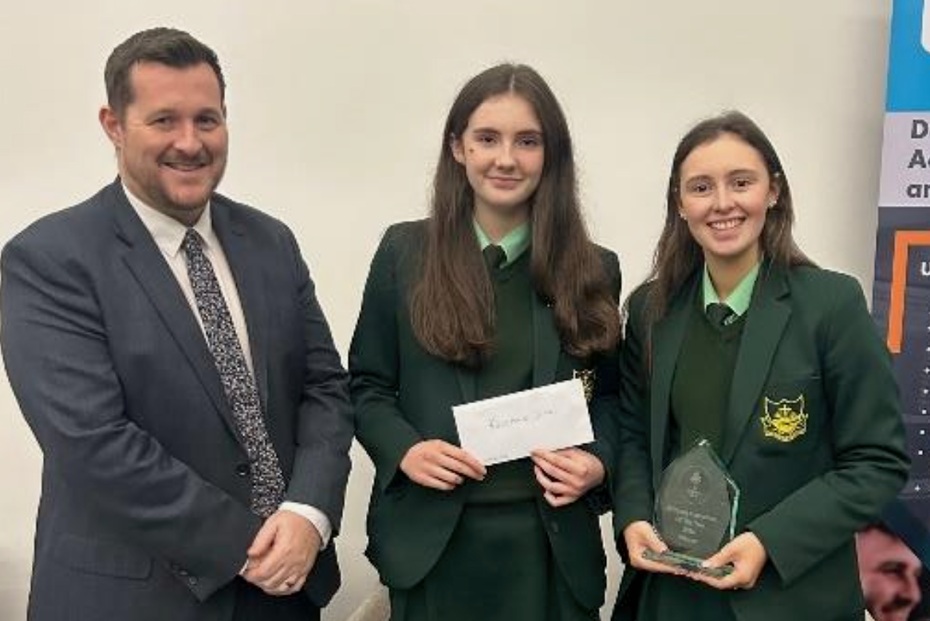
Students from the Sacred Heart Grammar School have taken first place in this year's NI Young Economist of the Year competition, which saw post-primary pupils from across Northern Ireland tackle some of the region's most pressing economic challenges. An Abbey Grammar School pupil took third place.


Ceallagh Waters and Michelle Brown were awarded top honours for their project examining health and social care reform under fiscal pressure. The competition, organised by NI Schools Hub and delivered in association with Ulster University Business School and First Derivative, drew submissions demonstrating exceptional economic insight and policy awareness from students region-wide.

The winning entry, titled 'Rethinking Public Services in Northern Ireland: Redesigning Health and Social Care Outcomes Under Fiscal Constraint' impressed judges with its sophisticated approach to complex policy questions. Academics from Ulster University Business School, who formally judged all entries, described it as "a highly accomplished and thoughtfully structured analysis, demonstrating a strong grasp of public finance, opportunity cost and efficiency within health and social care." They particularly praised the project's evidence-based recommendations and understanding of Northern Ireland's unique institutional and fiscal context.
Taking second place was a group from Shimna Integrated College, with Daniel Cutler, Tadhg Kennedy, Ben McNerlin, Matthew Turley and Rory Smith submitting their collaborative work on Rethinking Public Services: 'Improving Outcomes Without Increasing Taxation'. Judges highlighted the team's clear and coherent argument, noting their mature understanding of productivity, value for money and the trade-offs involved in public sector reform. The panel commended the strong collaborative approach and balanced evaluation of policy options presented by the group.
Justin Sheridan of Abbey Christian Brothers' Grammar School secured third place with his analysis of 'The Productivity Puzzle: Why Northern Ireland Lags Behind Comparable Regions and How Sustainable Growth Can Be Delivered'. The entry was praised for its analytical strength and effective use of economic theory, particularly in examining skills, investment and innovation as drivers of long-term productivity growth.
Students were invited to address pressing economic challenges facing Northern Ireland, with all submissions assessed on economic understanding, use of evidence, clarity of argument and the feasibility of proposed policy solutions. The rigorous and impartial evaluation process ensured entries were judged to the highest academic standards.
All prize-winning students received trophies and gift cards, alongside a two-day work experience placement with First Derivative. The placement offers practical exposure to the application of economics within Northern Ireland's expanding FinTech sector, giving students valuable insight into how economic theory translates into real-world business practice.