

 Write a comment
Embrace FARM, the support network for those affected by farm accidents, is encouraging people to join in the #WeRememberYou campaign this June to remember a person in their life lost or injured in a farm accident. The online service will take place Sunday 28 June at 2pm.
The campaign will this year culminate in an online Remembrance Service on where names of those affected by a farm accident will be spoken in order to honour their memory.
Kairos Productions will be producing this for Embrace Farm and It will also be shown on RTE on Sunday 5th July at 11am.
This is the seventh such annual Remembrance Service, but the first to be hosted online.
Last year more than 150 families had their loved ones remembered at the Ecumenical Service and Embrace FARM is encouraging people to send names of those they would like remembered this year.
Speaking about this initiative, Brian Rohan, Founder of Embrace FARM said “Our annual remembrance service is hugely important in the personal grieving process for many individuals and families.
Last year we had hundreds of people attend the service and while we cannot gather this year because of the Covid 19 social distancing guidelines, we just knew we had to host the event in a virtual way.
Behind each death there is a grieving family who are trying to find meaning and comfort.
Behind every farm accident victim is a survivor who’s injury may be impacting themselves and their families lives.
We would encourage anyone who would like their father, mother, husband, wife, child, relative or someone important to their family or community remembered to send us their details
so that we can honour their memory and continue to support each other on our collective journey.”
Statistics
From 2010 to 2019 there have been 214 lives lost due to farm related accidents in the Republic of Ireland according to the Health and Safety Authority (HSA).
A further 39 lives were lost from 2013 to 2019 in Northern Ireland according to the Health and Safety Executive for Northern Ireland (HSENI).
Teagasc research carried out between 2012-2017 estimates there are an average of 2500 farm accidents per year.
Embrace FARM is a registered charity which aims to provide support for those affected by farm accidents based on shared personal experience.
The organisation hosts the annual Remembrance Service, Residential Weekends for families and spouses facilitated by an accredited counsellor,
farm accident support groups and conferences, information evenings and farm safety information days.
Embrace FARM also works with other organisations and charities requiring additional emotional or practical support in the aftermath of the accident.
Embrace FARM Remembrance Service
The Embrace FARM online remembrance service will take place on Sunday 28th June at 2pm. The live stream will be broadcast on www.embracefarm.com
To submit loved ones details for inclusion call or WhatsApp 085-7709966 or email info@embracefarm.com with name, county, year of death or accident and a photograph if available.
For further information follow @EmbraceFARM on Facebook, Instagram and Twitter and join the conversation using the hashtag #WeRememberYou.
Write a comment
The management teams of the Ring of Gullion, the Mournes and Strangford and Lecale Areas of Outstanding Nature Beauty (AONBs) have teamed up with the Woodland Trust, to invite interested members of the local farming community to sign up for a Resilient Farms Development virtual workshop on Thursday 25 June at 7pm.
This is the second year of a project, which is working closely with farmers to partner them in trialling a new approach to delivering sustainable, improved and diversified farm businesses.
The project focuses on the use of ‘green infrastructure’ and management changes as an essential part of farming production. As part of the project, there will be an opportunity for farmers to develop a bespoke farm plan. The farmer can also be provided with assistance in exploring potential funding opportunities, which will facilitate the implementation of the plan on their respective farm.
Newry, Mourne and Down District Council Chairperson, Councillor Laura Devlin said “As well as the increasing daily running costs for farms, adverse weather and disease have also become major problems within our farming community. The prolonged wet, cold winter this year caused considerable issues at many levels. Outside shelter from hedges and trees are vitally important in protecting swards and stock and if properly planned, can be a vital tool towards farm viability. We are delighted to partner with the Woodland Trust for a second year to deliver this workshop, which will offer local farmers a unique opportunity to explore diversification and green infrastructure within their farms.”
In the last 50 years, increased mechanisation and use of artificial inputs, brought in fodder and changes towards continental breeds have allowed farmers to increase productivity. However, increases in the costs of fodder, fuel and fertilizer have in recent times lead to declines in overall income. With time and money at a premium, many farmers are now looking for more efficient ways to make farming pay. One such option involves exploring the benefits of green and living infrastructures such as hedges, trees, sward changes and even stock changes.
The Woodland Trust, a charity that supports the planting of trees and hedges, knows that it needs to work closely with farmers and help support them in their primary business of food production. It is therefore focused on working closely with farming communities to promote the many benefits that trees provide to help achieve this. Shelter and trees are only part of a bigger picture and for that reason the farm survey will, when required, offer support and signposting towards information of pasture management, stock changes and diversification opportunities and more.
To register for a place on the Resilient Farms Development virtual workshop, please
book directly via the Ring of Gullion website WWW.RINGOFGULLION.ORG or call 028 3082 8592.
Write a comment
Ministers from Northern Ireland and the Republic have come together to call for increased awareness of farm safety
With the ongoing high rate of fatal farm accidents in 2020, Minster Creed, Minister Poots, Minister Dodds and Minister Humphreys have urged all farmers across the island of Ireland, and all of those involved in agriculture, to play their part and reduce the rate of farm incidents.
In a joint appeal the Ministers said: “We all have a long association with farming and have all seen first-hand the devastation that follows farm incidents and fatalities.
“It is very concerning to see a surge in the number of fatal farm incidents on our farms. This year, there have been 15 fatal incidents on farms on the island of Ireland, with 12 fatal incidents in the South and 3 fatal incidents in Northern Ireland. The majority of these accidents have occurred during the Covid-19 restrictions and in particular it is very sad to see the number of children and older people that have died on our farms in recent weeks”
Three children and eight people over 65 have died this year. Thirteen have occurred during the Covid-19 restrictions. The Ministers continued: “There has been a remarkable level of public awareness across both jurisdictions of the need to flatten the Covid curve. Faced with an overwhelming public health imperative, practices such as physical distancing, coughing etiquette and hand sanitising have become a cultural norm.
“We need a similar and immediate effort if we are to make a real impact on the prevalence of farm incidents. Farm safety has to be built into our DNA. We have demonstrated with our collective response to Covid that this can be done.
“Research shows that farmers and contractors are generally aware of the risks, but often don’t adhere to the safety rules or take specific steps to ensure that the work they are engaged in can be done safely. Farm safety cannot be left to someone else. It has to be lived by the farmer, by all of us, and built into the routine. We are appealing to farmers and those working on farms to take time to think about farm safety every morning, before you go out into the yard. You should always plan your work, take a moment to STOP and THINK:
Write a comment
Farmers struggling to manage persistent digestive disturbances amongst their calves now have access to a breakthrough new 100% dairy protein milk formula from Volac.
New Imunogard® has been formulated specifically for under-performing stressed calves or to meet the unique needs of calf units wrestling with a stubborn scour problem that can’t be overcome by an improvement in environmental hygiene.
Volac global technical manager Ian Watson explains that the new 23% crude protein calf milk formula is vegetable protein-free, which means it is more easily digested by calves under stress.
“The protein in Imunogard® is 100% dairy. By formulating to 100% dairy protein we can maximise the level of Imunopro® in this new product. This also increases the delivery of the functional whey proteins (contained within Imunopro®) to the calf, which gives it the best chance of fighting off a disease challenge,” he says.
He adds that the new product also contains a slightly higher fat content to allow for more energy to be metabolised for growth.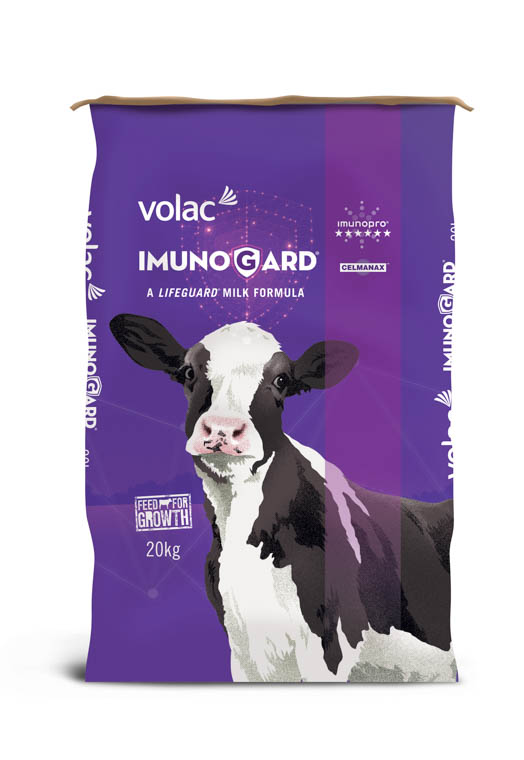
Additionally, Imunogard® incorporates the established hydrolysed yeast culture Celmanax from Church & Dwight to help improve calf gut function and mitigate the effect of a number of harmful pathogens.
“Proven hydrolysed yeast cultures not only provide readily digestible refined functional carbohydrates for the calf; they also have a recognised prebiotic function. Put simply, the inclusion of Celmanax feeds the calf’s beneficial gut bacteria and helps bind them to damaging bugs, such as cryptosporidia, E.coli and Salmonella spp. This stops these harmful pathogens from binding to the gut wall and taking hold to cause disease signs such as scouring,” explains Mr Watson.
“For example, independent scientific trials have demonstrated that calves supplemented with Celmanax shed three times less cryptosporidium oocysts than those which were not, thus helping to reduce the spread of cryptosporidiosis. The Celmanax supplemented calves also had improved faecal and dehydration scores1.”
Imunogard® also benefits from the inclusion of other beneficial health supplements, as standard in Volac’s Lifeguard range of calf milk formulas. For example, butyrate for its anti-inflammatory effects and ability to stimulate gut enzyme production, and the garlic-derived ingredient Gardion – known too for its natural pathogen inhibiting effects and ability to enhance immune system function.
The new calf milk formula should be mixed at the rate of 150g in every litre of water and be fed to calves according to Volac’s standard growth curve recommendations.
Calf rearers, vets and nutritionists interested in further information about new Imunogard® should speak to their local Volac Business Manager, or call Volac directly on freephone 0800 919808
Ref:
Write a comment
Slieve Gullion Councillor Oonagh Magennis has urged the DAERA Minister Edwin Poots to do more to support beef and sheep hill farmers.
It follows the announcement of an allocation of £25 million financial assistance for farming for COVID-19 relief by Agriculture Minister, Edwin Poots.
Cllr Magennis said “My understanding of the Ministers statement is that it looks like good news for the dairy sector and beef finishers but bad news for beef and sheep producers, who are mostly hill farmers and appear to have been overlooked.

The Minister states that his decision is based on evidence, however he seems to have taken no account of the closure of the marts during the month of April and the impact this had on primary producers who also had to contend with rising input costs, the impact of COVID, the loss of ANC support and a drying up of their cash flow forcing them to make farm to farm sales at poor prices”.
Cllr Magennis continued “According to the DAERA, during April when the marts were shut, 21,691 cattle were traded between farms and Minister Poots knows from evidence provided to him that cattle value had plummeted by £240/head and sheep by £31/head.
However, it looks as if no consideration has been given to these farmers, despite them being one of the few sectors whose income is so low that they could not benefit from other COVID support measures as the self-employed Income Support Scheme”.
Cllr Magennis concluded "This announcement is disappointing for beef and sheep hill farmers. Sinn Féin will continue to highlight their concerns and I would urge the Minister Edwin Poots to support our beef and sheep primary producers, who are at the very beginning of the food supply chain and the backbone of the agri-food industry.”
Most Immediate Need
Making the announcement Agriculture Minister Edwin Poots said “I have decided to target £21.4m of the £25m support package towards those businesses in the beef, dairy, sheep, potato and ornamental horticulture sectors that have been hardest hit financially and those in most immediate need as a direct result of the Covid-19 pandemic.
“Since other support measures are available to agricultural and horticultural businesses, rates of compensation for losses incurred have been set at 100% or 80% - depending on the nature of the business and other support already available.”
Breakdown of the £21.4m (indicative figures) is as follows:
The Minister continued: “The financial interventions that I am proposing to make will go a long way in helping these businesses survive the current crisis. However, I want to be prudent at this stage with the funding as we cannot rule out the possibility of further market disturbance as a result of this pandemic and the need for additional farmer support.
“For that reason, I want to retain a budget of just over £7m based on the residual funding of £3.6m (from the £25m) and £3.6m that has been reprioritised internally within my Department. This would allow me to address additional issues and challenges Covid-19 may present in the weeks and months ahead. As far as I am aware, this is the most comprehensive support scheme for our primary producers available anywhere within the EU."
Concluding Minister Dodds added “It is vitally important that we recognise the hard work of our farmers and those working within the wider agri-food sector who have, through these extraordinary times, ensured we have food on our tables.
Write a comment
A supply chain initiative between Asda and its main meat supplier, ABP not only supported Northern Ireland’s beef sector, but also gave consumers a much-needed value boost during the early stages of the Coronavirus crisis.
With the closure of the hospitality and food service markets creating a serious carcase imbalance issue, the Asda/ABP partnership offered an important outlet for the higher value meat cuts – including rump, sirloin and ribeye steaks – resulting in a 24% sales volume increase across the UK.
The value-focused marketing campaign also led to an unprecedented 50% uplift in volume sales of fillet steak in the initial five weeks of lockdown, while minced beef sales grew by 35% over the same period.

With 4000 NI farming families suppling beef and lamb to ABP, the success of the campaign reflects Asda’s level of support for the local agri-sector.
Marketed under Asda’s Butcher’s Selection brand, the effective promotional campaign coincided with a time when Asda shoppers faced wider uncertainties and financial worries associated with the Coronavirus pandemic.
Heather Brown, Beef Buyer Manager for Asda explained “ABP has been a long-standing supplier to Asda and the Coronavirus crisis provided an opportunity to support the supply chain by offering a guaranteed outlet for premium meat cuts.
“While everyday cuts such as minced beef have remained an important staple throughout this challenging time, our relationship with ABP, together with a significant investment in price, created strong demand for our rump, sirloin and rib-eye steaks.
“We’re delighted to support the agri-food sector at this time while also delivering great value and quality to our customers across the UK.
Asda and ABP are founding members of the UK Plastic’s Act and the sales drive coincided with the roll out of Asda’s halo card fully recyclable packaging which is now used across its steaks and grill range.
Commenting on the initiative, George Mullan, Managing Director, ABP Northern Ireland, said “ABP has had a long association with Asda in Northern Ireland and in that time we have worked together to promote local farming and the production of quality farm assured Northern Ireland beef to Asda customers in Northern Ireland and across the UK.
“This latest initiative demonstrates tangible support for the sector through strong collaboration with our retail partner, a keen focus on the needs of the consumer and the ability to adapt to a significantly changed operating environment.”
Write a comment
The Health and Safety Executive for Northern Ireland (HSENI) is supporting this year’s Farm Safety Week running from 20-24 July and organised by the leading farming charity The Farm Safety Foundation. Write a comment
As a finale to Farm Safety Week, HSENI would like to remind the farming community of the dangers associated with agriculture on our rural roads.
Tragically this year there have been a number of fatalities on our rural roads involving farm vehicles.
HSENI and the Ulster Farmers’ Union (UFU) are asking drivers to be particularly vigilant when travelling on rural roads as PSNI reports highlight that so far this year, 22 people have lost their lives due to a rural road fatality. This message comes during Farm Safety week and one of the busiest times in the farming calendar.
UFU deputy president Victor Chestnutt said: “Since the beginning of 2020 a number of fatal road accidents involving farm machinery on rural roads have occurred leaving families and the local community to deal with the devastating aftermath of losing a loved one. No one wants to experience this type of heartbreak which is why we are urging all road users to drive with care and caution when travelling on rural roads.

During this time of year harvest has begun, farmers are putting out slurry and many are completing their second silage cut meaning there will be more agriculture machinery on rural roads from early in the morning and throughout the day.
“Agriculture vehicles are large and slow moving and when combined with the state of many rural roads that have hidden dips, poor road surfaces and twisty bends, an accident can occur very easily if the appropriate speed, and extra caution is not applied by drivers. It only takes a split second for something to occur and by driving appropriately, drivers will have more time to react which could make all the difference between a near accident and a fatal one.”
It is crucial that drivers are patient when they come into close proximity with agriculture vehicles and no matter the time of year, road users should expect to meet farmers going about their daily work whether that be in agriculture vehicles or moving livestock on foot.
Police Service of Northern Ireland Superintendent Brian Kee said: “It is important to remember that farmers and drivers of agricultural vehicles have a valuable role to play in keeping our roads safe.
“Remember: Always ensure that agricultural vehicles used on the road are properly maintained, with rear view mirrors fitted, working lights and effective braking systems. Take particular care with projections such as bale spikes - remove them or carry them in a safe position. Make sure your vehicle tyres are in good, legal condition, with the correct pressures, that you have enough fuel and that you’ve topped up all the fluid levels.
“When driving a slow-moving vehicle be considerate of other road users - use lay-bys to allow traffic to flow. Do not allow mud or dirt to accumulate on the road as this can be hazardous to other road users.
“All road users, particularly those using country roads, need to ensure they drive at an appropriate speed to give them enough time to react to any slower moving agricultural vehicles. Please take extra care and have patience to reduce risk by not making dangerous overtaking manoeuvres and only overtake when it is safe to do so.
“Stay safe on the roads and be considerate of others.”
The Ulster Farmers’ Union Legislation Policy Committee have produced an advisory booklet on the law surrounding agricultural vehicles entitled “Agriculture and the Public Roads”. Information within the booklet ranges from licensing farm vehicles, to trailer towing restrictions and includes an enhanced section on operational and road safety.
The booklet can be found on the HSENI website at: WWW.HSENI.GOV.UK
Write a comment
The Ulster Farmers’ Union (UFU) AGM will be held this weekend at Eikon Exhibition Centre, Balmoral Park and Slieve Gullion Councillor, Cllr Oonagh Magennis is urging all suckler and hill farmers to attend if they are members of the UFU council, to put pressure on the Agriculture Minister Edwin Poots to listen to their calls for help.
The AGM will also be streamed live for those unable to travel at this time.
Cllr Magennis commenting on the issue facing farmers said “Many farmers throughout south Armagh and further afield feel very hard done by and most do not qualify for help from any scheme due to their lack of earnings.
"It is an extremely unfair system. If we are not careful the tradition of hill farmers and those with suckler herds will become obsolete. This would be a travesty for rural Ireland.
Cllr Magennis continued “The farming industry across the island is facing huge challenges with the COVID-19 pandemic and Brexit, so it is important that our farmers get the chance to challenge those in power to protect their own livelihoods at a critical period for the farming and wider agri-food industry”.
Concluding the Councillor said “Suckler farmers and hill sheep farmers need to be included in the scheme to get some of the £7 million that has not yet been allocated from the £25 million pot. Declan McAleer has been lobbying the Minister repeatedly on this issue and I hope those attending the UFU AGM on Saturday also put the pressure on Minister Poots to allocate the outstanding £7 million fairly to give these farmers a lifeline”.







 |
 |
 |