
 Write a comment
The success of ABP’s summer podcast for farm families which was hosted by the broadcaster and farmer Karen Patterson in Northern Ireland has led the company to commission further interviews. The podcast was initiated by ABP at the start of the summer as a way to connect with its farmer-suppliers during the Covid-19 pandemic and in the absence of the Balmoral Show.
The new podcast returns to the important topic of farm accidents. Previously Karen Patterson interviewed two survivors about their experiences; along with the Farm Safety Partnership and Air Ambulance NI. This time the TV and radio broadcaster Mary Kennedy talks to the international para-Archer Kerrie Leonard, who was paralysed at the age of six; Pat Griffin, Senior Inspector with the Health and Safety Authority (HSA) and Alma Jordan, Founder of AgriKids talks about the important of educating children on the issue.

The statistics in the Republic of Ireland reflect the seriousness of the issue across the island highlighted by a joint Ministerial statement in June. At that time, the Minster for Agriculture, Food and the Marine Michael Creed T.D., Minister for Agriculture, Environment and Rural Affairs Edwin Poots, Minister for the Economy Diane Dodds and Minister for Business, Enterprise and Innovation Heather Humphreys T.D., came together to highlight the need for all farmers, and all of those involved in agriculture, to play their part and reduce the rate of farm incidents.
The podcast provides stark industry statistics on the profile of farmers who are most vulnerable to accidents “Children and the elderly having accounted for75% of fatalities on farms in the South so far this year,” said Pat Griffin.
Further episodes of the podcast will examine rural life during the pandemic and reducing emissions in dairy beef.
All podcast episodes can be accessed in Northern Ireland on HTTPS://ABPFOODGROUP.COM/ABOUT-US/PODCAST/ and Spotify, Google, Apple Podcasts, Podcast Addict, Castbox and other podcast platforms.
Write a comment
The Health and Safety Executive for Northern Ireland is set to begin a series of telephone and virtual Agriculture Contractors advisory appointments focusing on how health and safety is currently managed whilst Contractors are on site.
The move to a virtual platform comes as a direct response to the unprecedented circumstances brought about as a result of the COVID-19 pandemic.

Beginning this month HSENI is offering Agriculture Contractors the opportunity to speak with a Health and Safety business adviser by telephone or if preferred a video call can be organised using a virtual communication platform. HSENI can make all the necessary arrangements to set up either call.
HSENI Agriculture Principal Inspector Camilla Mackey said: “Over recent years our annual programme of advisory visits to Agricultural Contractors has been extremely well received and has attracted positive feedback. Here at HSENI we want to continue to drive the industry to improve their safety standards. Agricultural Contractors should have extremely robust controls in place to ensure the safety of themselves, their employees and the farmer and their family they are working for, there is no excuse for complacency.
“Despite the challenges we have all faced this year, HSENI is determined to continue this advisory programme for Agricultural Contractors.
“I would strongly encourage contractors working in the agricultural sector to take a few minutes to contact HESNI and arrange an appointment, you will find this an extremely useful experience.”
HSENI advisers will be proactively making contact with agriculture contractors over the coming months to offer this free service.
Agricultural contractors wishing to directly arrange an advisory call to discuss health and safety or who would like more information on our Agriculture Contractors Initiative, should contact Deirdre Goan on Tel – 077200 36472 or e-mail - deirdre.goan@hseni.gov.uk.
Further information can be found on the HSENI website at: WWW.HSENI.GOV.UK
Write a comment
The third Royal Ulster Premier Beef & Lamb Championships, in partnership with principal sponsor Bank of Ireland, takes place on Tuesday 24th November 2020 at Eikon Exhibition Centre, Balmoral Park, Lisburn.

This year due to COVID-19 restrictions, the Beef & Lamb Championships will take place behind closed doors and it will not be open to the public. The live event will however be streamed online through the Royal Ulster Premier Beef & Lamb Championship’s You Tube channel. On the day, a live link will be posted on BEEFANDLAMB.ORG.UK and across its social media channels.
A limited number of buyers have been permitted entrance on the day, however for those unable to attend, bids can be placed online at BEATTIE.MARTEYE.IE. Interested buyers are encouraged to register well in advance to ensure that they can successfully bid on the night.
The highly anticipated event will kick off with the fierce competition in the beef and lamb showing classes commencing from 11am. Beef cattle will compete for the coveted title of Supreme Champion and the renowned Allams Cup, while lambs classes will battle it out for the title of Best Butcher Pair. Once showing is complete, the popular auction will take place from 6pm where all competition stock shown on the day will be offered for sale.
Richard Primrose, NI Agri Manager for principal sponsor Bank of Ireland UK commented, “With the beef and lamb industry playing such a vital part in the local economy, we’re looking forward to the show and sale taking place next week and the new online approach connecting the buyers and sellers with even more people this year.”
Alan Crowe, Royal Ulster Agricultural Society (RUAS) Chief Executive added, ‘‘The RUAS is thrilled to host the third Royal Ulster Beef & Lamb Championship in partnership with principal sponsor Bank of Ireland in the Logan Hall at the Eikon Exhibition Centre, Balmoral Park, Lisburn. The popular Show will feature a variety of showing classes topped off by the ever-popular auction in the evening."
He continued ‘‘Once again, we are delighted to have the generous backing of our principal sponsor Bank of Ireland. Their support has played a central role in enabling us to deliver this event and the partnership highlights our own and the bank’s support of the local beef and sheep industries.”
This year, the Royal Ulster Premier Beef & Lamb Championships will take place behind closed doors on Tuesday 24th November 2020 at the Eikon Exhibition Centre, Balmoral Park, Lilburn. The show of premier Beef Cattle and Lamb will be streamed online from 11am followed by the auction at 6pm. For more informationfollow the Royal Ulster Premier Beef & Lamb Championships on Facebook, Instagram and Twitter.
Write a comment
The beef and lamb processor ABP has achieved Platinum Level in Business in the Community’s 2020 NI Environmental Benchmarking Survey. The survey was conducted with 100 organisations as a comparison tool and to identify areas where they can improve their environmental impacts. It recognises and rewards those that are going above and beyond their legal environmental requirements.

“As a business depending on natural resources to produce its products, ABP fully understands its responsibility to ensure that those resources are in place for the next generation,” said George Mullan, Managing Director of ABP in Northern Ireland. “For this reason, operating with sustainability as a core principle goes to the very heart of our business. ABP is a fully integrated agri-business. This means that its main business function - the processing of beef - is supported by three supporting businesses: a pet foods division, a renewables division and a proteins division. This unique structure ensures that ABP’s products are processed in the most sustainable manner possible.”
Last year, ABP’s greenhouse gas (GHG) emissions targets were validated by the Science Based Targets Initiative (SBTi) demonstrating the company’s commitment to aligning its sustainability strategy to the global climate change goals as set out in the 2015 Paris Agreement. The new targets address GHG emissions across ABP’s business (scope 1 & 2 emissions) and its supply chain (scope 3 emissions).
Chair of Business in the Community NI and Group Chief Executive of Translink, Chris Conway, said: “Stakeholders, suppliers and the general public increasingly consider sustainability to be of utmost importance and the Survey is a way for organisations to publicly demonstrate their commitment to a greener future. I want to congratulate and thank all companies that have stepped forward to take part in the Survey, and report on their environmental practices.”
The survey is sponsored by Moy Park and supported by Department for Agriculture, Environment and Rural Affairs.
Write a comment
HSENI have launched their fourth Farm Safe Essential message, ‘Stay Off Roofs’, which offers guidance when working on farmyard roofs.
The Farm Safe Essentials messages aims to drill down into the key issues which are the main causes of major incidents and death on our farms. The first Farm Safe Essentials message, ‘No Brakes, No Chance’, was launched during this year’s Farm Safety Week, while the second message, ‘Plan Safe Spaces’ focusing on bulls, was launched in September. The third message, ‘Give Slurry Space’, was launched in October.
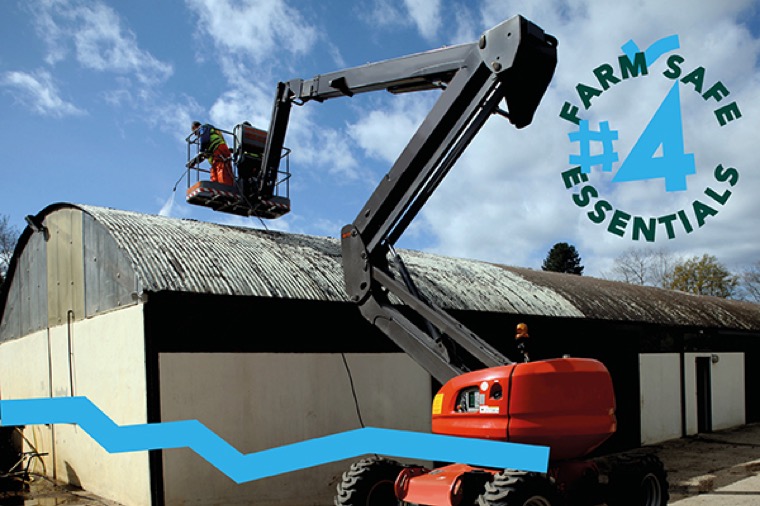
The fourth message, ‘Stay Off Roofs’, encourages the farming community to consider the risks when working at height and on roofs.
Falls from height remains one of the main causes of fatalities and major injuries on our farms. Common incidents include falls from ladders and through fragile surfaces. A number of recent fatalities highlights the dangers of falling inside a building under construction. It is critical to ensure that any person working at height is suitably competent to do so. The correct equipment must also be used for the job, and internal fall protection must be implemented if there is a chance someone could fall to the ground below them internally when working on the roof structure.
HSENI are proposing the following guidance:
Further information on the Farm Safe Essentials message can be found at HSENI.GOV.UK/ESSENTIALS
Write a comment
A new ‘Avoid Harm on the Farm’ child safety 2021 calendar has been launched by the Chief Executive of the Health and Safety Executive for Northern Ireland (HSENI), Robert Kidd. The calendars will be distributed through primary schools to 42,000 rural homes across Northern Ireland.
In previous years HSENI staff would have visited rural primary schools throughout Northern Ireland in the run-up to the summer holidays; delivering farm safety messages and encouraging pupils to enter HSENI’s ‘Avoid Harm on the Farm’ calendar competition.
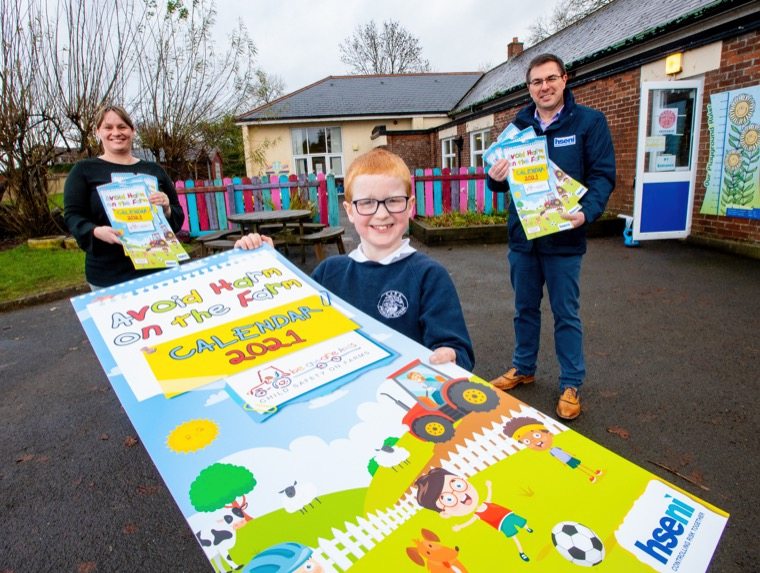
Unfortunately this year, due to the Covid-19 pandemic, personal visits were not possible, however, the poster competition continued on a virtual platform. Throughout the summer months primary school pupils were encouraged to submit their entries online. Each of the weekly winners received a £30 gift voucher and their entry features in the calendar.
Speaking at the launch which took place at Carr Primary School in Lisburn, Robert Kidd, Chief Executive HSENI said: “Almost 600 children entered our competition this year and a big ‘thank-you’ goes to each of them. We are also enormously grateful to primary schools across Northern Ireland for their continued support.
“Working together with schools and children, the annual farm safety calendar is now a familiar sight in classrooms and rural homes and it acts as a daily reminder of the very real dangers that exist for everyone when on a farm.”
Primary school children submitted a hand painted or hand drawn picture relating to a key farm safety topic. In their entries they highlighted some of the many hazards involved when working with animals, slurry, equipment and the risks of working at height.
‘Avoid Harm on the Farm’ poster competition winners
Week 1: Méabh Devine, aged 9, St Colmcille’s Primary School, Claudy
Week 2: Marykate Sloan, aged 5, Holy Cross Primary School, Atticall
Week 3: Wesley Baird, aged 9, Strabane Primary School, Strabane
Week 4: Beth McAuley, aged 6, Woodburn Primary School, Carrickfergus
Week 5: Leah O’Hagan, aged 11, Knocknagin Primary School, Desertmartin
Week 6: Eli Irvine, aged 9, Lisbellaw Primary School, Enniskillen
Week 7: Daniel Glenn, aged 8, Carr Primary School, Lisburn
Week 8: Joshua Totten, aged 7, Kells & Connor Primary School, Kells
Week 9: Maria Devine, aged 8, St Mary’s Primary School, Barr
Week 10: Charlie Connolly, aged 6, Carrickmannon Primary School, Newtownards
Week 11: Harvey Graydon, aged 7, Fivemiletown Primary School
Week 12: Romaine Killough, aged 11, Carnalbanagh Primary School, Ballymena
For more information about child safety on farms please visit HSENI’s farm safety webpage: www.hseni.gov.uk/farmsafety
Write a comment
The Ulster Society for Prevention of Cruelty to Animals (USPCA) and the Northern Ireland Badger Group (NIBG) are expanding their Operation Brockwatch initiative after successfully protecting six well established Badger families targeted by criminal gangs over previous years.
During year one of the project the Brockwatch team worked in partnership with landowners and the PSNI to first of all pinpoint the Badger setts and then monitored them very closely to protect them from further persecution. The team have now identified a number of additional vulnerable setts that they will be monitoring closely over the second year of Operation Brockwatch.

Brendan Mullan, USPCA Chief Executive said “We want to thank the landowners and the PSNI who have joined with us in a very effective rural partnership to stop this horrendous cruelty to both Badgers and Dogs. We have been keeping a very close eye on a number of Badger setts previously disturbed relentlessly and we will be watching even more setts over the coming months. We are asking everyone who spends time in our wonderful countryside to be vigilant and support Operation Brockwatch by reporting Badger persecution without hesitation. Our advice is simple, if you see suspicious activity in the vicinity of a Badger sett then ring the PSNI or Crimestoppers as quickly as possible and provide them with timely and accurate information so those involved can be apprehended at the scene of the crime or close by.”
Rebecca Millar, NIBG chair commented, “We have been delighted with the success of the pilot. These passive nocturnal animals live in tight family units called clans and we are so glad that we have been able to work together to help protect the badgers and their setts that are sometimes hundreds of years old! We know from the video footage we have collected over the past year that these threatened Badgers are currently thriving due to the added level of protection the Brockwatch team have put in place. We look forward to bringing even more setts under the Operation Brockwatch umbrella during the coming winter “

Brendan explained, “We never forget why we set up Operation Brockwatch in the first place. Badger Baiting is premeditated cruelty at its very worst, it is a shocking and sickening spectacle and is happening in every county in Northern Ireland. The sad reality is that Badgers are snared or cage trapped for clandestine baiting contests held at secret locations as well as being dug from their setts or lamped when foraging to satisfy the blood lust of the wildlife criminals. These activities all take place under the radar. The dogs they force to engage with the badgers inevitability endure merciless suffering with horrific injuries commonplace. If a dog fails to meet their depraved owner’s expectations, they suffer the same fate as the Badger, a torturous death.”
He continued “The criminals often travel long distances to very rural locations to commit their crimes, mainly but not exclusively, on Sundays. The Baiters also target pregnant or lactating badgers during January and February as mothers will fight to the death, irrespective of the odds, in an inevitably vain attempt to protect their cubs.”
Rebecca concluded, “Those involved in Badger Persecution are also steeped in many other criminal activities, Badger Baiting is their weekend hobby. The USPCA and NI Badger Group are appealing to all landowners to not only keep a watchful eye for suspicious activity but to secure gates that give vehicles access to their land. This not only helps wildlife but also reduces the risk of farm theft and helps ensure vital bio-security protection. Northern Ireland currently has the toughest animal welfare legislation in Europe with maximum five-year custodial sentences available to the Courts, life bans from keeping animals and fines of up to £20,000 can also be imposed. But prosecutions are all too few and the sentences currently handed down on conviction are totally inadequate to act as a deterrent.”
Closing a loophole
The USPCA and the NI Badger Group will offer all assistance to help all the relevant agencies to vigorously pursue and prosecute those involved in this vile cruelty to both badgers and dogs. The extremely cruel practice of digging out foxes is inexplicably still legal in Northern Ireland despite being banned in GB and this practice has very close links to badger persecution and provides a loophole for the Baiters, this loophole must be closed.
Reporting the Wildlife Criminals
Members of the public who witness ongoing sett disturbance should immediately call 999 to report the crime giving PSNI an opportunity to apprehend wrongdoers. If the motives of strangers seen in the locality seem suspicious the PSNI non-emergency line 101 will assist. Anyone uneasy at contacting the authorities directly can use Crimestoppers by dialling 0800 555 111. The public’s vigilance and help can assist the PSNI address this appalling abuse of animals that stains our countryside.
NI badger crime remains widespread, the updated PAW NI badger report reveals.
A report highlighting the disturbance of badgers and destruction their setts in Northern Ireland has stated, there were one hundred fifty-five (155) incidents concerning potential crimes against badgers reported to the Police Service of Northern Ireland (PSNI) during the period 2016-18. Published by the “Partnership for Action against Wildlife Crime - Northern Ireland” (PAW NI) the report reveals these offences were categorised as incidents which may have constituted wildlife crime, including incidents of sett disturbance; suspected badger baiting; or misuse of traps and snares.
Wildlife crime incidents against badgers in 2016-18 had a wide geographic distribution throughout Northern Ireland. However, most reports were made within county Down and county Antrim.
Dr Jon Lees, Northern Ireland Environment Agency – Wildlife Officer and Chair of the PAW NI Badger Subgroup said; “Around 50 incidents of crime against badgers are reported annually, but as with other wildlife crime we suspect this is not the full picture and many more occurrences may be going unrecorded. Incidents of badger baiting for ‘sport’ are unfortunately still occurring in across Northern Ireland in the 21st century. Additionally wilful or careless destruction of sett structures by landowners or their agents is causing death and distress to the animals”.
“Should members of the public suspect that a Wildlife Crime has been committed, we strongly advise people to report it to the PSNI by dialling Tel 101; describing the call as a Wildlife Crime report; giving details of the (potential) crime; and asking for an incident reference number. Alternatively, information can be left anonymously with Crimestoppers NI at 0800 555 111”.
It is widely believed that badger-related wildlife crime, like all wildlife crime, is under-reported in Northern Ireland. The report aims to help inform the public to discern what constitutes a badger crime, which may increase future reporting.
Supt. Brian Kee, Police Service of Northern Ireland Service Lead for Rural and Wildlife Crime for the Police Service of Northern Ireland said, “The Police Service of Northern Ireland take wildlife crime very seriously and will investigate if there is a breach in the legislation. In Northern Ireland Badgers and their setts are protected under the Wildlife (NI) Order 1985 (as amended by the Wildlife and Natural Environment Act (NI) 2011.
“In brief the law states: By being listed on Schedule 5 the badger cannot be intentionally killed, injured or taken. No person can possess or control a live or dead badger or part derived from one. The sett cannot be destroyed, damaged or have the access by badgers obstructed. It is also an offence to damage or destroy anything which conceals or protects a badger or to disturb a badger whilst it is occupying one.”
The full report is available to read or download at WWW.WILDLIFECRIMENI.ORG
Write a comment
During cold weather calves require more energy to keep warm – so less energy is available for growth and their immune system.
Young calves will not yet be ruminating thus less heat is generated by digestion, so it is vital to feed calves enough highly digestible milk to give them the energy to maintain body temperature and fuel growth. Ideally this milk should be based on highly digestible Imunopro concentrated whey protein

Young calves, less than three weeks of age, are very susceptible to the cold. In fact, temperatures only have to drop to 10 to15°C for a young calf to require more feed to maintain their body temperature, grow rate and good health.
By four weeks of age calves are more robust and will not ‘feel the cold’ until temperatures drop below 6-10°C.
Remember, the temperature below which a calf needs extra energy to keep warm is highly dependent on moisture levels and air speed – draughts of just 5mph can make calves 8°C to 10°C cooler.
Adequate colostrum
Whatever the ambient temperature it is vital that all newborn calves receive enough good quality colostrum. Give a first feed of four litres or 10% of bodyweight within four hours of birth. This should then be followed up by a further two litres within 12 hours of birth.
Practical measures
When it comes to milk feeding in cold weather, for a calf less than three weeks old, you need to step up the level of milk solids by 100g per day for every 10°C drop in temperature below 20°C. For example, if the outside temperature is 10°C, feed an extra 100g of milk powder per day. This can be achieved by either increasing the volume fed, or by increasing the mixing rate.
Keep bedding plentiful, clean and dry, and allow calves to ‘nest’ in the straw. Plastic and timber are better insulating materials than concrete and steel. Provide shelter from draughts and consider the use of breathable, water resistant calf jackets and/or the provision of an external heat source close to the calves.
For further information Freephone 0800 8652 2522, browse WWW.FEEDFORGROWTH.COM or contact Volac NI business manager Alistair Sampson tel; 07860 626442, e mail alistair.sampson@volac.com
Write a comment
Loughbrickland diary farmer Ian McClelland is included in the Dairy Council’s latest EU Sustainable Dairy Fact Book. The Dairy Council for Northern Ireland published its third annual EU Sustainable Dairy Fact Book, in conjunction with the EU and the European Milk Forum.
The publication, ‘From Research to Practice on Northern Ireland Dairy Farms’, looks at three AFBI and CAFRE research projects, and profiles three local dairy farms which are putting into practice the learnings from this research.

It also includes a foreword from DAERA Minister Edwin Poots and insight from Air Quality Specialist Professor Frank Mitloehner from University of California, Davis on how various greenhouse gases are measured and the role of dairy herds in recycling carbon from the atmosphere through the biogenic carbon cycle.
On environmental sustainability farmer Ian McClelland explains that hedge management has been an important part of the farms sustainability effort. In a bid to increase cover he has undertaken a hedge repair and replacement programme where damaged or poorly performing hedging is either cut back to stimulate new growth or replaced entirely.
The hedges are improving continually and are trimmed back every two years with the aim of growing as thick a hedge as possible to create a safe habitat for wildlife and increasing carbon capture on the farm.
The farm already plays host to a number of ravens, buzzards, squirrels, foxes and rabbits and Ian hopes that situation improves as he continues to nurture his internal and external boundaries.

Ian also recently introduced two beehives on the farm and he hopes the pollinators will improve biodiversity in the surrounding area further. He also enjoys the added benefit of having his own supply of honey on site.
Launching its third EU Sustainable Dairy Fact Book, the Dairy Council NI has said local sustainability expertise can help shape future agricultural policy in Northern Ireland and ensure the sector continues to contribute towards Northern Ireland’s transition to net zero.
The sector has already reduced the carbon intensity of a litre of milk by 34% since 1990, but acknowledges that there is still some way to go.
Commenting on the important role local research will play in future policy decisions, Chief Executive of the Dairy Council NI Dr Mike Johnston MBE said, “It is essential that the dairy sector continues fulfilling its role in the transition towards net zero, and, therefore, we need to be mindful of the UN’s four pillars of sustainability - climate, nutrition, economy and culture. Without sustainable local dairy farm enterprises, we cannot achieve the ambition of a sustainable future.
“We need to ensure future policy decisions and incentives are evidence-based and co-designed in partnership with the sector and subject matter experts who have been studying the sustainability of dairy farms for decades.
“One such example is the findings from an AFBI research project on soil nutrients which suggest improving the pH levels of Northern Ireland dairy grazing platforms, at a cost of £30 million, could yield an impressive sevenfold return on investment.

“Each of our three fact books offer an insight into the work being undertaken at AFBI, CAFRE, the investment being made by dairy processors, and the adaptation of new technologies and practices at farm level to improve the environmental footprint of the Northern Ireland dairy sector.”
The final chapter of the factbook explores the important part good nutrition plays in a sustainable diet. It highlights Optimeal®, a modelling tool which looks at the impact of food choices, not only on the environment, but also on nutrition and food prices, to help achieve a sustainable diet that is healthy, acceptable and affordable. The model is currently being updated to include data from all the EMF member countries (Northern Ireland, Republic of Ireland, France, Netherlands, Austria, Belgium, Denmark and Norway).
The Dairy Council NI fact book is part of an EU Sustainable Dairy programme in partnership with the European Milk Forum with funding from the European Union.
To view the 2020 fact book visit DAIRY COUNCIL NI




 |
 |
 |