Write a comment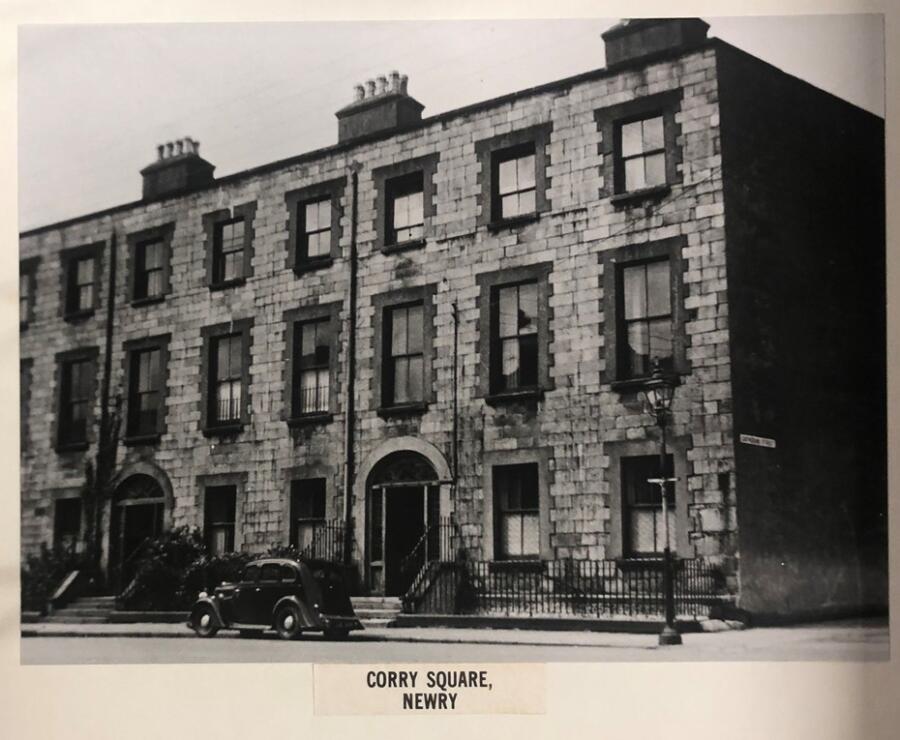
Before the 1690s, Britain and Ireland lacked standing armies, relying on temporary accommodations like taverns and private homes for troops. Newry had a military presence in May 1571, when Nicholas Bagenal commanded 50 cavalry men, possibly stationed in Bagenal’s castle. Following the Williamite-Jacobite War, Irish Protestants, fearing future rebellion, supported a permanent military presence. In 1698, the Irish Parliament approved 12,000 Williamite troops, requiring purpose-built barracks. For Newry’s Irish Protestants, recalling past expulsions in 1641 and the town’s burning in 1689, the military presence was reassuring. Irish Catholics, however, likely saw it as an occupying force enforcing a new political and land order that marginalised them.


Newry and Armagh 1760. The author believes the building complex is to the right
of the Custom House and is the first purpose-built Barracks in Newry. Newry &
Mourne Museum Collection
A 1706 lease shows Richard Skeffington granting land near Boat Street and Carricknelligan to the Trustees of Barracks. Carricknelligan may be an anglicisation of Carraig na Lochán ('rock of the small lakes/ponds'). This land had originally been leased from Sir Nicholas Bagnall in 1698, and a formal lease in 1699 (49 years) permitted the construction of an infantry barracks with a foot barrack, kitchen, coalyard, hayshed, "shout yard" (likely a drill yard), and house of office. Likely completed by the early 1700s, it appears in the 1703 Neville Survey close to Kilmorey Street. The premises measured 100 yards by 40 yards and were bounded by the Highway to Rostrevor (East), Newry River (West), Quay (North), and a park owned by Richard Skeffington (South).
Maps by Senex (1712) and Moll (1714) confirm it was an infantry barracks housing one company of troops, largely recruited from Britain due to laws stemming from the Treaty of Limerick (1691) which restricted Irish enlistment. Fears of Catholic uprisings and Jacobite invasions reinforced British-led recruitment, though Protestants in Ulster were occasionally enlisted in times of crisis. Despite restrictions, attempts were made to circumvent these laws to enlist Irishmen. By 1749, the Thomas Jefferys map labelled the barracks as a cavalry barracks, implying modifications such as stables.
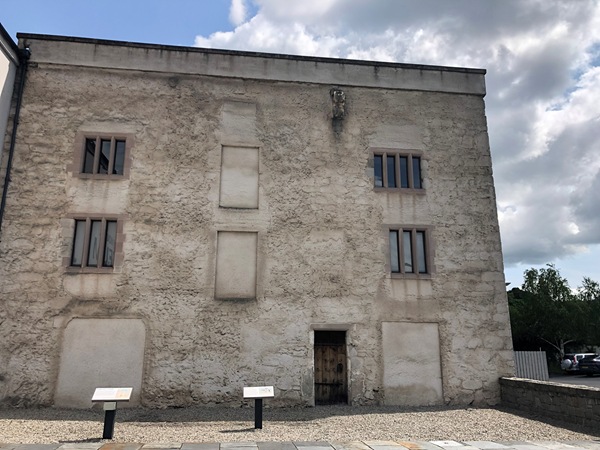
Bagenal had a retinue of soldiers some of whom resided in the Hall on the left
chamber first floor. Newry & Mourne Museum Collection
By 1768, Newry’s barracks had likely fallen out of use, reflecting the declining threat of Jacobitism. However, the absence of garrison left the town exposed to agrarian unrest, including movements like the Oakboys. A major riot in 1763 saw 4,000–5,000 people from County Armagh descend on Newry. Amid the chaos, Captain Grant allegedly wounded Mr. Warneck, who later died, before he threatened to burn every house in town.
In response, local guard rooms gained prominence. The Custom House had a guard room, likely established when the barracks ceased operation, while the Market House on Market Street housed guards until its demolition around 1785. Guard rooms in the 18th-century served as military accommodation, holding cells, military offices, and court-martial spaces, filling a security void.
Thomas Kitchin’s 1777 map shows no barracks in Newry, but unrest in the 1780s–90s led to new barracks at Corry Place (now Corry Square), likely the infantry barracks in Rocque’s 1790 map. A 1783 lease between Edward Corry and Joseph Scott records the area as a new street, though whether the barracks were purpose-built or repurposed remains uncertain. By 1797, rising security concerns prompted a letter to Lord Downshire, praising the Cavan Regiment and noting that 24 townsmen had volunteered as constables for nightly patrols. Tensions flared when a man arrested for insulting Captain Goddard later made seditious claims, whilst also accusing others of United Irishmen affiliation. The Cavan Regiment and 22 Dragoons detained the suspects and transferred them to Armagh Gaol.

Survey map of Newry. Newry & Mourne Museum Collection
In 1800, the government bought Newry’s Linen Hall (built 1783) for £14,000, converting it into a barracks. In 1808, the Old Barracks near Merchant’s Quay was listed for lease, though military occupation continued. The 1817 Military Register confirmed its use, and the Ordnance Survey (1829–35) recorded it as a cavalry barracks, 95 × 41 feet, 33 feet high, with a cellar. In 1856, it became a constabulary barracks, serving this purpose until 1866, when police relocated to Queen Street, and it became a private residence.
The Museum is currently offering free tours of the main exhibition galleries on Wednesdays at 2.00 pm. These must be booked in advance by calling our Education Officer at 0330 137 4422.
Newry and Mourne Museum is open Tuesday – Saturday 10.00 am – 4.30 pm. Please call 0330 137 4422 or email museums@nmandd.org for further information, or visit their website at www.visitmournemountains.co.uk