 Write a comment
Drawing is the most democratic form of art, requiring simply a plain surface and a pencil, a piece of chalk, a brush, or even a stick. Throughout history artists have used drawing as part of the creative process and while painting and sculpture have often been influenced by prevailing style and the art market, drawing has always offered much more freedom.


It was not until around 1500 that relatively inexpensive drawing paper as we know it became available, and the concept of sketching was born. The sixteenth century was a time of dramatic change with the rediscovery of classical art, a new interest in science, and the development of the role of the artist, driving the huge expansion in the concept of drawing. It became a tool for design and experiment with artists such as Leonardo Da Vinci making drawings of nature and human anatomy and using drawing to design architecture and machinery.
During the sixteenth century, drawing training was formalised, and students were asked to copy classical statues and living models to develop their skills, but by the 19th century artists began to move away from simple observation to drawings that are about personal expression and feeling. Today a drawing can mean almost anything and can even be made on a digital device.

Newry and Mourne Museum holds drawings created by artists and designers for a range of purposes, from preparatory sketches to portraits, from plans and technical drawings to observations of nature and the landscape.
In January this year, the Museum acquired a portrait sketch by Newry artist Margaret Clarke. This beautiful pencil and charcoal drawing is typical of a preparatory study, perhaps for an oil painting, but also a subtle and charming work in its own right. It probably dates from the 1930s when a critic noted that Clarke produced "remarkable drawings in which individuality is caught in a few swift economical lines”.

Local architect and engineer Samuel Wilson Reside oversaw the design and installation of the Dean Swanzy memorial stained-glass window, St Mary’s Parish Church in 1936. The Reside Collection in the Museum includes a watercolour sketch of the initial design by Abbot & Co, a firm making stained glass and church furnishings based in Lancaster and London. The company was established in1860 by the plumber and glazier William Abbott and the business continued under his sons and grandsons. Their work was influenced by the stained-glass artists of the Arts & Crafts Movement, and many examples of work produced by Abbot & Co can still be seen in churches, hospitals, town halls, pubs, and country houses across the UK and beyond.
Also in the collection, an intimate charcoal study of Charles Murray in his RAF uniform, possibly by one of his fellow airmen, shows the immediacy of drawing.
Murray from Acton, near Poyntzpass, joined the Royal Air Force in 1936 and was killed when the Lancaster Bomber, on which he was a Flight Engineer, was shot down during a bombing raid over Poland in 1944. The Museum holds a collection of his papers including training notebooks containing his own pencil and ink drawings and diagrams of aircraft parts.
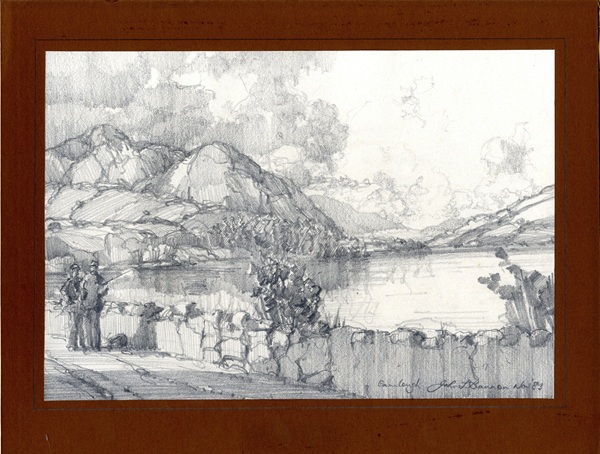
Camlough by John T Bannon is another example of drawing as a preparatory sketch. Bannon specialises in rural and urban landscapes, working mainly in oils. This drawing is one of several works by this Irish artist in the Museum’s collection.
On Saturday 17th May the Museum will be celebrating Drawing Day by holding free workshops with local artists. If you have been inspired, why not come along and try your hand at sketching a still life or figure study?
The Museum is currently offering free tours of the exhibition galleries on Wednesdays and Thursdays at 11.00 am. These must be booked in advance by calling their Education Officer at 0330 137 4422.
Newry and Mourne Museum is open Tuesday – Saturday 10.00 am – 4.30 pm. Please call 0330 137 4422 or email museum@nmandd.org for further information.