 Write a comment
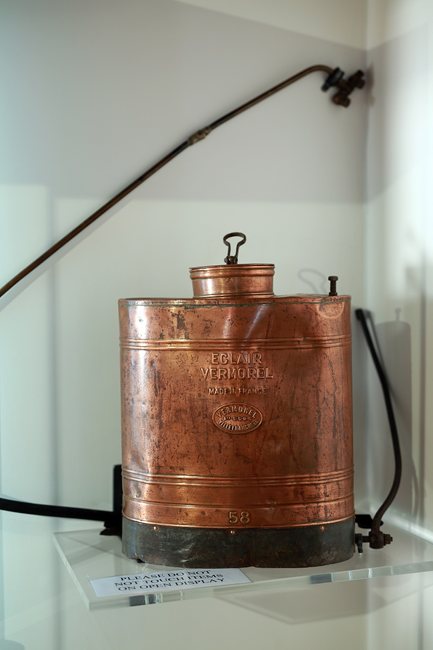
Following on from last week’s article on Sands’ Mill and local agriculture, this week we look at some agricultural implements and butter-making equipment which are on view in the Newry and Mourne Museum. In 2017 a Vermorel knapsack sprayer was donated to Museum. Made of copper and manufactured by Éclair Vermorel in Villefanche-sur-Saone in France, the sprayer was used to spray potatoes and other crops on a farm owned by the White family in Ballynaskeagh in south Down in the 1950s. First produced in the early 20th century, ‘Vermorel’ sprayers are said to have been used to neutralise trenches and dugouts which had been contaminated with chlorine gas during the First World War.


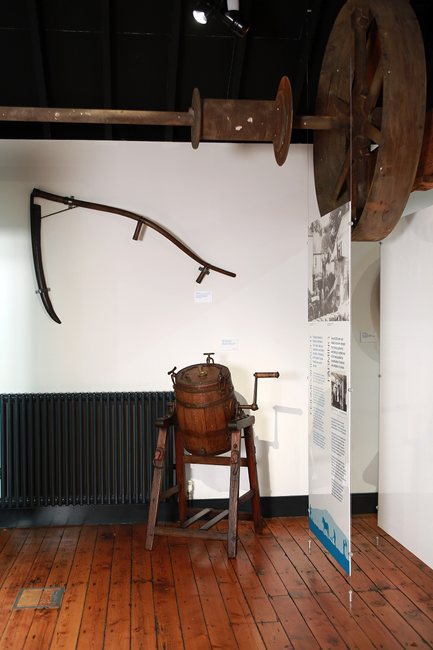
One of our many prized artefacts in Gallery Three is our timber oak butter churn made by Waide and Sons, Leeds. This wooden barrel churn is revolved on a timber stand and has a small window on the side to allow the maker to check on the progress of the butter without having to open the lid. The study of butter churns by historians has identified different shaped churns based on regions in Ireland and, in the 20th century, a new type of churn called an end-over-end was introduced. This is the type of churn which is on display in the Museum and was once a common sight in many houses in the countryside.
Evidence for butter making in Ireland dates to early times. Bog butter has been found and dated to 1000BC. The butter was stored in the bog before the convenience of modern refrigeration. In times past many houses in rural Ireland, including south Armagh and south Down, even those not on a farm, would have had a small piece of land - enough to grow some vegetables and keep a cow for milk. The milk produced by the cow was used by the household and frequently the milk was used to make butter. Butter making was just one of the many household jobs seen as women’s work and usually one day a week was set aside for butter making.
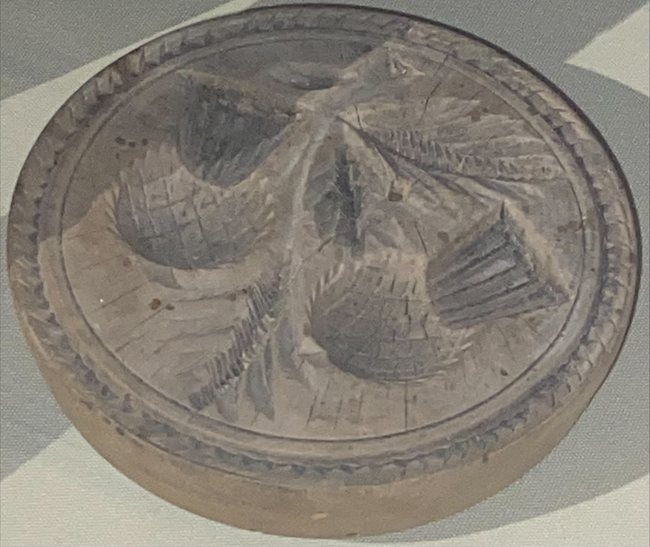
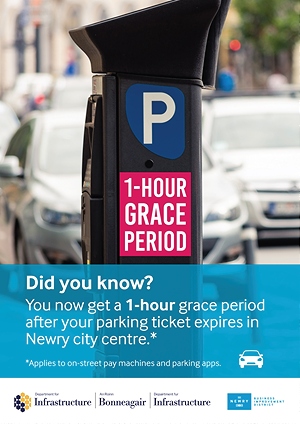
On display in the Museum is a range of butter-making equipment including butter pats, a butter cooler with terracotta lid with ceramic tray and a wooden circular butter stamp with a thistle motif. Once the butter had been finished churning, it was washed several times, salt added and then formed into blocks using timber butter pats. The butter pats were also used to make individual butter balls for serving at the table, especially when having visitors. If the butter was going to be sold it was formed into one-pound blocks, stamped with the makers personal decorative stamp (much like manufacturers brand their products today), and wrapped in greaseproof paper. These butter stamps or butter prints as they are also known as were made by woodturner. Each farmer would have had their own individual motif and our butter stamp with its thistle motif came from a farm in from south Armagh.
Other artefacts reflecting farming and rural life in the Newry and Mourne area which are on show include a scythe, chaff riddle, spinning wheel and tilley lamp.
The Museum is currently offering free tours of the exhibition galleries on Wednesdays and Thursdays at 11.00 am. These must be booked in advance by calling our Education Officer at 0330 137 4422.
Newry and Mourne Museum is open Tuesday – Saturday 10.00 am – 4.30 pm. Please call 0330 137 4422 or email museum@nmandd.org for further information.