 Write a comment
We continue our series of articles on the contents of some of the display cases in the Museum by looking at artefacts on display which focus on the development of churches in Newry and the surrounding area.


One of the display cases in Gallery 2 in Newry and Mourne Museum contains artefacts which chart the development of churches in the Newry area. The case includes an early 20th century model of the Cathedral of SS. Patrick and Colman in Newry which was made by the Toman brothers who lived in Francis Street, Newry. It depicts the Cathedral as it appeared at the end of the 19th century before later additions. The Cathedral was the first Roman Catholic cathedral built in Ireland after Catholic Emancipation in 1929. The Cathedral was constructed in 1829 from local granite and was designed by architect, Thomas Duff. The interior marble work and mosaics took five years to complete with craftsmen coming from Italy to undertake the work. The tower and transept were added in 1888 whilst, in 1904, the nave was extended.

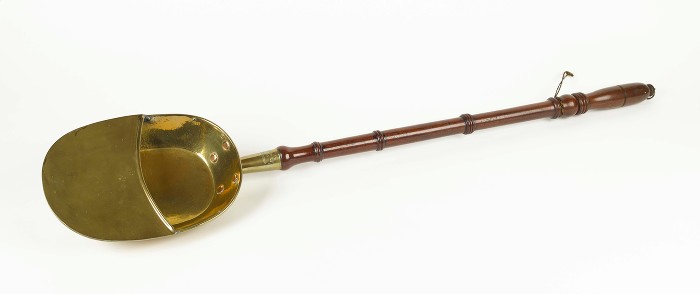
Also featured is a collection shovel from the 1830s and is reputed to have been used in St. Patrick’s Church of Ireland in Newry, to collect money from the congregation. It has a stamped maker's name on the handle, 'F. WHITE, NEWRY'. Frank White was listed as a Brazier and Tin-plate Worker in Margaret St., Newry in 1824. St. Patrick’s Parish Church was originally built by Nicholas Bagenal c.1578 as the first purpose-built Protestant church in Ireland. The present church dates from the 18th and 19th centuries.
Considered to be quite a prominent family, the Barcroft’s Family Bible is also on display. The copy of the King James Version of the Holy Bible on display is annotated with genealogical notes on the Barcroft’s family history and dates back to 1638. Henry Barcroft was the only son of Joseph and Mary Barcroft who were members of a prominent Quaker family in Lisburn and involved in the linen business. After their deaths, Henry moved to Moy to live with his uncle, wherein he became acquainted with John Grubb Richardson who had re-established a linen mill in the 1840s at Bessbrook. Henry married John’s niece, Anna Richardson Malcolmson from Clonmel in county Tipperary. Henry Barcroft and Anna Richardson Malcolmson were married on 29th August 1867 and moved to a large and impressive house in Newry known as The Glen. In 1869, Barcroft patented a new jacquard power loom which allowed a wider cloth with asymmetrical designs to be created. Known as the Bessbrook Loom, this new invention became widely used by other linen manufacturers.

The case also holds a 19th century printing plate that depicts St. Mary’s Parish Church which was built on Needham Place (now John Mitchel Place). Begun in 1811 and completed in 1819 at a cost of £12,566, it was built to provide for the increasing population in the Hill Street area of Newry.
A small wooden penal cross, which is on loan from the Ulster Museum, is also included in the display case. Penal crosses were used by Catholics as devotional objects before the various Catholic Relief Acts, passed between 1778 and 1793, repealed the penal Laws which repressed Catholic worship.
The Museum is currently offering free tours of the exhibition galleries on Wednesdays and Thursdays at 2.00 pm. These must be booked in advance by calling our Education Officer at 0330 137 4422.
Newry and Mourne Museum is open Tuesday – Saturday 10.00 am – 4.30 pm. Please call 0330 137 4422 or email museums@nmandd.org for further information.
Please visit our website at www.visitmournemountains.co.uk