
 Write a comment
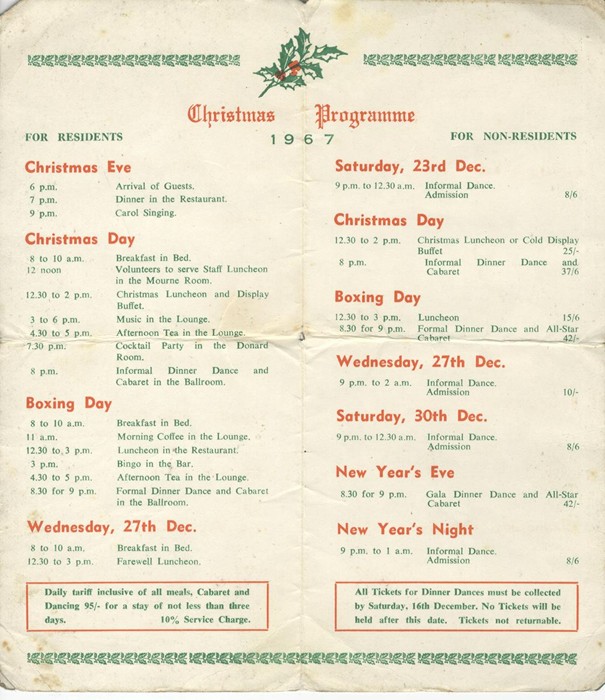
Christmas can be an enchanting time of year especially for the magic it can bring to children. Every culture and family have their own Christmas traditions that can vary significantly. In this article we revisit how some of our local customs, traditions and stories were established.
Christmas or ‘Christ’s Mass’ was first celebrated in the 4th century. By the 16th century, wealthy families began to enjoy indulgent feasts and elaborate entertainment such as plays and pageants, singing and dancing. Celebrations continued over the Twelve Days of Christmas, which ended on the evening of 5th January.
Christmas, as we know it today, began to emerge in Britain and Ireland in the 1840s. In 1841, Prince Albert, the husband of Queen Victoria, famously popularised the German tradition of Christmas trees and in 1843, the publication of A Christmas Carol by Charles Dickens, promoted Christmas as a season of goodwill. The Penny Post was introduced in 1840 which facilitated the sending of Christmas Cards which began in 1843 and was popularised by the Royal Family. The medieval tradition of singing carols was also revived. In 1948 the Christmas cracker, a simple package filled with sweets which snapped when pulled apart, was invented by confectioner, Tom Smith.
The Victorians also introduced the concept of eating turkey to celebrate Christmas. Many of the local household ovens were inadequate for cooking the turkey, this led the people of Newry to find novel ways to prepare their turkeys: “turkeys would have been cooked in McCann’s ovens and some of the home bakeries down Monaghan Street, McAlinden’s and Foley’s” as a local person remembers.
Other foods that are associated with the festive season, some of which date back hundreds of years, are rich foods such as mince pies, Christmas cake and plum pudding. These included ingredients such as dried raisins, currents, butter, mixed peel, almonds, nutmeg, cinnamon and ginger spices. Newry and Mourne Museum’s Collection includes a class cookery book from Newry Technical School (Sean Hollywood Art Centre) dating to December 1904. The book, written by Mary Ann Scott, aged fifteen, of St. Mary’s Street, Newry, contained many popular Christmas recipes.
Many countries have their own Christmas traditions. Irish Christmas traditions include placing a candle in the window. Lighted candles are placed in windows on Christmas Eve, as a guide that Joseph and Mary might look for shelter.
Another uniquely Irish tradition is that of the Christmas Rhymers or ‘Mummers’, people disguised in masks, usually made of straw, who would arrive at a house and perform a ‘play’. Money was given to the Rhymers, who were thought to bring good luck to the household in which they were made welcome.
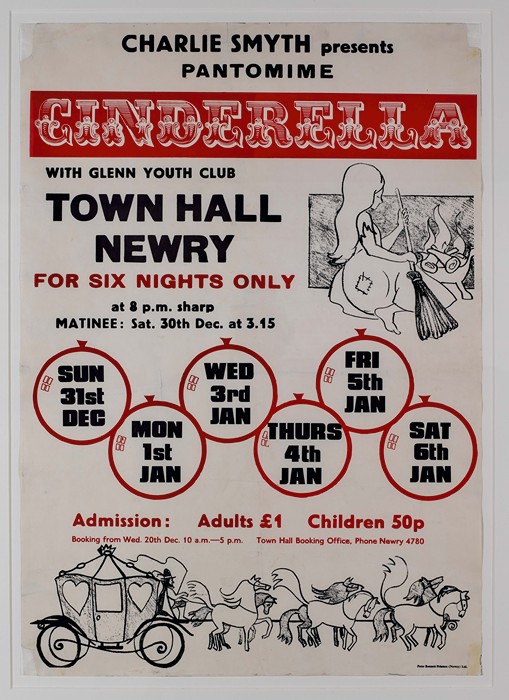
A visit to the Pantomime is another ritual around the Christmas period. From the mid-1930s P. J. McKay staged pantomimes in the town which continued throughout the Second World War. In the late 1950s Charlie Smith became involved in local pantomimes with Sean Canavan. In the 1970s, during the troubles, Paddy O’Hagan, Clerk of the Council asked Charlie Smyth if he could put on a show in Newry to raise people’s spirits. Along with the Glenn Youth Club a pantomime was produced and performed in the Town Hall, an annual tradition that has continued ever since.
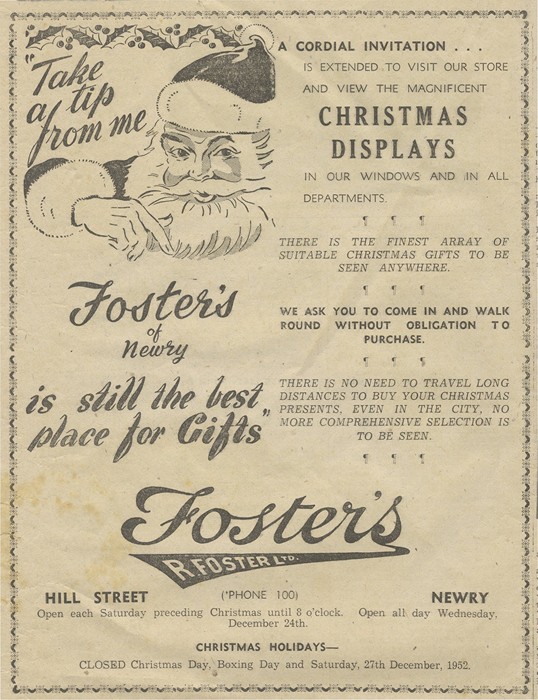
Christmas wouldn’t be what it is without the mention of Santa Claus. We believe that Santa is St. Nicholas of Myra, an early Christian bishop, famous for his generosity to children. By the 1860s, the cartoonist, Thomas Nast, had begun depicting Santa Claus as the jolly, breaded large man in a fur-trimmed suit that we know and love today.
The Staff at Newry and Mourne Museum would like to wish everyone a Merry Christmas and Happy New Year.
You can visit their website at www.visitmournemountains.co.uk