
 2 Comments
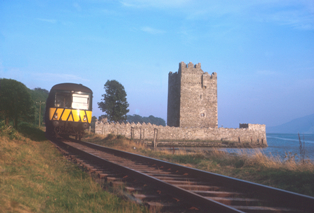
Situated on a promontory in the estuary of the Clanrye River, Narrow Water Castle (also known locally as Narrow Water Keep) is one of the most picturesque and well-known historic monuments in the Newry area. For over two hundred years it has attracted the talents of both professional and amateur artists and, in more recent decades, images of the Castle have been rarely absent from tourism brochures promoting the Newry and Mourne area to visitors. Narrow Water Castle was also once a familiar sight to those travelling to and from Warrenpoint by train. This brief article looks at the early history of Narrow Water Castle and provides some explanation as to why it was built.
The strategic importance of the Newry and Carlingford area became increasingly significant in the mid-16th century as the English government began to re-establish itself in Ulster, particularly after the death of Shane O’Neill in 1567. The grant of the former estates of the medieval Cistercian abbey at Newry to Sir Nicholas Bagenal, a settler from Staffordshire, in 1552 was part of this expansion. Research by Dr James Sheridan for Newry and Mourne Museum on the Bagenals suggests that this expansion also lies behind Captain John Sankey being established in the area south of Newry around Narrow Water in the 1560s. This was probably an attempt to limit the power of Sir Hugh Magennis of Iveagh along the west coastal area of Carlingford Lough. Sankey was paid £361 4s 2d for the construction of Narrow Water Castle and was granted the building in 1570. He was also granted the old district of Legan which comprised the townlands of Narrow Water, Dromore, Ringmackilroy, Aghnamoira, Burren, Carrogs, Carrickmacstay, Ballydesland, Donaghaguy, Ballymaconaghy, Ballyrussell and Tamnaharry.
The castle which Sankey built at Narrow Water is a typical example of a tower-house, the favoured type of residence of the lesser aristocracy and gentry in late medieval and early 16th century Ireland. The tower-house at Narrow Water has three floors, the first floor having a barrel vault. Like many medieval tower-houses in the northern Pale and east Down, the ground floor entrance is protected by a murder hole and box machicolation (a bottomless stone box projecting from roof level through which objects could be dropped on assailants below). The tower-house was surrounded by a bawn, which was described in 1570, as containing a stable and nine cottages. On the outside of the bawn wall, on the east side, was a landing place for boats.

Although John Sankey played an important role in guarding the approach to Newry, his grant was nevertheless cancelled in 1575 as part of an attempt by the government to placate Sir Hugh Magennis. Magennis was is possession of Narrow Water Castle by 1580 and the Magennises continued to hold the Castle until it, and the surrounding lands, were confiscated during the Cromwellian period and given to Joseph Deane, an English adventurer. In 1670 Deane sold Narrow Water Castle and its lands to Francis Hall of Glassdrummond in county Armagh and the Hall family subsequently developed the Narrow Water estate and the town of Warrenpoint.
By this time Narrow Water Castle had ceased to have any military function and was used for industrial purposes in the 18th century. Some restoration to the building, including the repair of the bawn wall, was carried out in the 19th century. The Castle became a State Care Monument in 1956.
The Museum is currently offering free tours of the exhibition galleries on Wednesdays and Thursdays at 11.00 am. These must be booked in advance by calling our Education Officer at 0330 137 4422.
Newry and Mourne Museum is open Tuesday – Saturday 10.00 am – 4.30 pm. Please call 0330 137 4422 or email museum@nmandd.org for further information.