 Write a comment
Many small towns and villages in south Armagh and south Down held fairs and market days in the 19th century and for much of the 20th century. An important part of the rural economy, charters were granted to some towns enabling them to hold to a marker and stimulate economic growth in the area. For example, Kilkeel received such a charter in 1767, Rostrevor in 1769 and Warrenpoint in 1776.

One of the most important market towns in south Down was Rathfriland. In Bassett’s Guide and Directory to County Down, published in 1886, Rathfriland is described as ‘one of the best inland market towns in Ulster’.

This is reflected in the diaries of James Harshaw, a farmer in the Donaghmore area, north of Newry, which date from the 1840s up to the 1860s. These are peppered with references to numerous family shopping trips to Rathfriland, particularly to drapery stores. As a farmer and flax grower, Harshaw was also a frequent visitor to the markets at Rathfriland. The market was originally held on Wednesday but, by 1886, Bassett tells us that markets were also held on Tuesdays and Saturdays when farm produce was sold. Livestock and fowl were sold on Wednesdays. A fair was held on the first Wednesday of every month and James Harshaw also mentions an annual ‘Gooseberry Fair’ which was held in late July or early August.
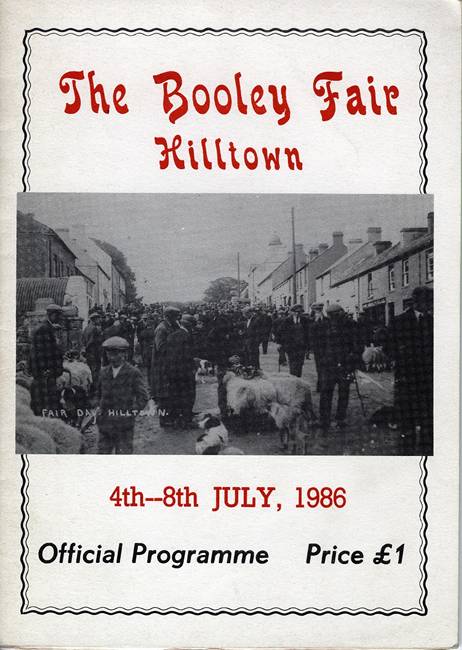
The fair at Hilltown was one of the best fairs in the north of Ireland. Flocks of sheep were brought to Hilltown fair from Donegal, Antrim, Derry and Tyrone, as well as from all parts of Down and Armagh. The fair usually commenced about ten o’clock in the morning and continued to four o’clock in the afternoon. There was a cattle, sheep, pig and horse fair, with donkeys and goats sold at the same fair. The fair was also a social occasion and, when business was completed, people stayed well into the night to make new and old acquaintances; dice was thrown, music played and ballads sung.

By 1800 Kilkeel had a fine Market House and markets held in the town became an important outlet for the produce of farmers in the Mournes. A market for potatoes, oats live pigs was held in the town each Wednesday and flax market when in season. A fair for cattle, sheep, horses and produce took place the on last Wednesday of each month.
The main markets for farmers in south Armagh in the 19th century were held at Crossmaglen and Newtownhamilton. A market took place every Friday at Crossmaglen for butter, eggs, fowl and for grain and grass seed when in season and a fair was held on the first Friday of each month for cattle, sheep, pigs and horses. At Newtownhamilton a free market was held every Saturday for butter, eggs and fowl and a fair on the last Saturday for cattle, sheep, pigs and farm horses. A hiring fair was held on the last Saturday of May and November.
South Armagh and south Down no longer has its network of markets and fairs. However, important livestock sales still take place at Hilltown and Rathfriland and the tradition of the fair has been revived in the Booley Fair which has been held in Hilltown since the 1980s.
The Museum is currently offering free tours of the exhibition galleries on Wednesdays and Thursdays at 11.00 am. These must be booked in advance by calling our Education Officer at 0330 137 4422.
Newry and Mourne Museum is open Tuesday – Saturday 10.00 am – 4.30 pm. Please call 0330 137 4422 or email museum@nmandd.org for further information.
by Ken Abraham and Dympna Tumilty