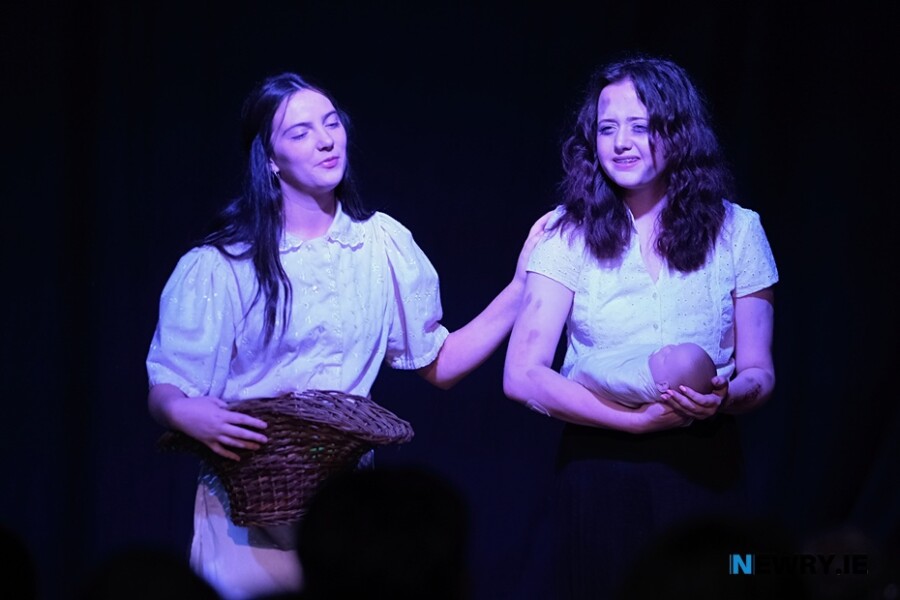
Write a commentA scene from the Newpoint Players Youth Group production of 'Orphans' in 2023. Photograph: Columba O'Hare/ Newry.ie
A plaque commemorating the lives of the female orphans of Newry Workhouse is to be placed near the main entrance of Daisy Hill Hospital this weekend and all are welcome.
This Saturday 26 October at 2 pm the plaque will be unveiled, the culmination of a celebration of the lives of the 35 girls who left Newry Workhouse between 1848 and 1850 for a new life in Australia.
Between 1848 and 1850, the thirty five orphan girls, aged between 14 and 18, left Newry Workhouse for a new life in Australia as part of the Earl Grey Scheme, which was designed to reduce the numbers of paupers in the workhouse and provide domestic and farm servants for the Australian colonies. In doing so, they escaped the probability of ending their young lives in the nearby Paupers' Graveyard at the side of the Camlough Road. A total of 4,114 Irish female orphans arrived on twenty ships over a two-year period, settling in Sydney, Adelaide and Melbourne.
Recalling the female orphans from Newry Workhouse
These young women made an important contribution to the growth of a new nation through their sense of adventure, their relentless optimism and ultimately, through their children, grandchildren and great grandchildren, who now number more than one million modern day Australians.
Since 2022 the project initiated by Newry historian Hugh McShane has sought to highlight this little known event in Newry's history through commemorative bonnet-making, an exhibition in Newry City Library, television and social media awareness raising, a series of illustrated talks and a visit from Australia by Sue Jacques a descendant of one of the girls as well as 'The Famine Orphans of Newry Workhouse' publication. Newpoint Players Youth Group also got involved with a production of 'Orphans' produced in September 2023.
Hugh McShane
In McShane's book 'Australia Bound - The Female Orphans of Newry Workhouse' he tells the story of some of the girls who travelled. The section below is about Margaret Larkin:
Among the Newry Workhouse girls who survived the initial trauma of adjusting to a new land and eventually prospered was Margaret Larkin, age 16, who arrived in Adelaide on board Roman Emperor in 1848. Margaret married Lawrence Guerin in 1850 and died in 1874. In an attempt to create a positive impression of the Earl Grey Scheme, and possibly persuade more females to take up free passage to Australia, letters were placed in local newspapers recounting the success of some of those who had earlier left workhouses for Australia.
Margaret Larkin was reported in the Newry Telegraph, under the heading "Married and Doing Well at the Diggings (Gold mines)", as having written home to her sister, "who is still a pauper in the same establishment", extolling the virtues of emigration: "I have got married to a man who has been at the diggings and done very well. We have purchased two sections of land - 160 acres, and have every prospect of going on prosperously. Dear sister, I wish you were with me here. I should have sent you the money for your passage if I were sure that this would reach you; but not knowing where you are, I must wait your answer".
The editor of the newspaper gushingly declares, “Is it not gratifying to find that the Irish never forget their relations in the Green Isle, no matter whither they go or how they prosper? The change from being a pauper to independence, in the course of a few years is rather unusual, but not extraordinary, in the gold regions. Many who have gone thither in indigent circumstances, a short time since, are now "rolling in riches," and, it is to be hoped, not a few will follow the example of Larkin, and assist their friends to emigrate to that land which is flowing, if not with milk and honey, with the precious metal."
The lasting legacy of this project especially with the plaque in situ, will ensure that the girls who took that leap of faith at the height of the Famine will be remembered for their great courage and their contribution to the building of a new nation on the other side of the world.


 Write a comment