 Write a comment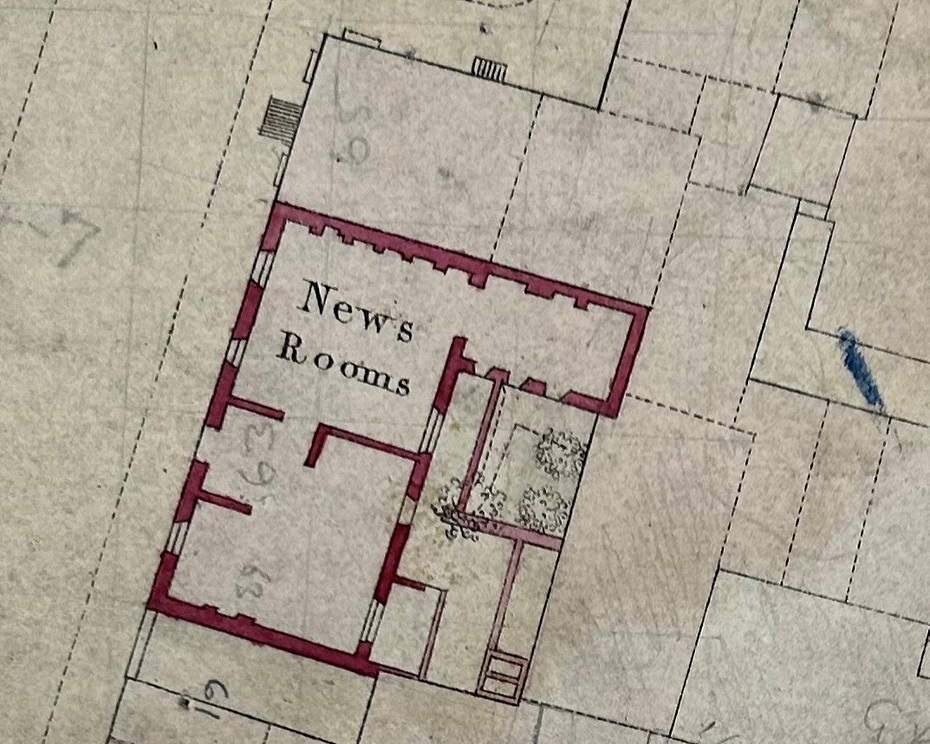
Commercial Coffee Room) from Typescript notes, etc., on old
houses in Newry, by J. Connellan. Courtesy of the Deputy
Keeper of the Records, the Public Record Office of Northern
Ireland (PRONI) D2355/3/9
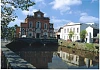
The site that later became the News Room was originally occupied by two bleach greens. In 1794–95, a group of prominent Newry merchants, including Jacob Turner, John Melling, John Gordon, Hugh Carlisle and Isaac William Glenny, raised a subscription of 320 guineas to lease a plot of the low-ground (modern-day Hill Street) from the Maxwell family. Several of these merchants were associated with the United Irish movement in the 1790s, most notably Melling and Gordon, the latter of whom was briefly imprisoned in Belfast. During his imprisonment, Gordon’s wife Anne famously rode non-stop from Templegowran to Belfast, securing his release with the unfortunate horse dying from its exertions. Jacob Turner of Turners Glen was the father of the informer Samuel Turner.

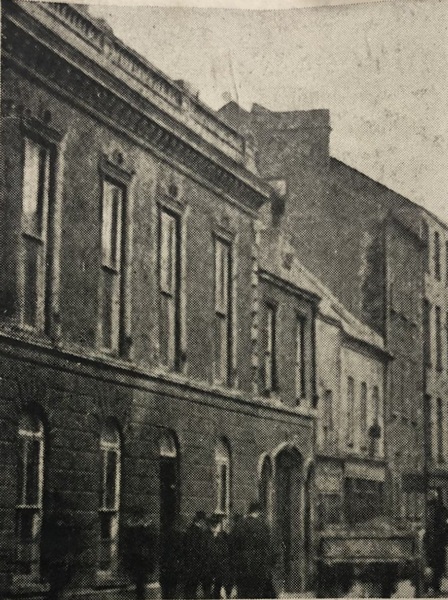
The building was likely completed before 1798 and, according to local tradition, the heads of executed United Irishmen George Cochran and Thomas Lowans were displayed above its entrance. The building was constructed on plain granite, a later photograph shows it as a two-storey building, with four rectangular sash windows on the upper floor and three arched sash windows on the ground floor, surmounted by an elaborate corniced top. Sale and rental advertisements from 1862 indicate that the building contained four principal rooms, likely two on each floor, each used for a variety of purposes.
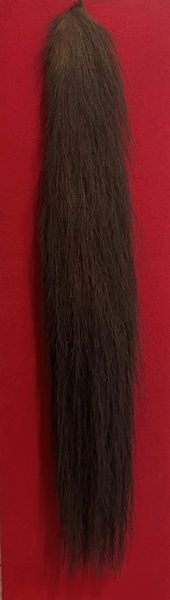
Gordon’s faithful horse,
which rode from
Templegowran to Belfast
without stopping and died
shortly afterwards. Newry
& Mourne Museum
Collection
From an early stage, the building was likely intended as a coffee house where merchants met to socialise, exchange news, and conduct business. It is first explicitly described as the Newry Commercial Coffee-Room in November 1802, a function apparently centered on the ground floor. That same month, the Coffee Room Committee resolved to establish a formal merchants’ exchange in the building, declaring it the town’s sole venue for such business. The exchange opened on 2 December 1802, probably on the first floor, and operated at noon on Mondays, Thursdays, and Saturdays. It quickly became a hub of commercial activity, hosting regular auctions of land, property, industrial concerns, and goods, and remained in use until at least 1820. The exchange was likely superseded by the Newry Savings Bank, founded in 1821, which occupied the site until its relocation in November 1840. Auctions remained a regular feature of business throughout the life of the news room.
The building formally acquired the name ‘Newry News Room’ in 1813, though it may have functioned as a news room or reading room from its earliest years. Newry had a tradition of literary societies connected with radicalism of the period, including the Newry Book Society, established by William Drennan in 1786 and the Newry Literary Society of the 1790’s whose library was carried away or destroyed in either 1797 or 1798.
The Newry Magazine of 1815 related that, “A variety of newspapers and other publications are read at the news room. The room is furnished with an excellent Atlas and barometer, a gazetteer &c. The rent and other charges are defrayed by the annual contributions of the subscribers.” Like the coffee room before it, the news room or reading room was on the ground floor. A newspaper from 1865 records the subscribers at that time, among whom were such local notables as Dennis Maguire, Esq., JP; Dr Savage; Isaac Corry, DL, JP; James McGeorge, JP; and John Moore. According to the Ordnance Survey Memoirs, strangers were “most liberally allowed” to read the newspapers for up to three months, after which they had to become subscribers, or pay 2s 6d for each visit (members of the military were exempt). Visitors could read a wide selection of Irish and British newspapers, along with the Army List, Navy List, and Lloyd’s List.
The Museum is currently offering free tours of the main exhibition galleries on Wednesdays at 2.00 pm. These must be booked in advance by calling our Education Officer at 0330 137 4422.
Newry and Mourne Museum is open Tuesday – Saturday 10.00 am – 4.30 pm. Please call 0330 137 4422 or email museums@nmandd.org for further information.
Visit their website at www.visitmournegullionstrangford.com