
 Write a comment
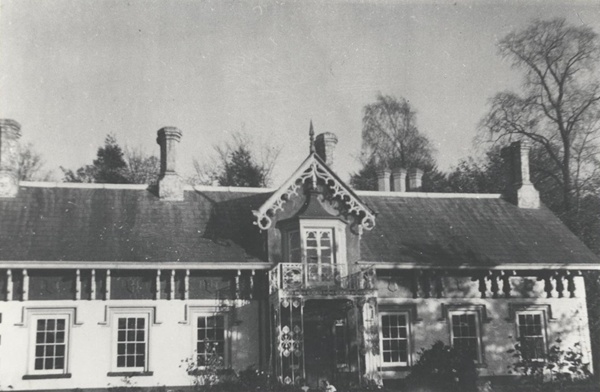
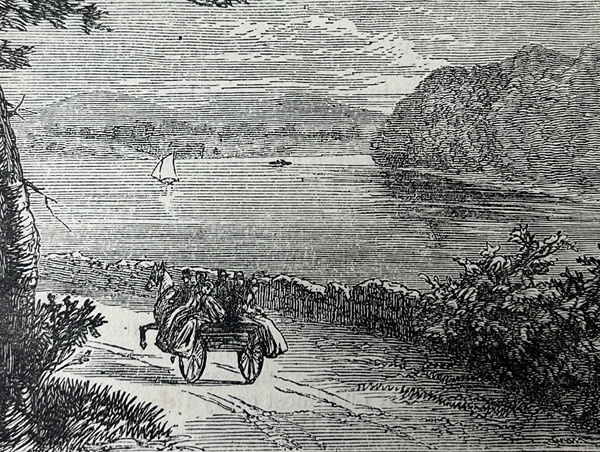
Greenwood Park was an extensive and richly wooded demesne which occupied land between the Old Warrenpoint Road and the Greenan Road, just outside Newry. In the late 18th century, the estate was owned by John Scott, a Newry merchant. In the early 19th century, it was in the hands of the Thompson family. The main residence, built in the Elizabethan revival style, stood in the northern corner of the estate and was designed by John Ramsay, the resident engineer to the Newry Navigation, who resided on the opposite side of the river at Fathom. In Shaw’s Picturesque Guide to Carlingford Bay in 1846 the grounds were described as tastefully arranged, and “one of the most beautiful of the sheltered suburban dwellings which surround and adorn Newry”.
The estate included a house, garden, orchard, stables and farm buildings, two labourers’ houses, steward’s house and 76 acres of land, all enclosed by a stone and lime wall. Along the back of the estate this was known locally as Scott’s Wall. In addition, a folly, known as the Sham Castle, stood in the demesne, a short distance southeast of the main house. The castle was described by Shaw’s Guide as “a picturesque quadrangular tower, completely shrouded with ivy, and surmounted by battlements, on which a few guns are mounted”. Dated around the same age as the house, it contained a large room, “splendidly fitted out . . . used only for balls or other festivities”. There was a fine view of the river from the ramparts.
When the Shaw’s Guide was published, Ross Thompson, Esq., a member of the local gentry, resided at Greenwood Park. He had an interest in and sat on numerous management committees of several developing railway companies in the local area. He was also a member of the Committee for the Relief of the Poor of Newry, making charitable donations to the organisation. He died suddenly at the age of 62 on the 27th September 1847 and was buried in St. Colman’s Churchyard in Bridge Street, Kilkeel. His wife, Margaret, remained in the house until her death on the 28th December 1883 at the age of 90.
In February 1884, household furniture and the outside effects of Greenwood Park, including livestock, farming implements and crops were auctioned off. In June, the estate was sold by public auction at the Commercial News Room on Hill Street and was purchased by Isaac Anwell, a contractor with the company Anwell, Dyson and Wainwright of Liverpool. He died at Greenwood Park on the 29th January 1888 at the age of 39 and was buried at Toxteth Park Cemetery in Liverpool.
In September 1889 Captain John Hudson of Omeath purchased Greenwood Park for £2,500. Originally from the Isle of Man, he entered mercantile service, commanding a vessel in the Baltic trade, rising to become commodore of the fleet of Lampert and Holt of Liverpool. He commanded the reformatory ship Clarence, a training ship for boys run by the Liverpool Catholic Reformatory Society, until the ship was destroyed by a fire. He was then employed as general superintendent by the Amazon Steamship Company in Pará, Brazil, until his health failed, and he returned to England, where he died on the 30th July 1892, aged 52.
Henry Campbell became Greenwood Park’s next owner in February 1892. Born in Kilcoo, County Down, he served his apprenticeship to the grocery business of Patrick Marron in Mill Street, Newry, before moving to Newcastle upon Tyne. He became private secretary to Charles Stewart Parnell, M.P., from 1880 to 1891, served as M.P. for Fermanagh South from 1885 to 1892 and was elected town clerk of Dublin in May 1893, a position he held until December 1920. He was knighted in 1921. He died in London, where he had gone for an operation, on the 6th March 1924, aged 68. After his death, the house was put up for auction in 1925, but the bids were considered inadequate, and the estate was withdrawn from auction.
In 1954, the house was taken apart and sold. The Frontier Sentinel, dated 11th September 1954, carried an advertisement for an auction at Greenwood Park House of Bangor Blue slates, timber, windows, flooring, shuttering and panelling, as well as the iron verandas and “the battalion of octagonal chimney pots” that had been mentioned in Shaw’s Guide in 1846.
The demesne was subsequently developed and is now the site of Forest Hills housing development.
The Museum is currently offering free tours of the main exhibition galleries on Wednesdays at 2.00 pm. These must be booked in advance by calling our Education Officer at 0330 137 4422.
Newry and Mourne Museum is open Tuesday – Saturday 10.00 am – 4.30 pm. Please call 0330 137 4422 or email museums@nmandd.org for further information.
Visit their website at www.visitmournemountains.co.uk