Write a comment

The Cistercian abbey at Newry was dissolved in 1548 and the site of the abbey in Newry and its estates were granted to Nicholas Bagenal in 1552. Nicholas Bagenal, who came from an English merchant family in Staffordshire, had been appointed Marshal of the Army in Ireland in 1547. He was granted the lands at Newry which were strategically important for English expansion into Ulster.
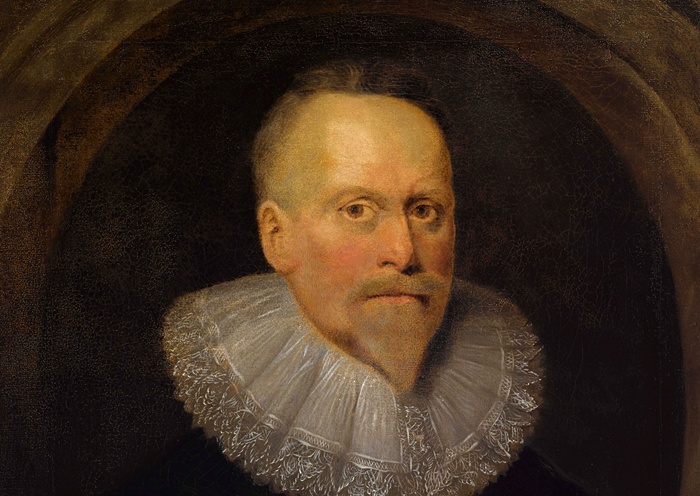
By the 1570’s he had built a castle in Newry and had begun to develop the town. He also had been granted Greencastle and lands at Carlingford. Bagenal married Elianora Griffyth, a Welsh heiress, and had at least nine children, including Henry, the eldest son and Mabel, the youngest daughter. He died in 1590, having arranged for Henry to inherit his title of Marshal of the Army. Sir Nicholas Bagenal is thought to be buried in St. Patrick’s Church in Newry, and his family coat of arms can be seen in the porch.
In 1594 opposition to English expansion in Ireland erupted into all-out rebellion. Hugh O’Neill, earl of Tyrone, who had married Mabel Bagenal in 1591, led resistance to English rule. With an army trained in modern warfare techniques, O’Neill achieved several notable successes. In 1598 at Yellow Ford, near Armagh, the English troops, under the command of Henry Bagenal, were surprised and beaten by O’Neill’s army. Eight hundred of the English army were killed, including Henry himself.

In 1599 the Earl of Essex was sent to Ireland with 17,000 extra troops, but his campaign was a disaster, and he was replaced with more able commanders, who quashed the rebellion. The English defeat of the Irish earls ended the Nine Years War. The Earl’s lands in Ulster were confiscated and were the first to be colonized in the Plantation of Ulster, turning it from the most staunchly Irish region in the land to one dominated by English and Scottish settlers.
Despite the continuing unease, Newry flourished as a centre of trade and commerce due to the patronage of the Bagenal family. Over the next 150 years the town was twice burned to the ground, once accidentally, once deliberately, and was rebuilt on both occasions. Arthur Bagenal, Sir Nicholas Bagenal’s grandson, reached 21 in 1603. He inherited the Castle and estates and developed the town. The economic revival of Newry and the influence of its merchants also afforded it some political importance and, in 1613, the town was granted borough status.

At this stage the town was centred around Bagenal’s Castle and St. Patrick’s church. However, in 1690, Michael Hill purchased the townland of Carneyhough from the Crilley family and the Hill family reclaimed land along the Clanrye River and developed Hill Street which became the main thoroughfare of the town.
The Bagenal line ended in 1712 when Arthur Bagenal’s son Nicholas, died with no surviving male heirs and the estates were divided between his cousins Edward Bayley and Robert Nedham. Robert Nedham inherited the Newry and Mourne estates in south Down. He also invested heavily in the development of Newry and construction work began on the Newry Canal in 1732.
Both the Needham and Hill families (later Earls of Kilmorey and Marquises of Downshire respectively) were involved in the business and commercial life of 18th and 19th century Newry, as well as local government and politics.
The Museum is currently offering free tours of the exhibition galleries on Wednesdays at 2.00 pm. These must be booked in advance by calling our Education Officer at 0330 137 4422.
Newry and Mourne Museum is open Tuesday – Saturday 10.00 am – 4.30 pm. Please call 0330 137 4422 or email museums@nmandd.org for further information.
Visit their website at www.visitmournemountains.co.uk