 1 Comment
Originally known as Turner Hill, the house was built in the late 18th century by a gentleman called Jacob Turner. It occupied a site on the hill behind Queen Street (now Dominic Street) overlooking the town of Newry with an extensive view of the town and the surrounding countryside. Samuel Turner, Jacob’s son was an informer for Dublin Castle during the 1798 Rebellion, revealing details of Theobald Wolfe Tone’s whereabouts in Paris. After passing to another son, Edward, the house remained in the Turner family until its sale in 1852, when the estate of Edward Turner was sold by the Encumbered Estates Commission, established in 1849 to sell off insolvent estates in the years after the Famine.


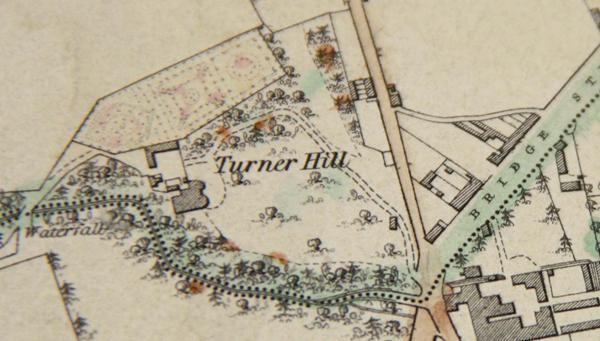
There was a very large attendance at the sale, which took place in the Commercial News Room in Newry, with “the principal merchants of the town, and men of capital being present”. Lot number 10, Turner Hill (which also included a site known as the old distillery) excited a great deal of interest. The Newry Examiner and Louth Advertiser dated Wednesday 28th April 1852 described the house as an elegant mansion, “The house and offices are in excellent repair, ready for the immediate reception of any gentleman’s family. The Glen is beautifully laid out and planted with valuable timber . . . recently valued at £1,053. Such a residence close to a town is rarely to be met with”. Samuel Frazer, attorney, was declared the purchaser, buying the lot for the sum of £2,800.

Turner Hill was then sold again for the sum of £3,600 in 1859. The new owner, Frederick Ludwig, Baron von Stieglitz, was born in Co Armagh in 1803. His father was from Bavaria and his grandfather had been created a baron of the Holy Roman Empire in 1765. He had recently returned from Van Diemen’s Land (Tasmania), where he had been a politician and pastoralist, farming sheep on his 5,000 acre estate for almost thirty years. Not long after his return to Ireland, he married Hester Anna Blacker of Carrickblacker House and became a magistrate for both counties Down and Armagh. He engaged architect William Barre to carry out a conversion of the old house and extensive additions, including a handsome conservatory and other modern improvements. The name of the house appears to have changed from Turner Hill to The Glen at this point.
After Baron von Stieglitz’s death, the house was again sold by public auction. The Newry Commercial Telegraph dated Thursday 20th June 1867 carries the advertisement of the upcoming sale which also included the contents of the house, listed room by room and outbuildings. Highlights included a Phaeton by Waugh and Smith in prime order; Grey Pony, quiet in any harness and a capital Roadster; a great variety of Green-house plants; Brussels carpets and rugs, all but new; German porcelain; China Dessert Services; Magnificent Mirrors; Superb China Coffee Service and Galvanic Battery. The house is described as “. . . large and commodious, contains ample accommodation and every requisite convenience for a family of distinction . . . The approach has a compact and comfortable Lodge at the Entrance Gate. The Gardens, Green Houses and Grounds display refined taste in the laying out, and are in every respect complete.”
After some spirited bidding, the buyer on this occasion was Henry Barcroft, who purchased the Demesne for £5,500. Compared to the sum of £3,600 paid by von Stieglitz just eight years previous, this was seen as an indication of the extent to which property in the town had increased. However, a note attached to the Valuation Revision Book for the period claims that this price was cheap!

The house was to remain in the Barcroft family for the next eight decades. Henry Barcroft, a world renowned inventor, had an engineering workshop in the basement of the house. During the First World War Mrs Barcroft and her daughters were involved in organizing help and ‘comforts’ for the sick and wounded. In August 1918 a grand fete was held at The Glen in aid of the Ulster Women’s Gift Fund which sent parcels of food, clothes, tobacco and other comforts to prisoners, many of whom were from the Newry area.
The two Barcroft sisters, Mary and Anna Henrietta lived at The Glen with their cousin Miss Muriel Richardson until c. 1950. The house was later demolished to make way for a housing estate.
The Museum is currently offering free tours of the exhibition galleries on Wednesdays and Thursdays at 2.00 pm. These must be booked in advance by calling our Education Officer at 0330 137 4422.
Newry and Mourne Museum is open Tuesday – Saturday 10.00 am – 4.30 pm. Please call 0330 137 4422 or email museums@nmandd.org for further information.
Please visit our website at www.visitmournemountains.co.uk/museums/newry-and-mourne-museum