 Write a comment
Just off the busy A1, the Parish Church of Donaghmore sits on a hill steeped in history, with links back to the time of St. Patrick.
The name Donaghmore comes from the Irish Domhnach Mόr, meaning “great church”. Place names with Domhnach are traditionally associated with St. Patrick’s mission in the 5th century. There are many Donaghmore place names in Ireland and to distinguish it from the others it was known as Donaghmore of Magh Cobha, “the plain of Cobha”.
The site was originally a rath or ring-fort, a protective enclosure likely built to house a farming family and some livestock. Under the hill runs a series of underground tunnels, or souterrain, the centre of which lies under the churchyard. Discovered in August 1837 when workers lowering the hill on the road beside the church cut through a section of tunnel, they were sealed in the 1930s due to safety concerns. The following year antique remains in the form of a cremated burial were found in the churchyard by workers building a fence, indicating the use of the site as a place for burials since early Christian times. Prior to relaxation of the Penal Laws in the latter part of the 18th century, Catholics and non-Conformists were prevented from having their own burial grounds and all denominations can be found side by side in the churchyard.

The first church on the site is said to have been founded by St. Mac Erc, who was the first bishop of Donaghmore in the mid-5th century. No trace of his church remains, however, a high cross, carved from Newry granite still stands in the churchyard. Dating from the late 9th or early 10th century, it gave the townland of Tullynacross, “the mound of the Cross” (now known as Glebe), its name.
Tradition says it was toppled in the 17th century, possibly by Cromwellian or Williamite forces, and the shaft broken into two pieces. Although the original site is unknown, it was re-erected in its current location in 1891 by the Rev. Joseph Davison Cowan, with help from the Belfast Naturalists’ Field Club.

Prior to the restoration the head of the cross had been broken off and was partly buried in a nearby grave. The shaft, though resting on its base, was broken across the middle. The head of the cross is narrower than the shaft and is believed to be from another cross, indicating that there may originally have been two crosses on the site.
The cross is a scriptural cross, depicting Biblical characters and scenes. Thought to be a means of teaching the Bible, scriptural crosses account for around a third of high crosses in Ireland. The Donaghmore cross is notable for the number of Old Testament carvings, of which there are seven. The difficulty of carving figures from hard granite along with centuries of weathering mean that it is difficult to interpret and identify the images with certainty. Carvings are believed to include Moses smiting water from the rock and David with the head of Goliath.
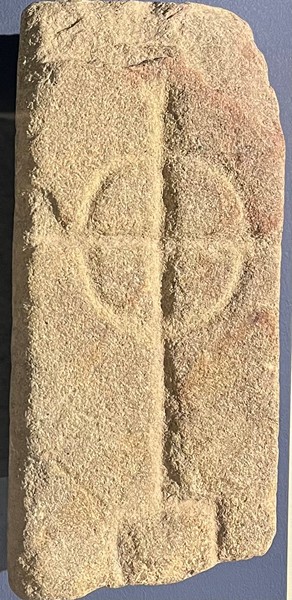
New Testament images can be seen on the head of the cross. The heavily weathered east face is believed to be Christ at the Last Judgement, while the west face depicts the Crucifixion. The top of the cross, which is broken and weathered represents the roof of a church.
Where the cross now stands is the likely site of the original small timber church. Despite being part of the Diocese of Dromore, the church was associated with the See of Armagh, which had a special claim to St. Patrick’s churches and their properties all over Ireland. The present church was built by the encouragement and financial support of Archbishop Boulter, Primate of All Ireland. It was consecrated in 1741 and became known as Saint Bartholomew’s.
Whether worshippers, archaeologists, genealogists or historical enthusiasts, the site of the Parish Churchyard has drawn visitors for over fifteen hundred years. A walk around its paths will uncover even more history.
The Museum is currently offering free tours of the exhibition galleries on Wednesdays and Thursdays at 2.00 pm. These must be booked in advance by calling our Education Officer at 0330 137 4422.
Newry and Mourne Museum is open Tuesday – Saturday 10.00 am – 4.30 pm. Please call 0330 137 4422 or email museums@nmandd.org for further information.
Please visit their website at www.visitmournemountains.co.uk