
 Write a comment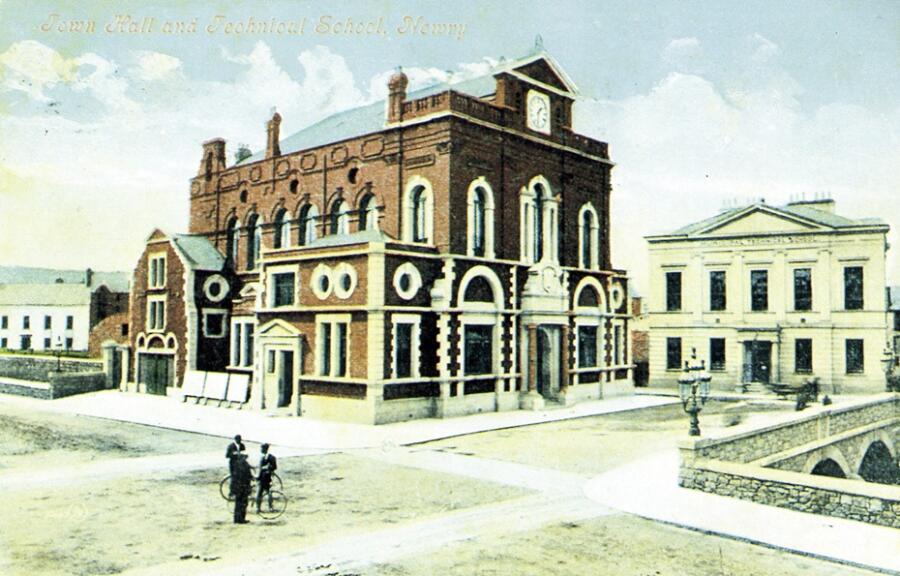
Newry Town Hall stands as one of the most recognisable buildings in Newry. Commissioned by the Newry Town Commissioners and completed in 1893, it served as the heart of local government under their authority, and subsequently under Newry Urban District Council, until 1973. Throughout its existence, the Town Hall has played a significant political, cultural, and artistic role in Newry’s history. With major plans for its further development underway, we will take a brief look at its history over two articles.

proposal for the addition of a clock tower to the building. The proposal
was not carried out.
Although the need for a purpose-built town hall had been discussed at a public meeting in the summer of 1887, it wasn't until March 1890 that the Commissioners announced an architectural competition for its design. From 1889 public business had been conducted in the town's Assembly Rooms, located in the Savings Bank on Bank Parade (Sean Hollywood Arts Centre).
Two competitions were held for the building's design. In 1890 William Sterling of Dublin won the first. He was praised for his design's architectural merit, modest cost, and the potential to incorporate much of the existing Savings Bank into the new structure. However, these plans were shelved. A second competition followed in spring 1891, and this time, William Batt of Belfast’s design was chosen. Unusually, Batt’s proposal placed the hall on the new three-arch bridge, then under construction and named the Armaghdown Bridge.
In July 1890, the Commissioners opted to erect the new hall over the Clanrye River rather than utilise the Savings Bank site. They considered it more economical to widen the bridge to accommodate the new building than to demolish the bank. The decision to build over the river is widely attributed to a desire to prevent rivalry between townspeople in County Down and those in County Armagh, as Newry straddles both counties. The Clanrye River marks the old county boundary, so building the Town Hall over it ensured it would be in both counties at once.
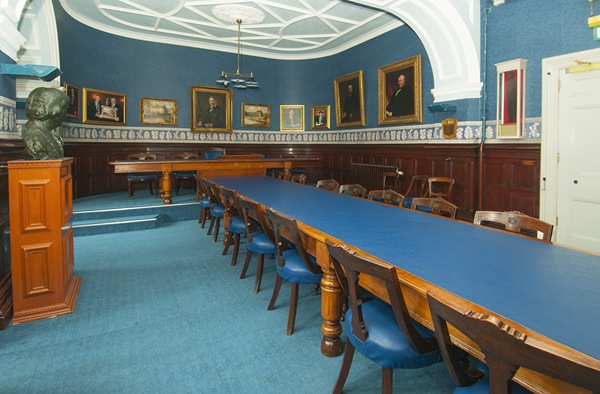
Newry Urban District Council held their meetings. Newry and Mourne
Museum Collection
The building was officially opened by the Earl of Kilmorey in March 1894. It featured a fire station at the rear, complete with a belfry for a hand-operated alarm bell, along with a spacious auditorium and a board room. In 1895, Batt was asked to propose adding a tower to make the clock more visible and the bell more clearly heard, but the plan was never realized. A Minor Hall was added in 1913.
The Town Hall served as the seat of local government from 1894 until 1973, initially under the Town Commissioners and then the Newry Urban District Council, following the reforms of the Local Government (Ireland) Act 1898.

District Council, 1909–1922 and 1929–1937. Painted by Frank
McKelvey in 1937. Newry, Mourne and Down District Council
The board room was the venue for regular meetings of elected councillors, where local policies were debated, budgets approved, services managed (such as sanitation, lighting, local roads, and public health), and the day-to-day running of the district overseen. The building also housed the various departments and officials responsible for executing council decisions, including the Town Clerk, engineers, and finance officers.
Following the major reorganisation of local government in Northern Ireland in 1973, the Newry Urban District Council was abolished, and its functions absorbed into the larger Newry and Mourne District Council with the establishment of new offices at Monaghan Row.
While the Town Hall might not have been the sole administrative headquarters for the entire new district, it continued to play a significant role. It acted as a venue for certain council functions or public-facing services, including the registration of births, deaths, marriages, and civil partnerships.
Further local government reform occurred in 2015 when Newry and Mourne District Council merged with Down District Council to form Newry, Mourne and Down District Council. In late 2017, the Town Hall underwent extensive refurbishment works. There are now further plans to upgrade the building, along with the Sean Hollywood Art Centre, incorporating a new theatre conference facility, including the construction of a new auditorium with a capacity of 255 seats.
Newry and Mourne Museum is playing a role in these changes. Several portraits that have hung in the boardroom have been transferred to Bagenal’s Castle for storage until renovations are complete. These include the image of John Moore, the first chairman of the Town Commissioners of Newry; the picture of Michael J. McCartan, the first Chairman of Newry Urban District Council (1899-1901); and the portrait of Hugh John McConville, Chairman of the Urban District from 1909-1922 and again from 1929-1937.
In the next article we will look at some of the major events and activities that have taken place in the Town Hall that highlight the important role this building has played in Newry’s history.
Newry and Mourne Museum is open Tuesday – Saturday 10.00 am – 4.30 pm. We currently offer free tours on Wednesdays at 2.00 pm. These must be booked in advance by calling 0330 137 4422 or email museums@nmandd.org for further information
Please visit our website at www.visitmournemountains.co.uk