Write a comment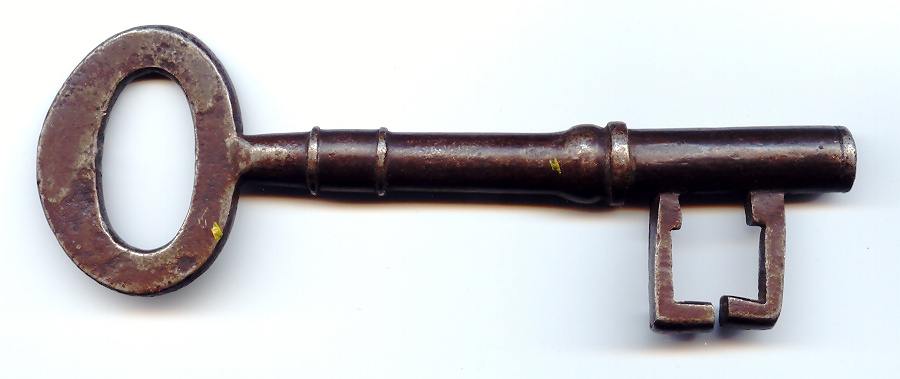
The workhouse legacy in contemporary Northern Ireland evokes both shame and fascination. Older generations will no doubt remember the threat of ending up in the workhouse that hung over them. All over Ireland, workhouse history is tied to the Great Famine and the thousands who sought sanctuary from hunger and disease within its walls.

Because of the rapid social and economic changes brought on by the Industrial Revolution, poverty quickly increased in Europe as old trades ended, factory systems replaced them, and people migrated to towns and cities for work. This created challenges for governments throughout the 19th Century in providing for the poor. The era's ideologies encouraged individual enterprise, which reinforced the notion that poverty was a personal and moral failing. Parliament passed the Poor Law Amendment Act in 1834, which established Poor Law Unions and workhouses funded by a local poor-rate in 15,000 parishes across England and Wales. Edwin Chadwick, the main driver of the Poor Law, suggested abolishing outdoor relief and replacing it with an institutional indoor system, arguing that the pauper lived better than the labourer. George Nicholls, another one of the Act's legislators, stated: "I wish to see the workhouse looked to with dread by our labouring classes."
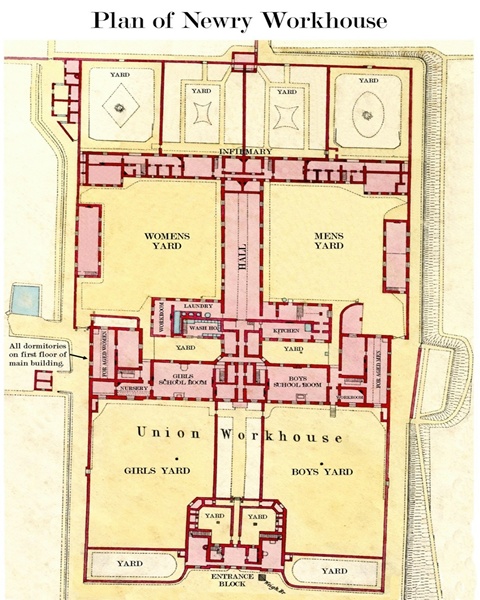
Newry workhouse, built at cost £7,100, (equivalent to £772,000
today) was designed to hold 1,000 ‘inmates’. Based on the
Ordnance Survey of Newry, 1860s. Newry & Mourne
Museum Collection
After the Act of Union of 1801, the British Government tried to address the causes of widespread poverty in Ireland. Over a hundred Royal Commissions and Special Commissions produced little in the way of practical results. A Commission from 1833 presented its findings, stating that the new system was impractical for Ireland, focused on the lack of jobs, and recommended economic and industrial development, with improvements to housing across the island. They noted the people would endure hardship rather than enter the workhouse. The Cabinet met the Commission's report with lukewarm reception.
In 1836, Nicholls spent six weeks in Ireland to assess whether a similar workhouse system would work there, visiting many towns, including Newry. Daniel O'Connell ridiculed the speed of this exercise and claimed that Nicholls "calculated everything and was accurate in nothing." Despite objections, Nicholls recommended a similar Poor Law for Ireland based on that in England and Wales and drafted the Poor Law of 1838. Ireland was divided into 130 Poor Law Unions, each managed by a Board of Guardians, who set the Poor Rate tax to build and maintain the workhouse.
In 1839, the Newry Poor Law Union, covering parts of Down and Armagh, was established, with a Board of Guardians of 31 representatives from the 23 local electoral divisions and an additional ten "ex-officio" guardians. The guardians met weekly, first at the Newsroom and later at the completed workhouse, located at what is now the site of Daisy Hill Hospital. The site benefited from a natural spring for water supply and had an area for cultivating its own food. Supported by donations from charitable societies, it also began collecting the Poor Rates from local ratepayers.
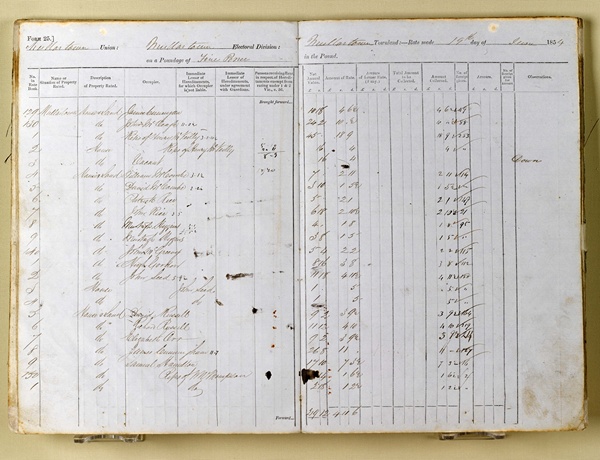
A similar system funded Newry’s workhouse.
Upon entry to the workhouse, the medical officer inspected inmates and split them into categories by age and gender. Males above the age of 15, males between the ages of 2 and 15, females above the age of 15, females between the ages of 2 and 15, and children under 2. This meant that any family entering the workhouse would be split up based on these categories. There was zero tolerance for rule breaches, with punishments ranging from withholding food to corporal discipline. Work in the workhouse could vary, and the most arduous tasks included stone breaking for male inmates and oakum picking - removing the fibres from old hemp ropes, for female inmates. The diet primarily consisted of bread, potatoes, sweet milk, oatmeal and some meat, supplemented by vegetables grown on site.
The workhouse was completed in 1841, and the "Poor Law Commissioners…declared the Workhouse of Newry Union fit for the reception of Destitute Poor" on 6th December of that year. The first inmates entered on the 14th of December. By the end of 1843, only 470 inmates were housed. By the end of 1846, with the Famine a year old, the inmate population was 1,063.
Newry and Mourne Museum is open Tuesday to Saturday, from 10.00 am to 4.30 pm. For further information, visit our website at www.visitmournegullionstrangford.com/museums/newry-and-mourne-museum, call 0330 137 4422 or email museums@nmandd.org