 Write a comment
NOTE: Click Aonad 2 from the sound files above to hear the Lesson.
- Comhrá 2: an script
|
Custaiméir |
Cárta uimhir a seacht, le do thoil. |
|
Oibrí |
An ceann seo? [Oibrí holds up the object] |
|
Custaiméir |
An ceann sin. Sin é! |
|
Oibrí |
Ceann amháin? |
|
Custaiméir |
Dhá cheann. |
|
Oibrí |
Sin ceithre phunt, le do thoil. |
|
Custaiméir |
Seo duit. |
|
Oibrí |
Agus seo do bhriseadh. |
|
Custaiméir |
Go raibh maith agat, slán! |
|
Oibrí |
Slán go fóill! |
b) Stór focal
Here are some words we’ve met so far, along with their plural forms:
uimhir uimhreacha
cárta cártaí
custaiméir custaiméirí
praghas praghsanna
sampla samplaí
Ceann
We use the word ceann to talk about things/objects.
Samplaí:
an ceann sin that one
an ceann seo this one
ceann amháin one (thing/object)
Cuntas counting (things)
We met the numbers 1-10 (a haon, a dó, a trí, etc) in unit 1.
When counting objects (not people) in Irish, we use the numbers a little differently. When counting things, we only need to make three changes to the numbers from Aonad 1. Those numbers (1, 2 and 4) are in the script in Aonad 2.
Focus on the number (underlined) itself for now:
ceann amháin (or simply ceann)
dhá cheann
ceithre phunt
The other numbers stay as they were in Aonad 1 when counting objects.
Counting euro € and other loan words
When counting objects named with loan words or brands (euro, Fanta, Rolo, etc.), the loan word, brand name, etc itself will not be affected by the number.
|
euro amháin / euro |
|
dhá euro trí euro ceithre euro cúig euro sé euro |
|
seacht euro ocht euro naoi euro deich euro |
|
Custaiméir |
Ceithre Twix, trí 7up, Twister amháin agus dhá Fanta, le do thoil! |
|
Oibrí |
Sin deich euro. |
Punt / Counting pounds – objects with Irish names
When counting objects with Irish names, however, the beginning of the object’s name may change. We saw the ‘p’ sound eclipsed by the ‘b’ sound in Aonad 1.
Keep an eye on the start of the word punt for changes. We’ve seen one such change (deich bpunt) already. This change takes place following the numbers 7-10. Have a look in the table below at what happens when there are 2-6 objects.
|
punt (amháin) |
|
|
dhá, trí, ceithre, cúig, sé |
phunt |
|
seacht, ocht, naoi, deich |
bpunt |
A séimhiú (a softening or ‘lenition’, shown by the letter ‘h’) is added to the beginning of punt, giving phunt. The same <f> sound is found in English words such as phone, pharmacy. Other nouns beginning with ‘p’ follow the same pattern of changes as punt and nouns beginning with certain other letters will follow similar patterns. A summary is given in Appendix 2 (B).
Counting items using the word ‘ceann’ / thing
Ceann is used to refer to objects in a non-specific way. If asked how many of an object you want, you can reply using the word ceann: dhá cheann / two.
In English, we can simply state the number, e.g. “How many do you want?” “Two”.
In Irish, a noun must follow the counting number.
When counting in Irish, some words follow patterns which appear irregular. There aren’t many of these in everyday speech.
Ceann is one such word. You should pay attention to the following forms when counting objects using ceann:
|
1 |
ceann amháin / ceann |
|
2 |
dhá cheann |
|
3-6 |
trí, ceithre, cúig, sé cinn |
|
7-10 |
seacht, ocht, naoi, deich gcinn |
- Eolas teanga: do / your
|
Oibrí |
Agus seo do bhriseadh. |
- In ‘seo do bhriseadh’, the ‘b’ sound in the word briseadh is softened with a séimhiú marked ‘h’ as a result of the word do / your before it.
- The ‘b’ sound becomes a <v> sound.
- This sound change is important, as the sound itself affects the meaning of the word.
d) Cleachtaí
Cleachtadh 1: Séimhiú / lenition
Sampla: seo do bhriseadh, le do thoil
Patrún / pattern: do bhata, do mhála, do chóta
Séimhiú: úsáid an patrún thus sa tábla seo.
Lenition: use the pattern above in this table.
|
bróga |
do bhróga |
mamaí |
do |
|
carr |
do |
paicéad |
|
|
dochtúir |
|
píosa |
|
|
cárta |
|
seans |
|
Cleachtadh 2: mata / maths
Líon an tábla / fill the table. Pay attention to changes in the word punt.
In (c) and (e) it’s up to you to set an appropriate price!
|
praghsanna £ |
costas iomlán = |
|
naoi bpunt |
|
|
|
|
ocht bpunt |
|
|
|
|
ceithre phunt |
Cleachtadh 3: líon an tábla
|
(1) (punt) |
punt (amháin) |
|
(3) (punt) |
trí phunt |
|
(5) (píosa) |
|
|
(6) (píotsa) |
|
|
(8) (paicéad) |
|
|
(10) (píosa) |
|
- Cleachtadh grúpa
Súil siar: Cluiche /
Review: Game
Caithigí súil siar ar an phatrún a bhaineann le ceann /
Review the pattern for counting objects using ‘ceann’
Beidh beirt nó triúr i ngach grúpa / There will be two or three people in each group
Beidh uimhir ag gach duine / Each person will have a number:
- duine a haon (1)
- duine a dó (2)
- duine a trí (3)
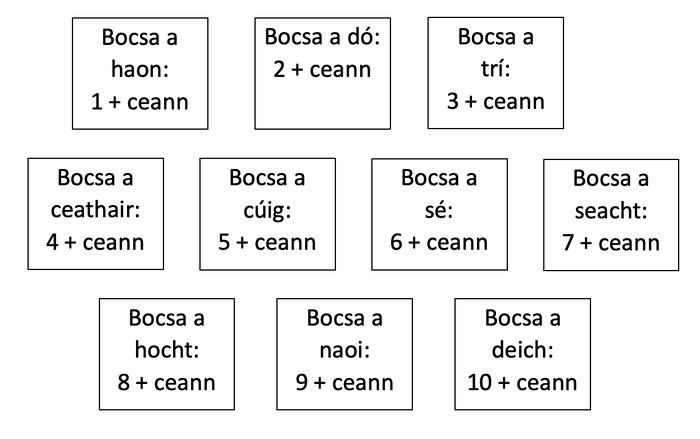
The game goes like this:
Duine a haon (Sam): A Sarah, bocsa a seacht.
Duine a dó (Sarah): Bocsa a seacht. Seacht agus ceann: seacht gcinn. A Greg, bocsa a haon.
Duine a trí (Greg): Bocsa a haon. Aon agus ceann: ceann amháin. A Sam...
- Piocann duine a haon bocsa do dhuine a dó / Person 1 picks a box for person 2
- Léann duine a dó an rud ar an bhocsa / Person 2 reads what is on the box
- Piocann duine a dó bocsa don chéad duine eile / Person 2 picks a box for the next person
Obair bhreise 2: comhrá fóin
An chéad chuid eile den chomhrá / The next bit of the conversation
Below are some customer requests and sample responses.
Custaiméir (C)
Oibrí (O)
(C) Ba mhaith liom labhairt le duine éigin faoi rátaí.
I’d like to talk to someone about rates.
(O) Ceart go leor, fan bomaite.
Alright, wait a minute.
(C) Tá mé ag iarraidh cuntas a oscailt.
I want to open an account.
(O) Ceart go leor, gheobhaidh mé an duine sin anois.
Alright, I’ll get that person now.
(C) Tá mé ag iarraidh labhairt leis an úinéir.
I’m looking to speak to the owner.
(O) Brón orm, níl sí ag obair inniu.
Sorry, she isn’t working today.
(C) Ba mhaith liom labhairt leis an bhainisteoir.
I would like to speak to the manager.
(O) Go breá, gheobhaidh mé é anois.
Fine, I’ll get him now.
(C) Caithfidh mé bille a íoc.
I have to pay a bill.
(O) Go breá, is féidir linn sin a dhéanamh anois.
Grand, we can do that now.