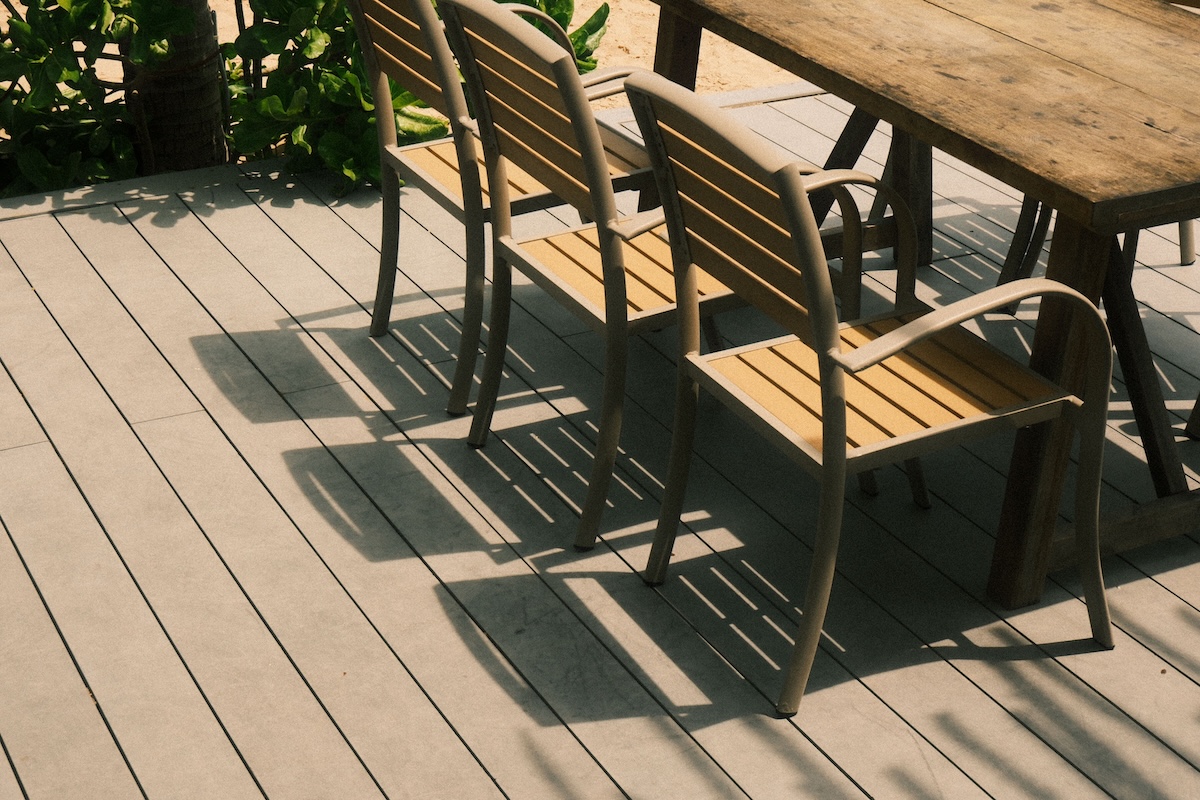
Before ordering boards for a small garden deck, draw the same rectangle twice. On the first sketch, run the boards along the long side. On the second, turn them through 90 degrees. Both sketches cover the same patch of garden, but they can produce very different shopping lists. In the worked example below, turning the boards cuts the total length left over by more than half, even though you buy more individual boards.
Newry.ie reported that nearly 300 people attended a local self-build event at Carnbane. A deck is a smaller project than a house, but the same habit pays off at the trade counter. Bring measurements and a list of the pieces you need. Then you can compare what’s actually in stock before you commit to a layout.
Measure the space you’ll actually use
Start with what you want the deck to do. If it’s for a table and four chairs, put the furniture where you want it or mark the space with string. Allow room to pull chairs out and still get past them. Check whether a gate can open fully and whether you can get from the back door to the lawn. It’s easier to shift a line of string than to redesign a deck after the boards arrive.
Measure both sides of the marked area and note anything that interrupts the rectangle, such as a step or a corner that needs to stay clear. If you’re fitting a deck between walls, measure at both ends. The opening may be wider at one end than the other. Write the measurements in millimetres so you can use the same units for the garden, the boards and the gaps.
Compare board lengths before counting how many to buy
A cut list records the number and finished length of the pieces you need. Start by finding out which lengths are available in the same board. The face width matters too. For example, 15 boards with a face width of 145 mm cover 2,175 mm before you add any gaps. There are 14 gaps between 15 boards, so if the product calls for 5 mm between them, the total comes to 2,245 mm.
Check the fitting guide for your chosen product before using those numbers on your own deck. Ask how much space to leave at a wall or edge, and confirm the width the boards actually cover once fitted. This buyer’s guide to decking board lengths explains how longer boards can reduce joins and why they can be harder to handle or cost more to deliver. Use the stock lengths and prices your merchant can offer to make the final comparison.
A worked cut list for a deck just over 7 square metres
Imagine a rectangular deck with a finished board area of 3,145 mm by 2,245 mm, open edges and no step within that area. Both options use a 145 mm board face and a 5 mm gap between rows, and each row uses one full-length piece cut from stock. Assume the same board comes in 3.6 m and 2.4 m lengths. These figures are for comparing layouts. On your own deck, check the product’s clearances and have the support layout checked before choosing a direction.
- Boards along the longer side. Cut 15 pieces to 3,145 mm from 15 boards at 3.6 m each. You buy 54 metres of board. The difference between what you buy and what goes into the deck is 6.825 metres.
- Boards along the shorter side. Cut 21 pieces to 2,245 mm from 21 boards at 2.4 m each. You buy 50.4 metres. The difference is 3.255 metres.
The shorter direction leaves 3.57 metres less, a reduction of about 52% in this example. The figures include material lost to saw cuts or trimming, so the pile of usable offcuts will be smaller. Both layouts avoid joins within the rows. The shorter option still has six extra rows, so check the number of clips or fixings and the cost of delivery before deciding which order costs less.
If the outside edge is flexible, see what happens when you move it far enough to finish with a whole board. That can save cutting a narrow strip along the length of the last row. If you want a border around the deck, draw and count those pieces separately. A spare piece may work on one edge but be too short for another.
Check what happens when a row needs two pieces
An awkward recess or a board length that’s out of stock can change the plan. If two pieces have to meet end to end, mark the join on the sketch and ask the installer how both ends will be supported. Check the end gap in the fitting guide and include it in the cut list. This is where an offcut earns its place. It has to be long enough for the marked position and fit the support and fixing layout.
Measure the first row in place before cutting the rest of the order. If one edge of the garden runs slightly out of square, a stack of identical pieces could leave you short at the far end. Remember that a saw removes a thin strip of material each time it cuts. When you want two pieces from one stock board, allow for the width of the cut and any end trimming before you mark the second piece.
Take the cut list to the merchant
Show the merchant both layouts and ask them to price the boards and fittings together. Confirm the actual lengths they can supply, whether they sell individual boards, and what delivery costs. Check that the longest board can get through your gate or turn along a narrow side path. If a different stock length is available at a better price, run the cut list again before buying.
If you plan to cut the boards yourself and need equipment, Newry.ie has covered tool hire at Carnbane Industrial Estate. Ask the hire desk or your installer which tools suit the material you’ve chosen. If you decide to order a spare, keep it uncut and label the board range and finish so you can match it later.
Northern Ireland’s waste hierarchy puts waste prevention first. For a small deck, that starts with checking the lengths before placing the order. Once the merchant confirms the stock, keep one copy of the sketch with the cut list. You’ll know which piece belongs where and can keep a useful offcut for a marked job instead of cutting into a fresh board.