 Write a comment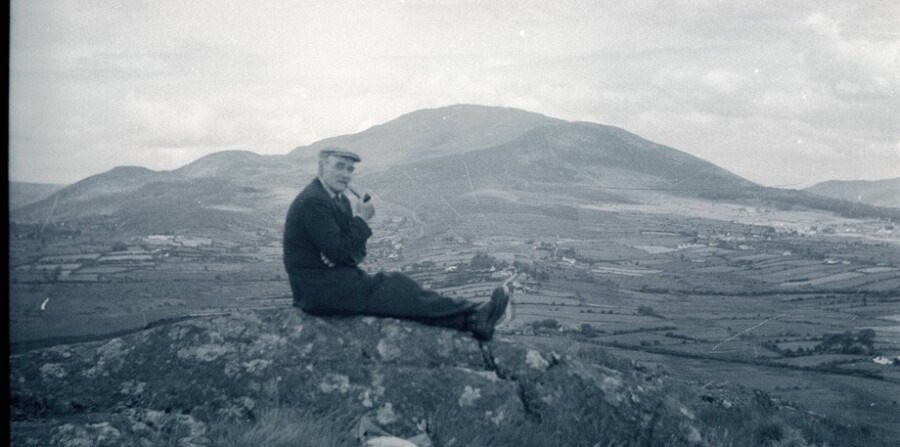
The annual Michael J.Murphy Winter School 2023 will take place this weekend at Tí Chulainn in Mullaghbawn.
Running Friday November 24 and Saturday November 25.The theme of this year’s gathering is ‘Who Fears to Speak of ’98?’
Held at Tí Chulainn Cultural Activity Centre, Maphoner since 2013 the event commemorates the life and work of this outstanding native of Dromintee, at the foot of Sliabh Gullion, Ireland’s most mystic mountain.
MJ Murphy was born in Liverpool in 1913 of South Armagh parents who brought him home to their own place in 1922. He attended Dromintee National School until he was fourteen years old and then went to work as a farm labourer with local farmers. Like Patrick Kavanagh,the Inniskeen, Co.Monaghan poet ,he ‘flew to knowledge without going to college’.
He began to record the folk tales and lore of his own area and published his first book, ‘At Slieve Gullion’s Foot’, in December 1941.He was contacted by the Irish Folklore Commission in Dublin and went on to collect the largest collection of oral tradition ever collected by a single individual in the English-speaking world.This unique collection,of 150 volumes, is now housed in the Department of Irish Folklore,University College,Dublin.
As well as compiling this monumental work, MJ was a prolific broadcaster, beginning in 1937 with the BBC. He broadcast widely for Radio Éireann; BBC Belfast; Radio Newfoundland and the BBC Pacific Service. He later made television programmes such as ‘Ulster in Focus’ and ‘Ye Barbarous Mountaines’ for BBC and UTV.
He also found time to write creatively. He was first encouraged, when he was nineteen years old to continue writing by Maud Gonne McBride. His creative prose was inspired by the richness of the language of the people around Slieve Gullion,in South Armagh, and he is the last, and possibly the only authentic voice of South Armagh language in written form. His prose poems, short stories, plays, journals and novels show us a writer who deals realistically with the complexities of rural life and the struggle with materialism and the environment.
He combined his work as a collector for The Folklore Commission and later for The Department of Folklore in University College,Dublin,with photographing the people and the places throughout ‘Old Ulster’ from Rathlin Island to The Boyne and to Sligo and Leitrim in the west.Many of these outstanding photographs can be viewed in University College,Dublin,and on the Dúchas website.
On the social and political front he campaigned continually from the 1930s against the hiring fairs and the hardships endured by the agricultural labourers.One of his abiding passions was that he saw republicanism as being continually compromised by greed and he returned to this theme over and over again in his articles, short stories, plays and broadcasts.
When the Cuimhneamh committee met to choose a theme for the Michael J.Murphy Winter School to take place in 2023, it was decided to look at the two-hundred and twenty fifth anniversary of the Rebellion of 1798.The second factor in the decision was that another great Co.Armagh scholar, John Kells Ingram,was a native of Mountnorris (commonly known as ‘Port’), within sight of Slieve Gullion. Indeed,the oral tradition around South Armagh attested that ‘the Orange Order started in Port’ and that statement will be examined on the Friday night!
Both he and Michael J. had an abiding interest in politics, literature, social justice and republicanism.Kells Ingram’s famous poem ‘The Memory of the Dead’ is better known by its first line ‘Who Fears to Speak of Ninety-Eight?’ and this question is particularly relevant to the Ireland of the twenty-first century.The debate at the forum on Saturday evening will be concentrating on this question and it will be opened to the floor by the chairperson, Anthony Russell.
John Kells Ingram was a member of a prominent family from the Mountnorris area. Although he was born in Templecarne,Co.Donegal in 1823,he was brought home to Mountnorris when he was six years old. The house in which the family lived is now the post office in the village.
He was educated at a classical school in Newry and went to Trinity College,Dublin,when he was fourteen years old.He was academically gifted and had a stellar career as a student, teacher, professor, librarian and vice-provost in Trinity College. He published works on mathematics, economics, classical studies, philosophy and sociology but he is best remembered for his famous poem written, as he himself said ‘unaided by alcohol or nicotine’ and which was published in ‘The Nation’,the newspaper of the Young Ireland Movement, on April 1st 1843.
The poem became very well known over the following decades.Kells Ingram died on May 1st 1907.
On the Friday evening,the concentration from 7pm to 9pm,will be on the local aspect of the rebellion in South Armagh, Mid-Armagh and South Down. On Saturday there will be an opportunity to go on a tour from 1pm to 3pm of sites associated with the period in the Mullaghbane and Forkill area (£10 - bookable on Eventbrite. All other events are free). At 7pm on Saturday the renowned historian, Professor Kevin Whelan of Notre Dame University, Dublin,will deliver the keynote lecture on 1798.This will be followed at 8pm by a Forum which will examine the relevance of 1798 to the twenty-first century. The chairperson will be the historian and scholar, Anthony Russell.The panellists are Stephen McCracken, Catherine Pollock, Odrán de Bhaldraithe and Sean Napier.
It is fitting that we should remember two outstanding Co.Armagh academics from very different backgrounds and once again pose the question ‘Who Fears to Speak of Ninety-Eight?’ Do come along,listen,learn and join in.
For further information go to the Cuimhneamh Facebook Page