 Write a comment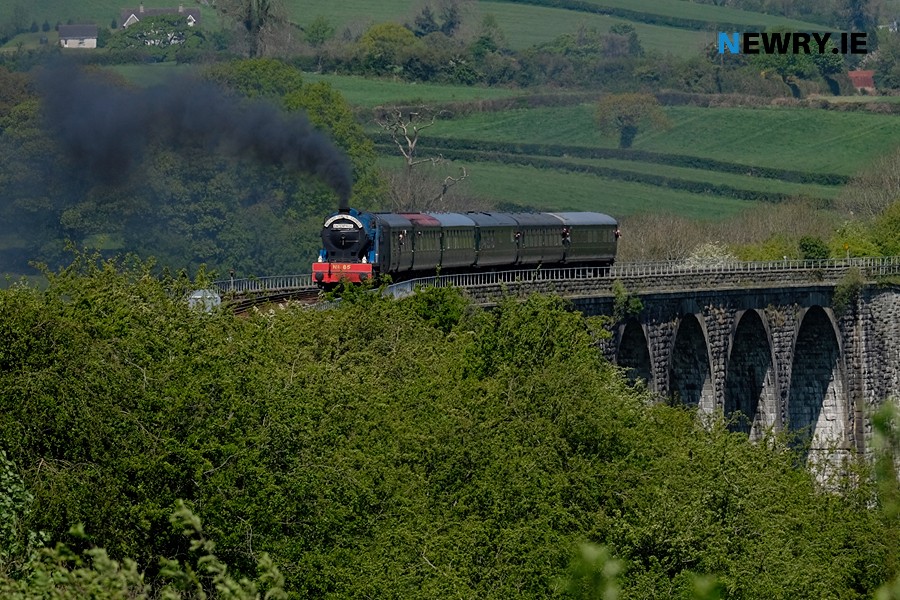
The flagship cross-border service between Belfast and Dublin is marking 75 years of connecting people and places.
At 10.30am on 11 August 1947, the inaugural Enterprise train service travelled from Belfast to Dublin – a seven-carriage steam train operated by the Great Northern Railway (Ireland).
Its first year in service consisted of one train in each direction, with its launch heralding a new era in cross-border rail travel connecting the two cities. Today, 75 years later, Enterprise passenger demand is on course to reach an all-time high with 16 departures daily Monday to Saturday and 10 Departures on Sunday.

There have been many milestones over the decades, like diesel railcars replacing steam locomotives, to major refurbishments and railway upgrades. But the Enterprise story has also been impacted by the wider historical context including The Troubles when the Peace Train Organisation was set-up and the ‘contraceptive trains’ of the Irish Women’s Liberation Movement.
Now jointly operated by Translink NI Railways and Iarnród Éireann, the Enterprise Strategic Development Plan outlines ambitions for the development of the service from procurement of new fleet and line electrification to journey time improvement options.
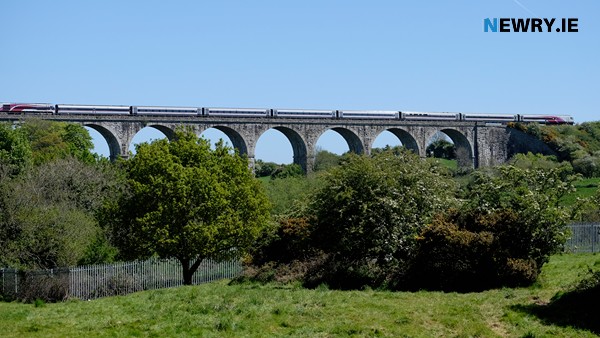
Newry is one of the key stops along the route. Chair of Newry Mourne and Down District Council’s Economic Development Committee, Cllr Robert Burgess said: The Enterprise service has been key in connecting local people throughout the decades to key cities. Not only has this created many memories for passengers throughout the 75 years but helped bolster the local economy and create opportunities for business. I hope to see continued growth along this invaluable public transport route for years to come.”
To celebrate the rich history of the service, an exhibition of photographs of the train, its customers and staff through the years is now on display at Dublin Connolly Station and Lanyon Place Station.
Translink Group Chief Executive Chris Conway said: “Today we celebrate the service, our staff and customers over the decades. Whatever your reason for travel, Enterprise has been there to connect us to family, friends and opportunity, evolving with the times and better connecting Belfast and Dublin. Thank you to everyone who has shaped the Enterprise journey and we look forward to delivering our ambitious plans to secure the future of our flagship cross-border rail service.”
Iarnród Éireann Chief Executive Jim Meade, said: “The Enterprise service has a rich and evocative history. I am certain that our customers will very much enjoy the exhibition that is now on display at Lanyon Place and Connolly. The Enterprise train is a key economic and social connector for the people of Dublin, Belfast and the stations in between and we look forward to another 75 years of its successful operation,”
Find out more at www.translink.co.uk and join the conversation online @Translink_NI and @IrishRail #Enterprise75
A History of the Enterprise Service
1947
At 10.30am on August 11, the inaugural Enterprise service travelled from Belfast Great Victoria Street Station to Dublin Amiens Street Station (renamed Dublin Connolly in 1966),
Operated by the Great Northern Railway (Ireland), it was a non-stop prestige express service with customs checks at either end (rather than at the previous mid-points of Goraghwood and Dundalk) - running Monday – Saturday with journey time 2¼ hours.
A seven-carriage steam train aimed mostly at the business traveller, with first class accommodation, catering, more leg room and lavatories.
The 1st year in service consisted of one train in each direction – the 10.30 ex Belfast and 17.30 ex Dublin.
The new service was usually worked by locomotives named Eagle, Falcon, Merlin, Peregrine and Kestrel – birds of prey – and painted blue.
1948
On 31 May, a Dublin-based train was introduced for a 09.30 ex Dublin and a 17.15 ex Belfast.
5 new locomotives built mainly for Enterprise took over the service and were named after rivers across the network – Liffey, Boyne, Lagan, Foyle and Erne.
1950
AEC Diesel Railcars replaced steam on the lightly-trafficked Dublin-based Enterprise.
From 2 October 1950, the Belfast-based Enterprise was extended to Cork with journey times of 6.25-6.5 hours.
Coaches from GNR and from Córas Iompair Éireann (CIÉ) worked on alternate days and both trains had GNR Buffet Cars at first.
This extended service to Cork ended on 27 June 1953 but a through coach continued to operate until September 1953.
On September 1 1953, the governments of the Republic of Ireland and Northern Ireland nationalised the GNR as the Great Northern Railway Board GNRB.
1957 - 1958
The Great Northern Railway Board ordered more powerful BUT diesel mechanical railcars, ending steam traction on the Enterprise. They could run up to 8 cars including a full buffet car and replaced steam on the Belfast-based Enterprise from 19 June 1957.
The GNR Board was dissolved on 1 October 1958 and its assets and liabilities were split between Córas Iompair Éireann (CIÉ) and the Ulster Transport Authority (UTA) — the predecessors of Iarnród Éireann and Northern Ireland Railways respectively.
UTA took over the northern portion of the route and CIE took over the southern portion.
1960
1st intermediate stop introduced at Dundalk, open to Belfast-bound passengers.
1965
Enterprise service doubled to 4 trains each way per day and Portadown stop was added.
1967 - 68
NI Railways was established in 1967 and, from January 1969, the NIR Enterprise was worked by new 70 class diesel-electric railcars.
1971
Contraceptives were illegal in the Republic of Ireland at the time. The Irish Women’s Liberation Movement triggered a media storm when they travelled by Enterprise to Belfast to purchase contraceptives.
1972
By July, all Enterprise services had intermediate stops and later that year air-conditioned coaches were introduced.
1976
Following the completion of the Belfast Central Line Project, which involved the relaying of track along the route of the former Belfast Central Railway, the Belfast terminal moved from Great Victoria Street to the newly constructed Belfast Central station.
1977 – 1980
In 1980, two new General Motors Diesel–Electric main line locomotives and a train of 8 BR Mark IIB coaches were introduced to the NIR Enterprise service.
A new CIE timetable was introduced with all Enterprise services stopping in Drogheda.
1980
The Railway Preservation Society of Ireland (RPSI) begins its Steam Enterprise public excursions between Belfast and Dublin.
1982
By June, Enterprise offered six services each way daily.
1989
Peace Train organisation was set-up in response to bombings and security alerts along the Belfast-Dublin railway line during The Troubles.
1997
The service was upgraded with a new timetable and new coaching stock from French train makers De Dietrich Ferroviaire (now Alstom DDF). At this point the service, which had operated under either the IÉ or NIR brands, was branded separately as Enterprise.
2009
Part of the Broadmeadow estuary viaduct, north of Malahide, collapsed on 21 August 2009, causing serious service disruption. The line reopened on November 16th with full service resumed.
2014
Enterprise £12.2m mid-life refurbishment programme announced to extend the life of the De Dietrich coaches.
2015
In November, the 1st refurbished Enterprise train entered passenger service after major interior overhaul including new power sockets, tables, lighting, redesigned catering car, better signage and an electronic reservation system.
2018
Belfast Central Station re-named Lanyon Place.
2020-21
Covid 19 pandemic causes major impact on Enterprise services with passenger journeys at times falling below 10% of pre-covid levels.
2022
Enterprise offers 16 departures daily, 8 in either direction (Mon – Sat) and 10 departures on Sundays.
Passenger numbers exceed pre-pandemic levels with a surge in demand for cross-border journeys and customers choosing rail travel to an unprecedented number of special events from concerts to sporting fixtures.
In Belfast, main works start on the new Grand Central Station – a modern world-class integrated transport hub – situated on the existing Europa Buscentre/Great Victoria Street Station site. The surrounding Weavers Cross area will feature impressive mixed use development opportunities across an eight-hectare site, acting as a catalyst for regeneration.
On opening, Grand Central will become the new Belfast terminus for Enterprise, returning the service close to its original Great Victoria Street departure point 75 years ago.
Future Vision
The Enterprise Strategic Development Plan seeks approval to start procurement of new fleet and fund a detailed Technical & Feasibility study for journey time improvement options.
An hourly Belfast – Dublin service could be achieved within 5 years with a journey time of less than 2 hours.
Longer term, additional improvements could be achieved with investment in line electrification to achieve further frequency improvements and a journey time of potentially 90 mins or less.
Acknowledgements
Special thanks to Charles Friel and Peter Rigney from the Railway Preservation society of Ireland and Ciarán Cooney and Barry Carse from the Irish Railway Record Society for their help in compiling the Enterprise archive.