Write a comment
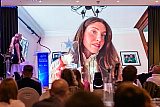
Hundreds of people from Newry made it down to the Ireland's Future event in the Three Arena, Dublin on Saturday 1 October where speakers from many walks of life talked about their aspirations as well as their concerns in front of a five thousand strong audience.
Mixing with members of the public and local school pupils were public representatives including Mickey Brady MP, Newry and Armagh; MLA's Liz Kimmins, Justin McNulty and Conor Murphy as well as Newry City Councillors Valerie Harte and Roisin Mulgrew.
Speaking on the event Mickey Brady said "Together We can build a new and United Ireland. A stronger, better and fairer country withing the EU. Now is the time to plan and the Irish government must establish a Citizens Assembly to begin the preparations for a future Unity referendum."
Justin McNulty spoke on the same lines as his party colleague Colum Eastwood who spoke at the conference. He said “For me, there are two great divisions to be healed in Ireland – the division of partition, which has disrupted and inhibited life on this island for over a century, and importantly, the divisions between the two proud traditions on this island – unionism and nationalism. Since our inception, the SDLP’s mission has been to dismantle those divisions.
“I want to see the creation of a fair, inclusive and diverse New Ireland, built on social democratic principles. That can only happen through the facilitation of a broad based inclusive effort, where everyone has a seat at the table and a stake in the conversation. We need to be prepared to listen to views that we don’t agree with, and have the generosity to make accommodations that might make us uncomfortable.
“The New Ireland envisaged by the SDLP is not one based on triumphalism or domination, but one based on partnership and reconciliation. It’s not about replaying the divisions of the past, it’s about capturing the promise of the future.
“We are saying loudly and proudly, the task of building a New Ireland belongs to us all – so come and build it with us."
Liz Kimmins added "What an uplifting and powerful day in Dublin! Young and old, people of faith and people of none, people of different colour and creed, all coming together to be part of the conversation for a better future for everyone on this island we all call home. The momentum for Irish Unity is unstoppable, and today was undoubtedly a landmark day on that journey. It's important that every voice is heard, there is no limit to what we can achieve when we work together"
With a panel of around 30 speakers at the event, the lesser known participants in many cases made the most important points in the discussions.
Please don't put the past on our backs
Belfast Baptist Minister, Rev Karen Sethuraman spoke of the middle ground, people who remain to be convinced as she put it. "I think there's lots of people wanting to be convinced and I think that puts the spotlight on us to convince them"
Rev Sethuraman continued "When we think of a border poll whenever that will be, the question will ultimately be, what is our future. Will it be to remain part of the union or will it be to join up with Ireland, but I think the question to ask people today is can our home be better. The reality is that this is already our home that's our starting place. We all belong whatever our background, this is our home but can it be better.
"This is an opportunity for us to create something new. It's not about holding hands or running off into the sunset or singing Kumbaya, everything's all great, there's a lot of work to be done. But there are people who are watching, there are people who are listening, there are people who have those burning answers, that isn't necessarily about green or orange. It's what I call the everyday living. What will this mean for my health service. What does this mean for my children? And that middle ground is growing, is there, is present, and our role in Ireland's Future and other people who are championing Irish unity is to cast a vision to say this is what's best for us."
"What I love about our young people is they say it like it is. I have one young person say to me, please don't put the past on our backs. Our young people don't want a sectarian, divided society. I hear things. I did a survey with 100 young people and it's simple things like why can't we just get on? Why can't we just be friends? And it's the simplicity of those messages on our youth that not only should cause us to want to make something better, but it puts the onus on us to make sure that we do."
The next stepping stone
Tánaiste Leo Varadkar spoke of the event as a statement of intent.
"Today's gathering is a statement of intent about Ireland's future. A statement grounded in hope and optimism about that future. A respect for different opinions and a belief in what we can achieve together." he said.
The Tánaiste continued "United Ireland is something that many Irish people have dreamt about for many years. It is a noble and legitimate aspiration and one that I share. It's an idea that I believe has come a very long way in a very short time. I know when I was growing up in the 1980's an event like this would have been criticised for being disruptive and divisive and that's if it happened at all. Decades of violence had sullied the dream of unification.
"In the 1990's peace changed everything. Old hatreds were replaced by a new hope and we won the freedom to dream anew. We dare to ask ourselves, what was the next stepping stone in our national story? But with that freedom comes a challenge, a responsibility on all of us to ensure that our dreams do not become someone else's nightmare. A challenge to avoid repeating the mistakes of the past and imposing our will on the unwilling. This conference is entitled Together We Can - le chéile is féidir linn. For those of us gathered here today who believe in a united Ireland the biggest challenge is not the word together or the unspoken promise of what can be achieved, it is with the word WE. No one doubts the power of what we can achieve when we work together. We've seen it throughout our history, and most recently during the pandemic. But throughout our history we've all too often failed to find solutions that work for all. We know what that has led to, a history of resentment, of violence, of bitterness of betrayal. A legacy of pain, a divided Ireland and a divided people. There are opposing dreams on this island which cannot be ignored, cannot be wished away, cannot be silenced nor should they be. Those approaches failed in the past and they will fail in the future."
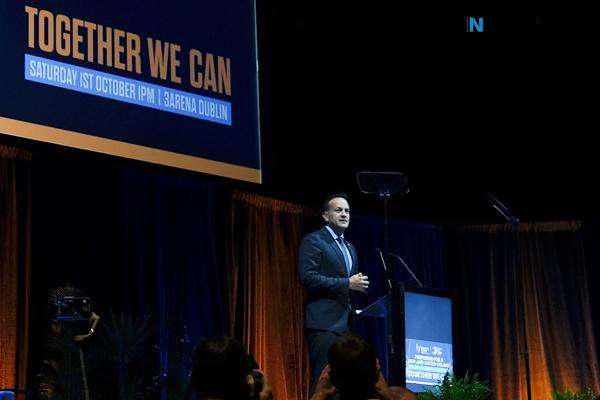
Mr Varadkar continued "Our own long history has taught us that a dream imposed by force is no dream at all. What has succeeded is respect for other opinions, a willingness to work for the collective good, an attempt to build consensus ourselves together. So we need to acknowledge the cross community engagement in Northern Ireland and between north and south remains far short of where it needs to be if we want to build this new and united Ireland. There is a distinct danger that we could focus too much on a border poll and on future constitutional models and not enough on how we enhance engagement, build trust and create the conditions for a convincing majority of change, which is what we want.
"So we need to engage with Unionists we have here today and that growing group of people who identify as Northern Irish rather than British or Irish and indeed those who identify with both. That middle ground that other speakers spoke about. We also needs to acknowledge the right of northern nationalists to have equal recognition in this debate. We can't build a future based on narrow majorities or on the wishes of just one community and for these reasons, I believe our objective should be to secure as large a majority as possible in both jurisdictions in any future poll. 50% plus one is enough on paper and in law I don't dispute that for a moment. But a majority so narrow is not a recipe for success. Our only hope depends on presenting a proposal north and south that will be able to achieve democratic consent and this will involve compromise. It might mean accepting a form of unification that is more inclusive and imaginative than what we've considered before. One that can achieve the greatest measure of democratic supports, and therefore legitimacy and therefore the greatest chance of success. We need something that can evolve and deepen over time. And we need to remember that the next step doesn't have to be the final word."
Continuing Mr Varadkar added "100 years ago, a treaty created a new state, was ratified by our Dail and subsequently by our people. It wasn't perfect, and indeed, many felt abandoned on both sides of the border and indeed they were. It didn't give us everything that had been dreamt for for so long. But I believe and I appreciate others feel differently that the analysis stood the test of time. It was the first in a series of stepping stones to what we have today. It gave us the freedom to achieve more freedom. So from this place, our mission today should be to find the next stepping stone. I believe there are models which can work. I don't believe I have all the answers. And that's why engagements like this are so important.
"For example, Northern Ireland could continue to have its own devolved Parliament with cross community power sharing, its own courts education system, police and health service. We could continue to have north south bodies and east west co-operation. We could strengthen and deepen both of these strands. There are lots of ideas as to how that can be done and I don't have the time today to elaborate on them but I would like to. Some people mightn't see that as sufficient change. But the biggest change would be the most important one. A sovereign government would be an Irish one. The right to be Irish, British or both and accepted as such, would continue as enshrined in the Good Friday Agreement and in the main symbols would not change without agreement.
He concluded "It can't be a forced set of relationships and can't be based on ultimatums or deadlines or demands. It cannot and should not be the triumph of one tribe over another. Because otherwise, we will all suffer and it won't succeed. So I believe we need to have more events like this and we need to fill them with more voices who will challenge our views and force us to confront uncomfortable realities. We need to aplaud those views as strongly as we cheer for those who tell us what we want to hear and that will send out a message across the island and across the world that we're genuinely interested in what can be achieved together. I believe we can do this in the years ahead and we can make this a shared dream for a shared island."
Money is not the first question - The only thing in referendum campaigns is the people
Seasoned campaigner Ailbhe Smyth spoke of what she regarded as an historic moment.
"Together We Can Is a great slogan. I love it, we used it before, you can have it, we can all have it again. We know how important it is.
"But togetherness is not a given. Togetherness, as anybody who's ever been in a relationship well knows is something that has to be made. It has to be built. You have to work at it. You have to talk, you have to be on platforms like this, be on platforms not like this and talking to people who don't agree with you and what we have to do now is actually build that support, build that core support and get it to work together in a huge alliance, a coalition, a platform, I don't care what we call it, but that is what is going to work for us and it is so absolutely crucial that we think of our core support, as Orla's already said that others have said before, this is about everyone. Because these campaigns, this issue reunification is about all our futures. It is not about the futures of some. It is about the futures of every single person on this island and we owe every person on this island, the honor and the respect of making sure that they have the opportunity to say their say and be involved.
Smyth continued "So it's about all of the people on this platform. And what we have represent, trade unions, sport, business, NGOs, culture, everything but it is about much more. It is about women as Orla said, it's about youth groups. It's about older people like me. It's about so many people, people with disabilities. black and brown people, our new communities, migrant communities in this country. It's about LGBTIQ also like me. People who's voices are not always heard"
She added "Many of the people that I've mentioned they come not with a baggage of Irish history as I do, which may not be an advantage. They come with fresh perspectives and ideas and the multiple identities that you were talking about Orla. They come with very different visions of what our new Ireland can be. We value them and we treasure them and together we truly can do it. Money is not the first question, it really isn't. The first question, the only thing in referendum campaigns is the people!
Reimagine the future of our country
President of Sinn Fein Mary Lou McDonald spoke of the united Ireland discussion as the most important conversation of our generation. "Together, we look to an Ireland beyond partition. We reimagine the future of our country, discuss our ideas for a united Ireland and a tomorrow that captures all of the potential and the immense opportunities of this island. We are here in a spirit of ambition to seize the day to exceed even our own expectations for Ireland's future to reach beyond the trenches of the past and seek to see the lights of a new dawn friends. We have come together to build our nation anew. Often discussions about nation building get lost in complexity but for me, it's actually very simple. Building a nation means building a home. The two conservative reactionary states established on this island following partition failed generations.
"Born of colonization and division, and broken further by economic collapse by inequality, by greed, by strict social rules, and by religious dogma. The dream of and the right to a good life was lost to so many. So this is now the duty of our generation to fix what was broken, to make Ireland the home that we know it can be for everybody. A home for every person, regardless of community, colour, creed, sexual orientation, identity or background. Recognizing and embracing that while we have many tribes and traditions we are but one nation."
Ms McDonald added "We come together, north, south, east, west, urban and rural joining together in common purpose and under the banner of no one left behind. A united nation fueled by confidence and compassion, driven by talent and ingenuity rising together claiming our future and our rightful place amongst the nations of the world. A home is where you are loved, respected, nurtured, encouraged to succeed. It's where you are protected. Home is where family comes together despite all difference under one roof, where everything is organised in a way that reinforces that unifying message that this is where you belong. That's the foundation of building a nation and for governing a nation too.
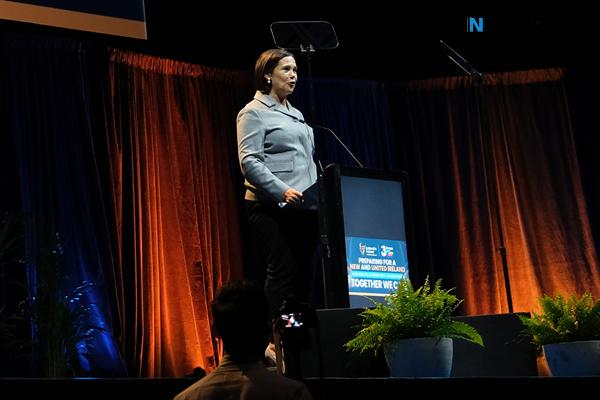
"For if we are aspiring to build our new Ireland as a real home for everyone then that will shape how we deliver healthcare and housing and public services. It will shape how we create good jobs, decent wages, dynamic businesses, and how we ensure that workers and families can live good, secure and prosperous lives. We can achieve big things. Together we can build prosperity. We can end poverty in Ireland. Together, we can make equality real for every person. Together, we can achieve energy independence and use our renewable resources to drive a just transformation to a green clean future. We can do all of this and so much more, but we must do as a nation united not divided."
Speaking about the younger generation she said "I love our people, I love our young people they are great. They are a generation brimming with compassion, solidarity and talent refusing to be held back by the limitations of the past, calling out the inequalities in our society, demanding a better future - and good for them I say, because no one is more deserving of change than our young, more deserving of a nation home. In our young people we have everything that we need to achieve our new Ireland we will not tolerate another generation of forced emigration, no way.
"We want our young people here where they belong. But if you do leave for however long or short, leave knowing that we are determined to build a new Ireland for you to come home to. An Ireland where you have opportunity, an Ireland where you can make it and an Ireland where you can build your future. Friends building a new Ireland as a nation home for all our people isn't beyond us. The title of today's conference is Together We Can. I say Together We Can and together we must. We must go forward, we must unite, we must build our new Ireland because for far too long Ireland's progress was held back by the oppression of second class citizenship and by the politics of them and us and there is no doubt and a matter of historical truth that we have had very different experiences, different perspectives, different traditions, but in the end there is no them, only us. Us who call Ireland home. And Ireland's future will be determined by choices made today, by decisions of this generation.
"So the question before us is clear. And it is this. Do we remain hemmed in by the narrow boundaries of the past by a dogma told to our parents and grandparents, this far and no further, or do we together choose ambition, courage, and the belief that we can build anew. I think we should choose courage. I think we should choose ambition. I think we should choose hope. I think we should choose a united Ireland."
Concluding Ms MCDonald added "Those who say yes, but not now. have long lost sight of the bigger picture. The Irish government is represented here today and rightfully so, because the days of treading water are over. This is the time for leadership a time for energy, a time for action. It's a time for the government to establish a citizen's assembly on Irish unity.
"It's time now to plan for constitutional change, to plan for referendums in accordance with the rule book of the Good Friday Agreement, because our change that is coming must be orderly, democratic, peaceful and planned. Those who seek to guard and defend the status quo have had their day. Their day is gone. Make no mistake.
"Make no mistake friends that history is happening now. The challenge is now, the moment is now. We are all nation builders. And Ireland's future belongs to us all. And we can achieve this new Ireland. We can realize the promise of a better tomorrow and we can do that We will do that in our time. And we my friends will make Ireland our nation a nation home for everybody."
Have a referendum
Joining the platform TD Peadar Toíbin, Aontú said "I think we're on the precipice of enormous significant change in this country. Change that would first of all, fulfill the objectives of generations of Irish people who had justified objections to Irish unity but also change to lift the economic circumstances of everybody in this country.
You can say forever and a day will a referendum pass. The only way to know for sure is to have a referendum, end of story. I would ask establishment, north and south to stop running away from the democratic rights of people north and south to self determine our future through a referendum now.
The north's future direction must lie in the hands of its people
It was left to Actor, Jimmy Nesbitt to conclude the event.
Mr Nesbitt said "I am humbled and delighted to be invited to contribute to this important dialogue on the broad theme of Together We Can and how the people of this island might come to a common understanding of the future relationship of the people here and indeed the relationships between the nations and regions that go to make up the British Isles. I'm also bloody terrified, not least because at this stage of my career I'm probably Northern Ireland's longest serving Police Officer.
"I'm not putting one position over the other but I do consider that an informed debate based on clear evidence needs to happen. It needs to examine what health services, financial modeling, sport and so on would look like in various scenarios."
Mr Nesbitt spoke of his upbringing in Brougshane, Co Antrim and how his father sent him and his sisters to St Louis' Convent in Ballymena to learn piano.
"I think Dad was a bit of a torchbearer without realising it, and I think it was also about sending out a message, even then that there could be integration. That said in my youth I played in a flute band and I marched, but I didn't really think anything of it. Broughshane was by no means at the heart of the troubles. It was very easy to grow up with the troubles just up the road and feel distance from them. So I was brought up as a Protestant, but my key driver was to be an actor and I was supported by this, by my family.
"When I was 19, I moved to England. Now I went very much as a Protestant but the first time I went to drama school there was an automatic assumption that I was pro republicanism. Not because of anything I said or did but because I was being considered Irish for the first time in a sense, and that really made me begin to consider myself as Irish. I think for a lot of Protestants, particularly my generation when we went away It was quite a shock that we were regarded as Irish by others, particularly the English who don't really distinguish between North and South. Playing Ivan Cooper in Bloody Sunday was cathartic for me. It was maybe the first time that I examined the power of my job, and I examined the place I came from, its complex history and the relationship between these islands. The truth about Bloody Sunday was not something I had been aware of. I think, to a certain degree Protestants were taught history with a British perspective and Catholics were taught with an Irish perspective.
The actor continued "But I suppose I grew to understand Northern Ireland better through my work in Northern Ireland. The director of Bloody Sunday Paul Greengrass always used to say that for any Irish actor from the north particularly, the troubles is a responsibility, meaning that at some point, we must engage both artistically and personally. I began to realise what the power of my job could do, but also in a way, why I love where I come from. It's about love and responsibility. One of the best love affairs I've had in my life has been with home. It's incredible in a place where there remains such division that actually people here are so united about loving where they come from. If we can just get hold of that we could really go places. Harnessing this love of home is a key part of my ambition for change and for that change to happen through a fully inclusive, non sectarian conversation about the kind of society Northern Ireland wants to be, regardless of its constitutional status. When I first got involved with the Connected Citizens Initiative, with Conor Houston, Eamon Mullan and the late great Jim Dornan. Jim was passionate about and committed to a shared Ireland and he's a great loss to the debate."
"When I became involved it was out of a sense of frustration, maybe even anger that we were not making the progress that the Good Friday Belfast Agreement promised, the so-called peace dividend. The day I gave an interview to Freya McClemants of the Irish Times a few years ago, I had just presided over a series of graduation ceremonies, young people full of hope for the future. And I talked to those young people. They were saying it rarely comes up in conversation, the differences that plagued my generation and many generations past. I think we really are at an important moment where we can actually begin to escape all that. We're ready to have this debate in the public domain even if at times, it seems our politicians are not. In saying that I'm not a politician, I'm not being critical. Politicians have a challenging role in any context and I admire those who put themselves up for public office. But I believe, I firmly believe that we need to bring this discussion out of the Dail, out of Stormont, out of Whitehall, out of academic fora and into the town halls, the village halls, the church halls the orange halls."
Mr Nesbitt believes that any change must be people led. "Solutions must emerge from a public discussion, the options and the future constitutional governance of the island and its relationships with our friends and the rest of the British Isles and the European Union. I would also include in that discussion, with the Irish diaspora across the world, a debate I don't believe you've ever had. Politicians may point to political mandate giving them the power and responsibility to lead but people can only vote for those on the ballot paper. I believe that it's time to ask wider society outside of the ballot box what way it wants to be governed."
"We need to focus on the full diversity of society on this island and the connections we enjoy north and south as well as east west across these islands. I've added a few strands to these relationships earlier and we should also recognize that we are an increasingly multicultural and multi-ethnic society. I mentioned earlier that the differences that affected our generation and previous generations don't matter to today's young people."
He continued "We're standing at a profund moment here in the history of the islands and those graduates that I mentioned earlier they were all about 21. And they are the very first generation who have the potential that no other generation has had and that is to know a permanent peace and the potential to progress as a society without the constraints of the past. Although my work with Wave Trauma Centre as recently as this week, convinces me that there are issues related to victims that still need to be addressed. I'm thinking particularly of the implications of the proposed Legacy Bill for many of the families of victims and of course of the families of the remaining disappeared."
Mr Nesbitt attended a Hurling match in Croke Park in the summer which made him think how much we miss out on by not engaging with other cultures
"I think there's a real appetite here now to ensure that that peace transitions into economic and cultural and social prosperity across the island. What is stopping that. What is stopping that is unquestionably the governance structures. There is still division in the north and that division is reflected in the nature of our politics and in structures that were essential in bringing about peace but do not I believe lend themselves to progress." he adds
"Of course it's easy for me to say this. I'm someone who lives in England a good bit of the time, I have a degree of success and lived and all that. I'm well outside it but I have never left Ireland ..... It is my home. I hope no one can accuse me of not being committed to Northern Ireland. I fully believed in the roles that I've held as Chancellor of Ulster University, as Patron of Wave Trauma Centre and others. I go back to the fact that there's a five year old wee boy from Broughshane in here who actually loves coming back home, he wants to come back home and he would love the notion of somehow being a very small pebble in a very large wall that actually begins to change who is allowed to be involved in terms of deciding the future of relations between these islands and their peoples, and in making progress. The conversation needs to change. The governance structures in the north aren't working."
Mr Nesbitt believes that many sectors of society should now step up. "The north's future direction indeed the future direction of this island must lie in the hands of its people, not the politicians for now. the health, education, arts sectors, industry, business and sport, they need to step up and become more involved in public life to take responsibility for change, rather than simply bemoaning the status quo or blaming others for the lack of progress. And then when that happens that politics evolve to take forward the emerging crisis."
"In part it is about perspective. I want Northern Ireland to be seen as a progressive society rather than one defined by its past But in order for that to happen, much must changed. The Good Friday Agreement promised that there was going to be a new future for these islands, that there were going to be new relationships built, new institutions. That has not happened. There are many who have found the frequent dormancy of Stormont just so unbearable, unpalatable, embarrasing.
"In the New context, new language is needed and I speak carefully here, I know my audience, those words United Ireland they need to be analyzed because those two words put together carry such a political connotation and a connotation which is rather more about emotion than pragmatism. I think one of the big challenges and actually one of the great opportunities is to start getting away from language that is incendiary and most from my background talk of a United Ireland is difficult, but the conversation is out there. I prefer something like a new union of Ireland where people from the north, particularly those from my traditions would feel that they have their identity that is in no way threatened, that they have an equal voice, that they are part of a society that is progressive, inclusive, diverse. That they have prosperity, that they are not marginalized, and that they can be proud to be from the north of Ireland in a new union of Ireland."