

 Write a comment
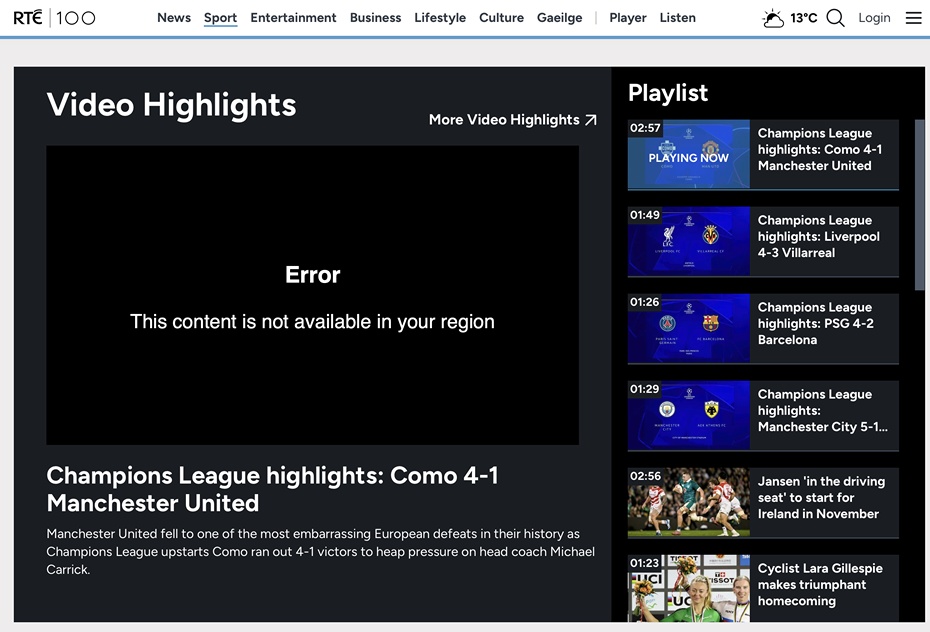
A new OFCOM report has highlighted the ongoing problem of geoblocking of RTÉ and TG4 programmes for viewers in the north. Irish language and sporting content is blocked or restricted on a range of platforms and devices, including children’s shows such as Bluey, Spongebob and Dora, and GAA Beo. Conradh na Gaeilge has welcomed the report and says it is in discussions with TG4 on a permanent solution.

The report was published by OFCOM, the independent British statutory broadcasting regulator, and was requested by the Economy Minister. It recommends that both Governments review the 2010 Memorandum of Understanding on digital television services to assess whether it remains fit for purpose as viewing habits evolve.

Geoblocking has been a long-standing issue, with sporting broadcasts and Irish language content blocked or restricted on both RTÉ and TG4 because of digital and licensing considerations. Numerous programmes are affected, whether viewers are live streaming RTÉ or TG4 or using the online players for on-demand services. Bluey is restricted on RTÉ, while Spongebob and Dora are restricted on TG4 and Cúla4. Irish language sport such as GAA Beo is also affected, along with other live sporting broadcasts and highlights programmes.
Communications Manager with Conradh na Gaeilge, Dr Pádraig Ó Tiarnaigh, said: “Gaels in the north are rightly frustrated and angry when Irish language and sporting programmes are blocked or restricted on this side of the border. If you follow sport, you will know there are numerous live broadcasts and highlights programmes that we cannot access across devices, on some occasions, when teams and competitors themselves are from this part of Ireland.”
He said TG4 does provide for wider access, but that this has not solved the problem. “We recognise that TG4 make provision for an all-Ireland, 32 county license for much of their material. Unfortunately, even then, due to IP restrictions and non-UK licenses, many of those programmes continue to be restricted on various platforms and devices.”
Dr Ó Tiarnaigh said the restrictions are pushing viewers away from Irish language content. “The inevitable result is that people engage less with Irish language content and turn to English-language streaming services due to ease of access and range of unrestricted programmes available. Why would even the most dedicated Irish-speaker spend their time trying to find a solution or work-around to access Bluey in Irish when they can get it immediately through English on BBC iPlayer?”
He acknowledged the competing issues involved, from technical IP issues to commercial licensing problems, but said “the effect of those issues combined is that Irish speakers in the north are left with a lesser service than our counterparts south of the border.” He added that this is damaging to the ongoing revival of Irish.
Dr Ó Tiarnaigh also pointed to the Good Friday Agreement. “We must remind both the Irish and the British Governments that they are co-guarantors of the Good Friday Agreement and in that agreement they have jointly promised to ‘take resolute action’ to promote Irish, specifically to “explore urgently with the relevant British authorities, and in co-operation with the Irish broadcasting authorities, the scope for achieving more widespread availability of Teilifís na Gaeilge [TG4]” in the north. In that regard, they are failing to uphold the Good Friday Agreement.”
Conradh na Gaeilge is currently engaging with TG4 on the issue. Dr Ó Tiarnaigh said the organisation looks forward to finding a permanent solution that gives northern Gaels equal access to the full library of content on TG4, Cúla4 and RTÉ.