
 Write a comment
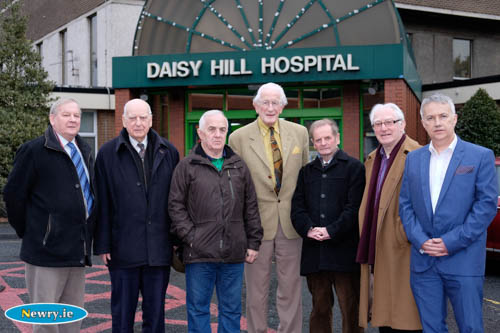
A group campaigning to retain and enhance services at Daisy Hill Hospital are encouraging people to attend a public meeting next week to support Daisy Hill’s stroke unit and A&E department.


Daisy Hill Hospital Action Group would like to see as many locals as possible at the meeting on Monday coming, 16th January 2017. It starts at 7pm and will take place in the Newry Conference and Banqueting Centre, The Mall, Newry.
The meeting will provide a great opportunity for the public once again to show their support for the retention of Daisy Hill Hospital’s stroke Unit and A&E department. The meeting is being organised by the Department of Health to consult people on its future plans for the delivery of health care in the North of Ireland. The recently published Bengoa study has set out criteria to measure the future provision of medical services in the North and this will be the topic of the consultation at the public meeting.
The Chairperson of the Daisy Hill Hospital Action Group, Mr. Francis Gallagher, said “We would urge the public to attend this meeting and discuss their views about our future health care. It is crucial that people let their opinions be known other wise we could lose our excellent stroke unit and Daisy Hill’s acute status.”
“Quite some time ago the Department of Health said Daisy Hill’s Stroke Unit would close but it is still at Newry because thousands of local people had enough confidence to support a better future. The Bengoa report, while having many good points such as more support for primary care, represents a new threat to acute services at Newry but this too can be defeated.”
“ It is recommended in page 73 of the Bengoa study that Daisy Hill’s excellent stroke unit should be centralised to Craigavon but in terms of the clinical evidence, Daisy Hill’s stroke care has exceptionally positive outcomes for patients.”
“It is important to go by the clinical evidence in health care provision and we would argue that the evidence backs up the case for the stroke unit and A&E to stay at Daisy Hill. Medical professionals advise us that If someone unfortunately takes a stroke they will need to have a scan and maybe a ‘clot busting’ injection very quickly before a clot becomes ‘well organised’. How will this early intervention be provided if valuable time is wasted by taking a patient on poor roads to Craigavon.”
“The Bengoa study states at some length that people are getting older. This would be celebrated in any healthy democracy but here it is used as an excuse to explain the failings in the health service. How many families have not had to advocate for a critically ill mother or father because of staff shortages? It is unfair for many staff to have to try and cope with an excessive workload. This can also be a very upsetting experience for patients and families to be put in this situation”.
“We accept radical change is needed in health care but it needs to be progressive. We have referenced much material from medical research that shows over 80% off all acute medical care can be provided in the well resourced acute hospital with the super specialist centres needed for the remaining 20%. This principle of subsidiarity in health care, where the maximum amount of health care is empowered to the lowest grassroots level, is a worthy vision and one that government here should be working towards.”