 Write a comment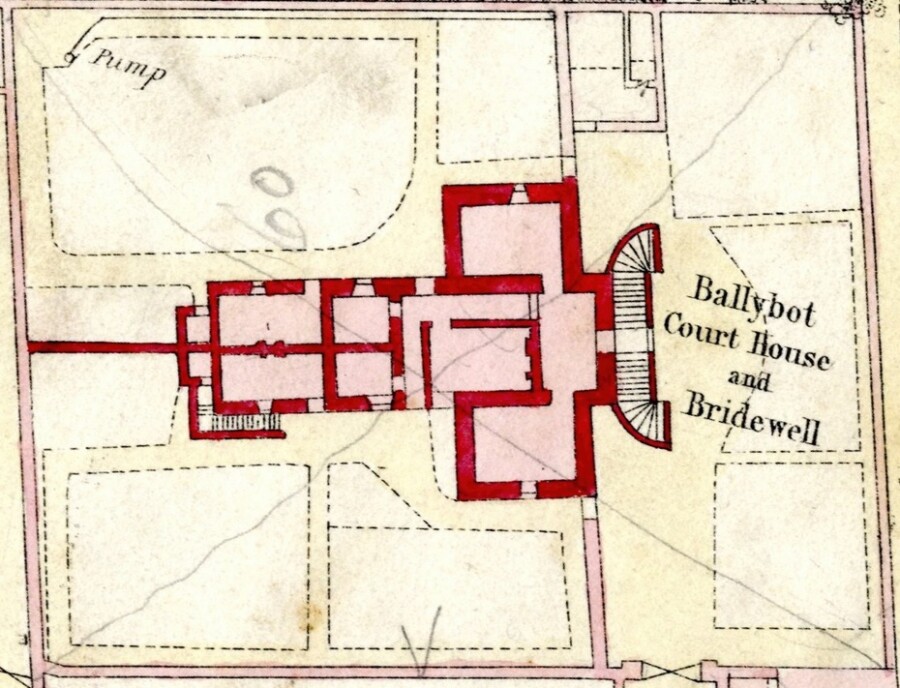
Built in 1797, Ballybot Bridewell and Courthouse was situated on the north side of Kiln Street. It was a cruciform building with a sessions court on the first floor and gaoler’s accommodation and cells for twelve prisoners, on the ground floor, although occasionally over thirty prisoners were held there. An 1836 report into the state of prisons stated,
‘This is a most miserable bridewell, and by no means well kept; it is most strongly recommended to the Grand Jury to build a suitable prison in this very important and distant situation.’
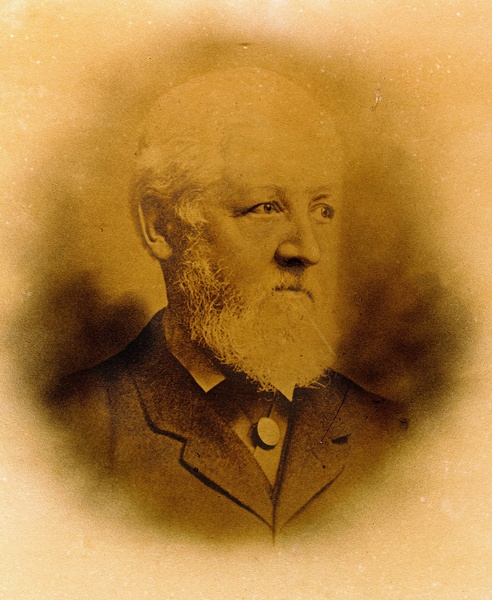
In December 1844 inspector general James Palmer described it as, ‘…deficient in accommodation, there being only two large cells; there are also two dayrooms and two yards; but the whole wants repair, and four more cells at least should be erected.’
By 1866 the local inspector Mr. J. McKinstry reported that having paid visits to several bridewells, that Ballybot was much improved. It was inspected again in 1873 and was found in a most satisfactory state regarding its sanitary condition. During its existence it had various Bridewell Keepers or Governors; they included John Thompson, George Guy, James Craig, and John Bourke.
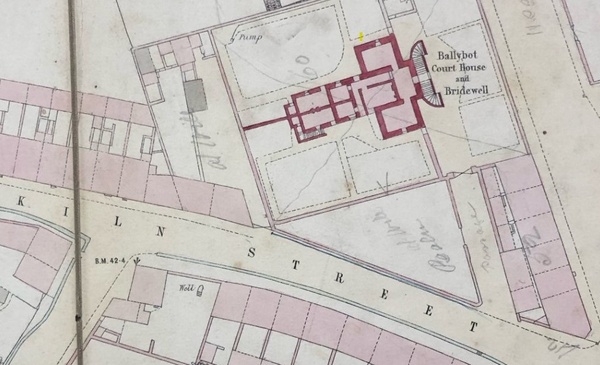
In 1877 there were major reforms in the prison system in Britain and Ireland with the introduction of the Prison Act, which sought to centralise the running of prisons. New powers were delegated to a Board of Prison Commissioners and Ballybot Bridewell was listed along with other bridewells to be discontinued and no longer used after 12th August 1878.
The building’s other executive function as a courthouse remained. The first-floor sessions court was 46 feet by 19 feet with a jury room on each side and a room for the use of the barrister at the end. Some of the magistrates that appeared in Ballybot were amongst the large gentry and merchant families of the area, and included amongst others, Denis Maguire, Meredith Chambre, William Wann, James Johnston, Colonel James Caulfield M.P., Colonel Maxwell Close, Roger Hall, William N. Thompson, Major Henry Waring, Isaac Corry, John Henry Loftie, Bartholomew Warburton and M. Singleton.
In 1865 the County Surveyor applied for £1,000 for improvements to the courthouse, a most considerable sum at the time. The application was certified by a Grand Jury and would be levied in two instalments. However, the discontinuation of the Ballybot Bridewell after 1878 reduced the significance of the court. In 1879 criminal cases were ordered to be removed to Armagh Courthouse.
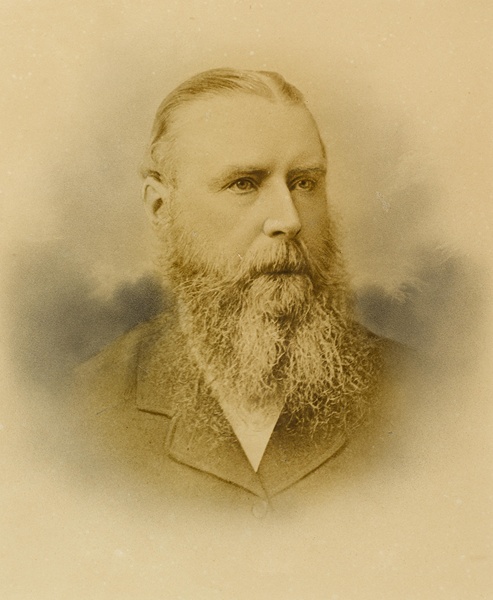
Despite a further application for monies in 1892, raised by a Mr. Dorman for the sum of £220 for repairs, to include a new approach, at the Armagh Grand Jury Presentments, a Mr. Willis stated that the court was in a dilapidated condition and that the County Court Judge was complaining about it every quarter session.
In 1898 the building was transferred to Down County Council under such conditions and restrictions that it was found to be of no use. In 1900 Ballybot petty sessions were moved to the courthouse at Trevor Hill. In a meeting of the Down County Council in January 1901, it was decided to hand over the Council’s interest in the building to the Earl of Kilmorey. At the end of 1903 the building had been converted into two dwelling houses.
The Museum is currently offering free tours of the main exhibition galleries on Wednesdays at 2.00 pm. These must be booked in advance by calling our Education Officer at 0330 137 4422.
Newry and Mourne Museum is open Tuesday – Saturday 10.00 am – 4.30 pm. Please call 0330 137 4422 or email museums@nmandd.org for further information.
Visit their website at www.visitmournemountains.co.uk/museums