 Write a comment
After the evacuation from Dunkirk in 1940, Allied forces worked towards landing a force in German-occupied north-west Europe for four years. On the 6th June 1944, D-Day, a combined naval, air and land assault, codenamed Operation Overlord began, landing troops on five beaches in Normandy, beginning the process through which victory would be achieved almost a year later.
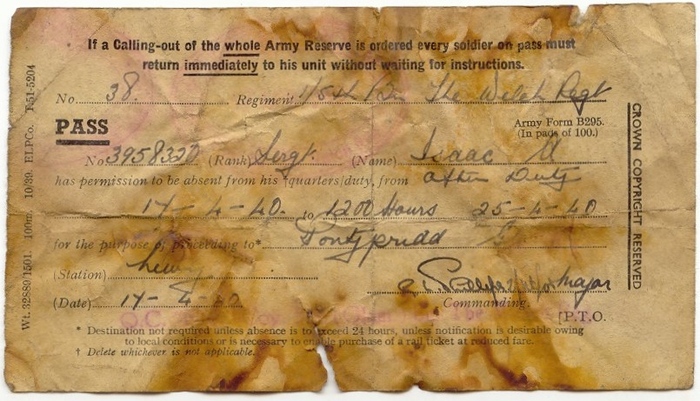
British forces had been stationed in the local area since the beginning of the war to maintain internal security. After the evacuation of Dunkirk their function changed to guarding against German invasion through the south of Ireland. With the Japanese attack on Pearl Harbor in December 1941, the United States of America formally entered the war. By January 1942, American troops had officially arrived in Belfast. Land at Greencastle, near Kilkeel had already been requisitioned on the 9th December 1941 by the British Air Ministry as a site for a new airfield. Around 800 people were employed in the construction of this new aerodrome which opened on the 30th July 1942 as RAF Greencastle. In early August 1942 it was transferred to the United States Army Air Force (USAAF) and was redesignated as AAF Station 237. It would be the largest airfield used by the Americans in Northern Ireland.
Over the next year the aerodrome proved invaluable as a stopover facility for aircraft and became home to USAAF units engaged in maintenance, training and flying operations. In the immediate months preceding D-Day the airfield was visited by General Patton in March 1944 before he inspected the 5th Infantry Division in the Mournes. Local tradition has it that female nurses were asked to leave the platform, so they would not hear his colourful language. Additionally, in May 1944, Supreme Allied Commander, General Dwight D. Eisenhower was flown to the airfield on a B-17 and inspected the 10th US Infantry Division and their artillery.
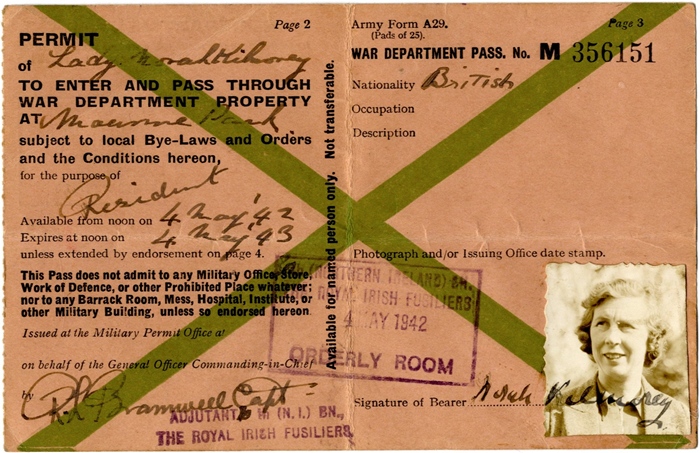
Several large houses and estates in the area were requisitioned to accommodate British and American troops. Camps, comprising of Nissen huts, would typically be set up in the grounds of the estate for the troops while the officers resided in the main house. The owners were usually allowed to remain in residence but their movements around their own property were sometimes severely restricted. Requisitioned houses and estates included Mourne Park, near Kilkeel, Narrow Water Castle, Warrenpoint, and Mount Caulfield, near Bessbrook. American soldiers were also stationed at Drumbanagher and Dromantine.
In Newry, soldiers were billeted in Drumalane Mill with another large contingent at Ashgrove. A Red Cross Club canteen catering for American troops was opened in the YMCI at 81 Hill Street. The smartly dressed American soldiers brought excitement and glamour to the town. Their ‘PX’ or army store was like an Aladdin’s cave to local people, who were not allowed access. Tobacco, cigarettes, alcohol, women’s stockings and a host of other items were available to the American soldiers. Families who hosted soldiers in their homes would have received gifts such as sweets and other rationed items. American officers socialised with local people throughout the area and some women became GI brides.
A number of British regiments were stationed locally. Narrow Water Castle was requisitioned for the Cheshire Regiment, followed by the Northumberland Fusiliers and then the US Army, with most of the castle, the farm and land given over to the troops. A battalion of the Welch Regiment were stationed in Newry and Bessbrook and carried out training on Slieve Gullion and the Mourne Mountains. In Newry they would parade to Saint Mary’s Church of Ireland for Sunday service with the regimental goat. Some of these soldiers married local women and settled in the area, like Cyril Wiltshire, originally from Wales, who married and lived in Castle Street in Newry. He was killed on 21st July 1944 when his battalion came under heavy attack from German forces in Normandy.
The withdrawal of American and British soldiers billeted in the local area began in the lead up to D-Day as troops moved to England to begin final preparations. Many were engaged in the Normandy campaign. Remnants of their presence can still be found on the estates that were requisitioned and the relationships formed between soldiers and local families have created links with the area that still endure today.
Uniforms from the Second World War belonging to Private First Class James Quinn of the US Army’s 563rd Motor Ambulance Company and Major Gerald Reside of the 4th (Ulster) Light Anti-Aircraft Regiment, Royal Artillery, who both took part in the Normandy campaign are currently on display in Newry and Mourne Museum.
The Museum is currently offering free tours of the main exhibition galleries on Wednesdays at 2.00 pm. These must be booked in advance by calling their Education Officer at 0330 137 4422.
Newry and Mourne Museum is open Tuesday – Saturday 10.00 am – 4.30 pm. Please call 0330 137 4422 or email museums@nmandd.org for further information.
Visit their website at www.visitmournemountains.co.uk