 Write a comment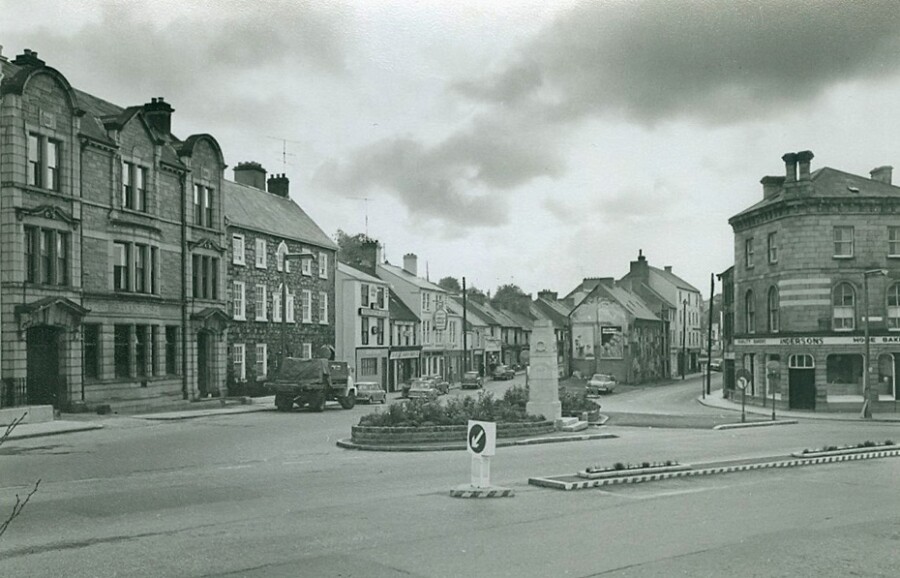
At the eleventh hour on the eleventh day of the eleventh month in 1918, the Armistice, an agreement to end the fighting of the First World War, came into effect. It is still commemorated today and takes many different forms, from personal to public. However, on Remembrance Sunday the focus shifts towards public observance at the war memorials in the district and further afield.

Newry War Memorial was designed by Major Gerald Wilson Reside, a simple granite cenotaph inscribed “To Our Glorious Dead”. It was not erected until 1938, the year before the outbreak of the Second World War. Originally located at Trevor Hill it was later moved to its present site by the Crimean cannon on Bank Parade. A decision influenced by financial constraints and concerns about omissions meant that no names were included on the memorial. Newry Urban District Council began work on a Roll of Honour for Newry in 1914. The RIC were despatched around the town, going from street to street to gather information. The intention was to add further names during the course of the war. However, the initial list, presented in April 1915 at an event in the Town Hall remained unfinished. It is now part of Newry & Mourne Museum’s collection.

Bessbrook War Memorial is located in the middle of the village. An obelisk constructed of marble and granite was unveiled in 1934 by the Earl of Kilmory. It is inscribed with the names of 84 men from the First World War. A stark testimony to the impact of war on this small community. In the grounds of Mourne Presbyterian Church, Kilkeel War Memorial was unveiled in 1923. It consists of a large plinth base surmounted by the figure of a soldier and the front and sides are inscribed with the congregational roll of honour.
The fallen are commemorated in various cemeteries around the world. In an effort to ensure that everyone was treated equally, the Commonwealth War Graves Commission (CWGC) marked their final resting places with uniform headstones made of Portland Stone, with no distinction made on account of rank, race or creed. Personal inscriptions were paid for by family. The names of those who died and were never recovered are included in various memorials, such a Thomas Lundy, of the Royal Dublin Fusiliers, who was killed on 29 June 1915 and whose name is carved on the memorial at Twelve-Tree Copse Cemetery in Gallipoli.
Local CWGC headstones can also be found in graveyards around the district, including those in St. Mary's Old Chapel Cemetery and St. Patrick's Church of Ireland, Newry, where the grave of an unknown soldier, believed to have been recovered from the wreck of the SS Conamara in November 1916, can be found. It is simply inscribed “A Soldier of the Great War, Known unto God”.
Churches, schools, businesses and other organisations commemorate members, former pupils and colleagues. St. Mary’s Church of Ireland features stained glass windows dedicated to those who served, while Newry Intermediate School, now Newry High School, erected a memorial tablet. The Post Office, the Great Northern Railway Company and various sports clubs also remembered their employees and members in this way.
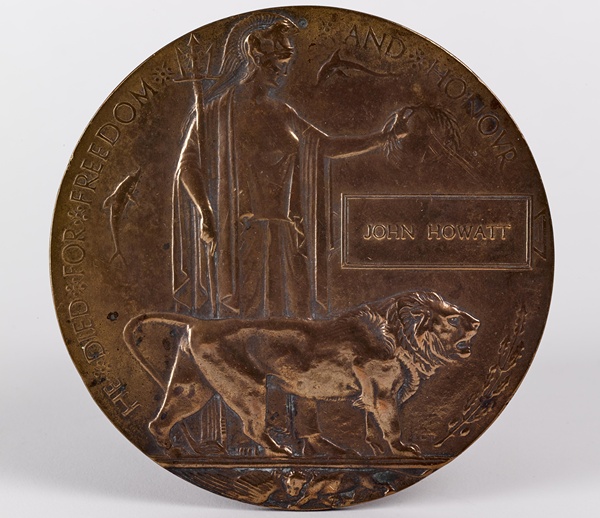
The personal loss felt by bereaved families was encapsulated in the small bronze memorial plaques, also known as the "Dead Man's Penny" which were issued to the families of the deceased. These were presented along with a commemorative scroll. On display in Newry and Mourne Museum is death penny awarded to Sapper John Howatt from Meigh, who died on 14 October 1918 and is buried in Dadizeele, Belgium.
While services on Remembrance Sunday mainly focus on public memorials, many smaller tributes can be found throughout the local area.
A Guide to Commonwealth War Graves and Newry’s Roll of Honour can be found online at www.issuu.com/visitmourne
The Museum is currently offering free tours of the main exhibition galleries on Wednesdays at 2.00 pm. These must be booked in advance by calling our Education Officer at 0330 137 4422.
Newry and Mourne Museum is open Tuesday – Saturday 10.00 am – 4.30 pm. Please call 0330 137 4422 or email museums@nmandd.org for further information.
Visit their website at www.visitmournemountains.co.uk