 Write a comment
One of the strengths and unique facets of the Reside Collection at Newry and Mourne Museum is the estates records which give a valuable insight into the social and economic history of the Newry and Mourne area in the 18th, 19th and 20th centuries. One document of particular importance in the Collection is a report completed in 1860 on the management and profitability of the estates of Francis Jack Needham (1787 – 1880), 2nd Earl of Kilmorey in Newry and Mourne. The report was written by Lord Kilmorey’s first cousin, Octavius Newry Knox (1836 – 1923) and comprises a description of the estates along with an assessment of their management and a rental listing the tenants in each townland, their rents and the extent and terms of their tenancies.


The section which deals with the town of Newry provides a snapshot of Newry about ten years after the end of the Great Famine. It describes the buildings, including schools, in the streets in the part of the town owned by the Earl of Kilmorey, and explores ideas for developing the economic potential of Newry and its environs.
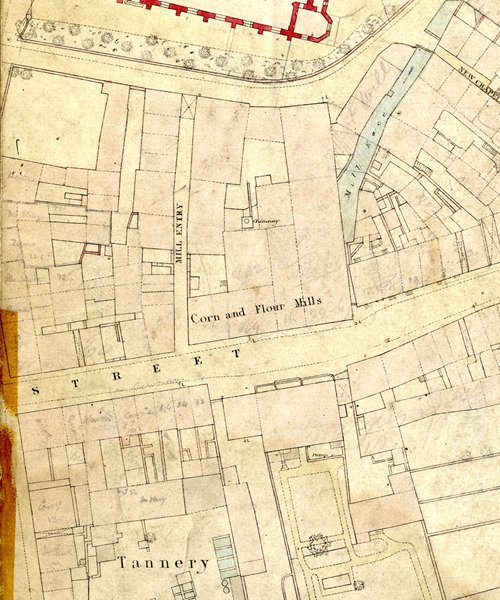
Houses in Needham Street are described as being of “rubble, dashed and slated and in fair repair” while, in Queen Street, a house had been recently sold to the Newry and Warrenpoint Railway Company for demolition, evidently to make way for development of the railway line. The same street contained a stable with store above which was “in good repair” and the buildings adjoining the Buttercrane were also in a similar state of repair. However, many of the sheds in the area were unlet. Houses in High Street were equipped with an outbuilding and small garden but were “slightly built and only in moderate repair.”

An insight into the industrial potential of the Newry estate is provided by the comments on a water-powered corn mill in Mill Street. Although the large stone building which housed the mill was in good condition and was recently extended, it had been vacant since November 1859 with no apparent prospect of it being let. Significant investment had been injected into the development of the mill and Knox recommends that advertisements should be placed in newspapers not only in Newry but also in Glasgow, Liverpool and other large towns which have “accessibility” to Newry. Such a strategy obviously indicates the trading and commercial network of which Newry (and the Kilmorey estate) was a part in the mid-19th century. This network was undergirded by the links between Newry Port and other ports in the Irish Sea region.
Knox’s report also includes information on the state of schoolhouses in Newry. The school in Upper Commons was “of stone, rough cast and slated: in good repair but the eaves to be spouted.” The situation was less happy at Ballybot School where “the whole place is in a most discreditable state” with part of the school being “uninhabitable from the dampness caused by want of proper drainage and spouting.” Knox advised the trustees of the Kimorey estate only to provide a grant for repair of the buildings if the school committee “pledge themselves for the future repair and maintenance of the building.”
The report goes on to recommend the re-planting of Fathom Wood, which had been cut down seven years previously and better management of the mixed plantations in Upper and Lower Commons. It was envisaged that these measures, which were also recommended for plantations on the Mourne estate, would raise a considerable sum of money. Comments were also made on the good stone from a granite quarry in Ballynacraig.
Although brief, Octavius Knox’s report, together with the accompanying rental, provides a very useful insight into Newry and south Down in the years after the Great Famine and allows historians to assess its social and economic impact in the area. The report can also be used in conjunction with other sources in the Museum’s Reside Collection such as Encumbered Estate Rentals which provide more detailed information on individual estates.
The Museum is currently offering free tours of the exhibition galleries on Wednesdays and Thursdays at 2.00 pm. These must be booked in advance by calling our Education Officer at 0330 137 4422.
Newry and Mourne Museum is open Tuesday – Saturday 10.00 am – 4.30 pm. Please call 0330 137 4422 or email museums@nmandd.org for further information.
Please visit our website at www.visitmournemountains.co.uk