 Write a comment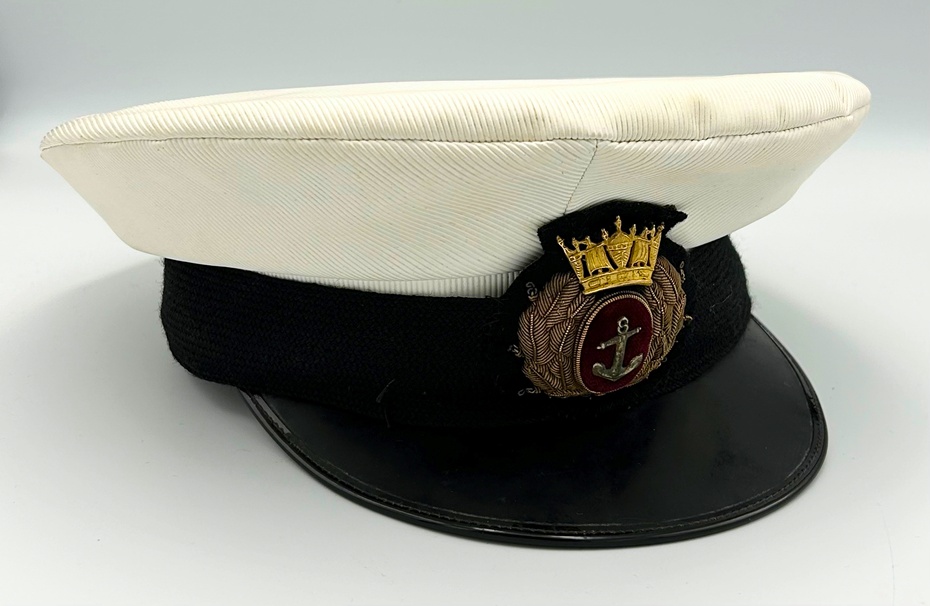
In 1954, Christian Dior famously declared, “Without hats there is no civilisation.” It is a bold claim but one that feels surprisingly fitting when we look back through history. Hats have long been more than mere fashion: they have signalled status, offered protection, defined professions and reflected the societies that wore them.


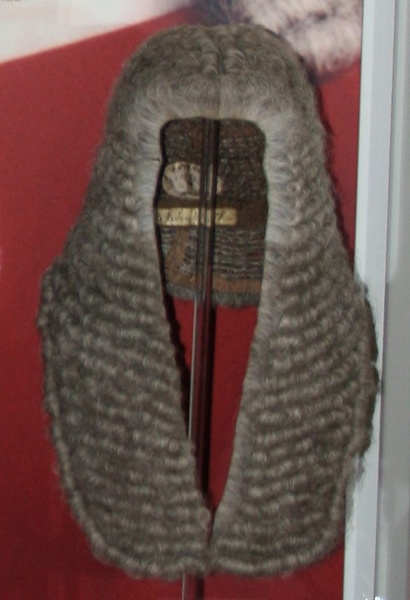
the early 20th century. The wigs, which are made from
horsehair, have their own metal carrying case with an
internal stand on which they are supported upright.
Newry and Mourne Museum Collection
This week, we turn our attention to some of the fascinating stories behind the hats and headwear in Newry & Mourne Museum’s collection, revealing how these everyday items provide a window into the lives of those who came before us.

Among the most enduring styles is the humble cap. Today it may seem casual and commonplace, but its origins are rooted in law and industry. The Cappers Act of 1571 required most men over the age of six to wear woollen caps on Sundays and holidays. The aim was simple: to boost the domestic wool trade. Failure to comply came with a fine - an early reminder that fashion has often been shaped by economics as much as taste. Although the law was repealed in 1597, the cap remained closely associated with working people for centuries.
Over time, the cap evolved beyond its statutory beginnings to become part of official uniforms. One example in the museum’s collection is the peaked cap belonging to Captain John McParland, a merchant navy captain. His headwear reflects a significant change in maritime history. The British Mercantile Marine Uniform Act of 1919 introduced standardised uniforms following the execution of Captain Charles Fryatt during the First World War. Fryatt had attempted to defend his ship from a German U-boat but, lacking official uniform status, was treated as a civilian combatant. The introduction of uniform, including caps, was intended to prevent such tragedies from happening again.
Another hat with practical beginnings is the bowler. Designed in 1849 by London hat-makers Thomas and William Bowler, it was originally commissioned to protect gamekeepers riding through wooded estates. Their previous headgear - tall top hats - were easily knocked off by low branches and quickly damaged. The solution was a close-fitting, hard-wearing design that soon proved its worth. What began as practical country wear soon crossed class boundaries. The bowler hat’s journey did not stop in Britain. By the late 19th and early 20th centuries, it had firmly established itself across the Atlantic, where it was commonly known as the “derby.” In the United States, the bowler became one of the most popular hats of the period, favoured by businessmen, railroad workers, and city officials alike. Its durability made it ideal for the bustling, fast-paced environments of American cities and the expanding frontier. Unlike in Britain, where it was closely associated with the middle class and authority, in America the bowler carried a broader appeal, worn by men across social ranks and professions. Figures such as lawmen, financiers and even outlaws were often depicted wearing bowlers, embedding the hat within the visual identity of the American West and urban life alike.
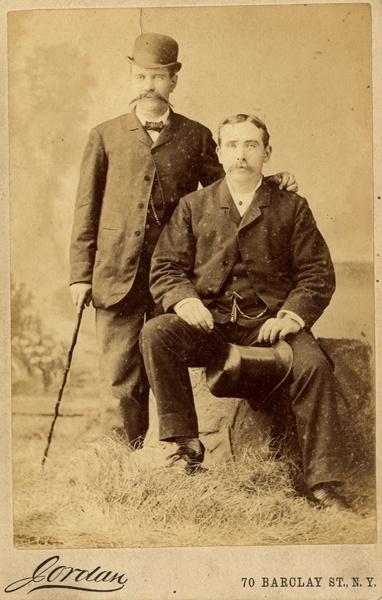
one seated with a top hat, one standing with a bowler
hat and cane, in the studio of Jordan, New York.
Taken in the late 19th century, this highlights the
popularity of the bowler hat. Newry and Mourne
Museum Collection
Beyond hats and caps, the museum’s collection also highlights headpieces tied to professional identity. Among these is the judicial wig belonging to the Right Honourable Turlough O’Donnell QC, a former Lord Justice of Appeal. Courts in Britain and Ireland adopted wigs in the late 17th century, with elaborate full-bottomed wigs once the norm in criminal trials. Though such styles fell out of everyday use by the 19th century, they continue to survive today as part of ceremonial dress.
Judicial wigs, meticulously crafted and costly, are rarely discarded. Instead, they are passed from one legal figure to another, carrying with them a quiet legacy. O’Donnell’s wig itself once belonged to Sir Anthony Babington, Attorney General for Northern Ireland from 1925 to 1937, before he too became a Lord Justice of Appeal linking generations of legal history through a single piece of headwear.
From mandated wool caps to protective riding hats and symbols of professional authority, the items in the collection reveal how something as simple as a hat can tell stories of law, conflict, class and tradition. At Newry and Mourne Museum, these stories are brought back into focus inviting visitors to see familiar objects in a whole new light.
If you have information about this incident or can help with the investigation please call police at Ardmore on the non-emergency number 101, quoting reference number:
You can also submit a report online using the non-emergency reporting form via www.psni.police.uk or contact Crimestoppers anonymously on 0800 555 111 or online at crimestoppers-uk.or
The Museum is currently offering free tours of the main exhibition galleries on Wednesdays at 2.00 pm. These must be booked in advance by calling our Education Officer at 0330 137 4422.
Newry and Mourne Museum is open Tuesday – Saturday 10.00 am – 4.30 pm. Please call 0330 137 4422 or email museums@nmandd.org for further information.
Please visit the Museum website at www.visitmournegullionstrangford.com