Write a comment
Flour milling developed in Down during the 1700s with bounties paid by the Irish Parliament after 1759. The dry climate in counties Down and Armagh proved to be advantageous in growing grain. With the combination of the climate and the growing population, the industry continued to thrive so that by 1835, flour, meal and oats were the most important exports of Newry, amounting to 24,867 tons. Most of this was exported to Liverpool and Manchester. By 1891 there were eighty-nine mills in county Down, sixty-nine powered by water, five by steam, nine by a combination of both and six mills powered by windmills. By 1900, Down was responsible for nearly a fifth of the total Irish crop of wheat.


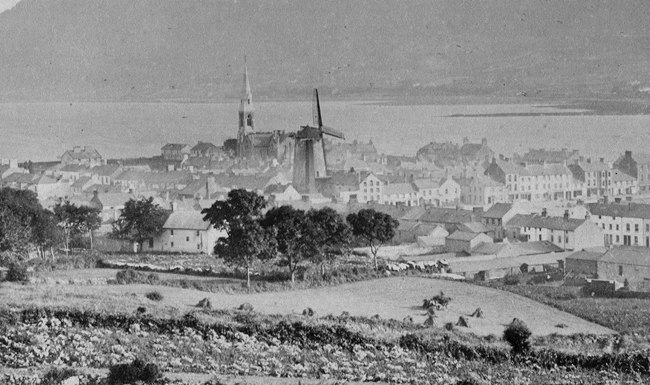
Due to the extensive grain growing, Down also saw other industries such as brewery and distilling begin to flourish with Newry building two large distilleries and two breweries within that time. In Warrenpoint Robert Turner built a large windmill in the centre of the town in 1802 which included a brewery, malt house, bakery and stores.
The mills were originally designed as Norse or horizontal mills. However, these were no longer operating by the mid-19th century. The 20th century saw the addition of kilns to mills to dry the grain. Other changes to the milling industry saw the introduction of the Vitruvian water wheel and decline of binding tenants to grind their corn at their landlord’s mill. Now the practice consisted of a miller renting a mill and reimbursing himself with a percentage of the ‘mouter’.
The declining population and the improved transport are believed to have a been a factor in the reduction in the industry. The import of American grain may have also been an issue as by the middle of the 20th century, an estimated ten corn mills were operating in Northern Ireland. One such mill was the former corn mill near the Kilkeel road in Hilltown. Belonging to Patrick O’Hagan in 1838, the mill was refurbished in the mid-1800s before it was owned by John Martin. In 1922, the mill passed into the ownership of George Mussen and worked until at least 1929. After closing it served as a vehicle repair workshop.
A mill which experienced a boom during the First World War was the mill in Mayobridge. Operating as a corn and flax mill, both became disused around 1892, although the corn mill seems to have been put back to work around 1915, during World War I. After being used at a later date, probably during World War II, it has now fallen into disrepair.
One of the most well-known corn mills in the area is the Annalong Corn Mill which was believed to have been erected in the early 1800s, superseding a corn mill located a short distance upstream in the same area. A kiln and store were added before 1859. The mill was believed to have been refurbished in the mid-19th century to include three pairs of millstone as opposed to the two that were noted in 1835. The steam engine (and associated engine house) was installed in the 1890s as an auxiliary drive and, from 1901, the river was partly diverted at the Annalong Weir, Dunnywater, to supply the Mourne Conduit to Belfast. This engine was superseded around 1930 by a Marshall engine. The mill stopped working around the mid-1960s and was believed to be one of the last working watermills.
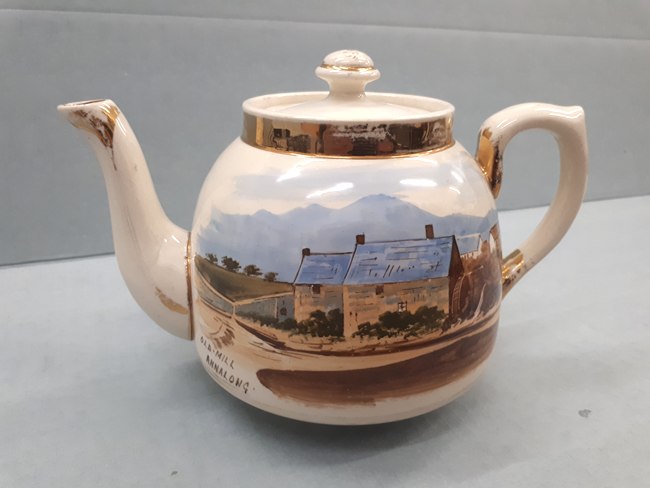
The mill was purchased in 1982 by the then Newry and Mourne District Council and restoration commenced the following year. This involved re-roofing all the buildings, re-erecting the collapsed chimney, inserting new floors, doors and windows, plastering the walls and replicating the smaller items of equipment. Where possible, the original materials and dimensions were maintained. The Council re-opened the complex as a tourist and educational attraction in 1985. The Mill was the winner of a Civic Trust award in 1986.
Newry and Mourne Museum is currently offering free tours of the exhibition galleries on Wednesdays and Thursdays at 11.00 am. These must be booked in advance by calling our Education Officer at 0330 137 4422.
The Museum is open Tuesday – Saturday 10.00 am – 4.30 pm. Please call 0330 137 4422 or email museum@nmandd.org for further information.