Write a comment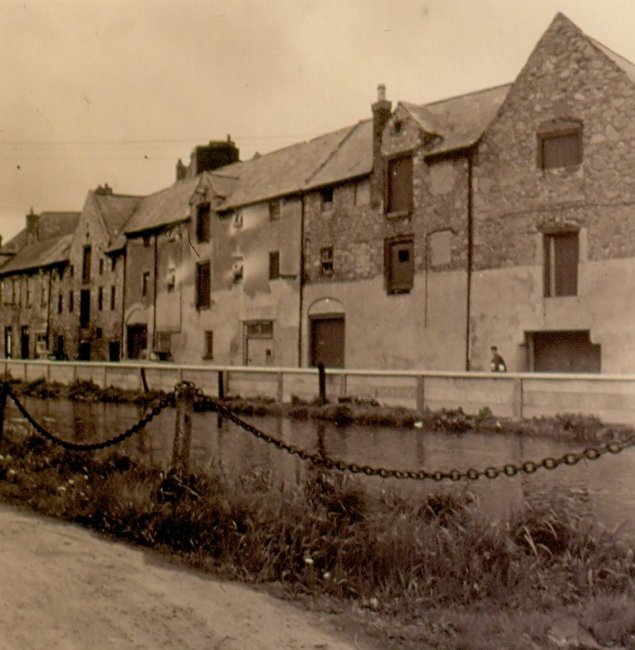
Newry Canal and Quays were vital to the development of the town’s mercantile character in the 18th and 19th centuries. Boat Street, Quay Street and Custom House Avenue are the site of Newry’s old port and the original point of entry into the Canal. A sign of Newry’s increasing prosperity was the transfer of the Customs House from Carlingford to this site in 1726. The Newry General Directory in 1820 refers to the Old Custom House as a very good building, situated on the river, opposite to what was formerly the lowest lock of the Canal. In 1756 a number of the local traders and merchants paid five shillings to Robert Needham to gain rights to the Custom House and quay of Newry, including James McCamon, William Ogle, James Moore, Robert Scott and John Scott.

By the mid-18th century a new commercial centre was being laid out on the east side of the Canal and River on reclaimed land called the Low Ground, now Hill Street. New Streets and houses were being built on ground formerly flooded by the tide. By 1800 a bank had been built up between the Clanrye River and the Canal, what we now know as Middle Bank. In later years this spot (now a carpark) would become home to Carvill’s shipyard, where various ships including the schooner, the Mary Anne, were built. Wealthy merchants built dwellings and storehouses on part of the new Canal Quay (now named Merchant’s Quay). Some of the more prominent merchants who had property in this area include Denis Caulfield, Samuel Smith, Samuel Glenny, Denis Maguire and Patrick McParlan. The prominent building opposite Dunnes Home Stores at the back of Merchant’s Quay appears to have been a Spade Mill run by Francis Carvill in the 1860’s or possibly even earlier.

A map drawn by Matthew Wren in 1761, now on display in Newry and Mourne Museum, shows how Sugar Island and Canal Street were becoming a major commercial area. The streets clearly take their name from the lucrative trade of importing sugar from the West Indies. An advertisement in the Dublin Evening Post in August 1792, states that John Scott hoped to lease out the Sugar House which is stated as fronting the canal, measuring 122 feet [presumably across] and 92 feet from front to rear. The same advertisement refers to the area as being the most ‘improving’ part of town. Such improvements would not have been possible only for the increasing trade being catered for by the Basin Quay or the ‘New Basin’ as on Wren’s map, where ships that had already unloaded, turned around before heading back down the Canal and out to sea.

By the 1820’s various merchants including Henry & Reid, and Swanzy and Wilson were operating in Sugar House Quay. Thomas Biddell Swanzy, a merchant, by then was in ownership of the Sugar House. Francis Carvill and John Richie had stores in and around 2-3 Sugar House Quay. In 1836 the store was two storeys high, and in 1873 it was rebuilt with four storeys by John Kidd Todd who acquired it in 1870. The stores held such goods as Galway Kelp, Puncheons of Old Malt & Corn Whiskey, as well as flaxseed and clover seed.

Next week’s article with at the development of businesses linked to Newry Canal in the 19th century.
The Museum is currently offering free tours of the exhibition galleries on Wednesdays and Thursdays at 11.00 am. These must be booked in advance by calling our Education Officer at 0330 137 4422.
Newry and Mourne Museum is open Tuesday – Saturday 10.00 am – 4.30 pm. Please call 0330 137 4422 or email museum@nmandd.org for further information.