 Write a comment
Newry has a long history of firefighting. One of the earliest records dates to 1737 when Richard Needham gifted the town of Newry a fire engine.

Until 1877, firefighting was carried out by Insurance Fire Brigades which only fought fires in buildings which had subscribed to a private company. If a building caught fire, it would only be put out if it posed a risk to an insured building. The insurance company brigades consisted of a few men with a manual pump, some lengths of hose and a nozzle. Members of the public were often drafted in on the spot to help in exchange for a beer allowance.

As Newry was a garrison town, the army, based at Linenhall Square, also has their own fire brigade who would be called out to assist the Insurance Brigades.
The modern fire service as we know it began in 1877 when Newry Volunteer Fire Brigade was formed by a group of businessmen for the protection of the town. Mr R F Maginnis was appointed Captain and Mr A Mc Clelland and Mr A Scott as 1st Officers. The town commissioners funded 12 volunteers, 6 paid men with a manual pump, a hose cart, ladder and a fire escape. The equipment was stored at a fire house on The Mall.
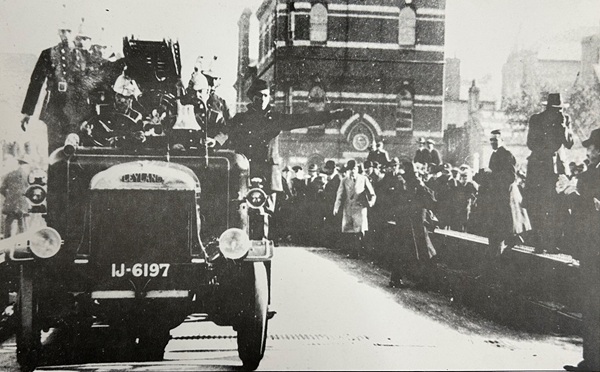
In 1910 a steam horn was fitted to the gas works to mobilise firemen. However, it was quickly replaced by call out boys as the noise caused problems for residents of Chapel Street – it was so loud that an elderly lady died of a heart attack. In 1927 an electric siren was placed on the roof of the town hall.
That same year the fire brigade tackled their biggest fire when a 6-storey flour mill caught fire on Hill Street, the fire spread and engulfed shops and the printworks of the Newry Reporter. Firefighters worked from the roof of Newry Cathedral to extinguish the blaze and tragically Fireman Fegan lost his life.
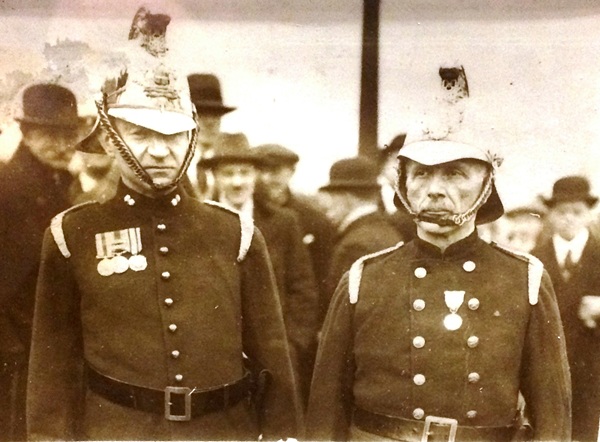
In 1930, James Heather, Hon Captain of the Newry Fire Brigade was the first civilian to be awarded the Kings Police and Fire medal in honour of his “39 years exemplary service distinguished by special merit and ability”. He wore his Newry Fire Service Uniform at the ceremony.
Newry Sub officer and honorary “fire chief of Newry”. Jackie McClelland. was awarded a British Empire Medal in 1972, "for his courage, leadership, and devotion to duty." His son John also served as a fire fighter in Newry and in 1996 became Chief Fire Officer of Northern Ireland.
In the 1960s the Fire Brigade moved to a new station on Cecil Street. As civil unrest increased the fire fighters adapted new tactics for firefighting during riots. Barricades were erected around the town and many decided to stay at the station to be available in an emergency, although the living conditions were spartan as the building had not been designed to house firefighters.
Throughout the 1970s the fire brigade had to adapt to a rise in arson, incendiary devices and bombings. The firefighters were issued with new personal alarms to replace the siren, fire appliances were fitted with 2-way radios and new breathing apparatus was issued.
In the 1990s steps were taken to provide Newry with a full-time fire service and a new station on Edward Street. The new station included accommodation for personnel and fire engines, an open space for a fire drill and a drill tower and is still in use today.
The Museum is currently offering free tours of the main exhibition galleries on Wednesdays at 2.00 pm. These must be booked in advance by calling our Education Officer at 0330 137 4422.
Newry and Mourne Museum is open Tuesday – Saturday 10.00 am – 4.30 pm. Please call 0330 137 4422 or email museums@nmandd.org for further information.
To explore their collections online and for further information please visit their website at www.visitmournemountains.co.uk