 Write a comment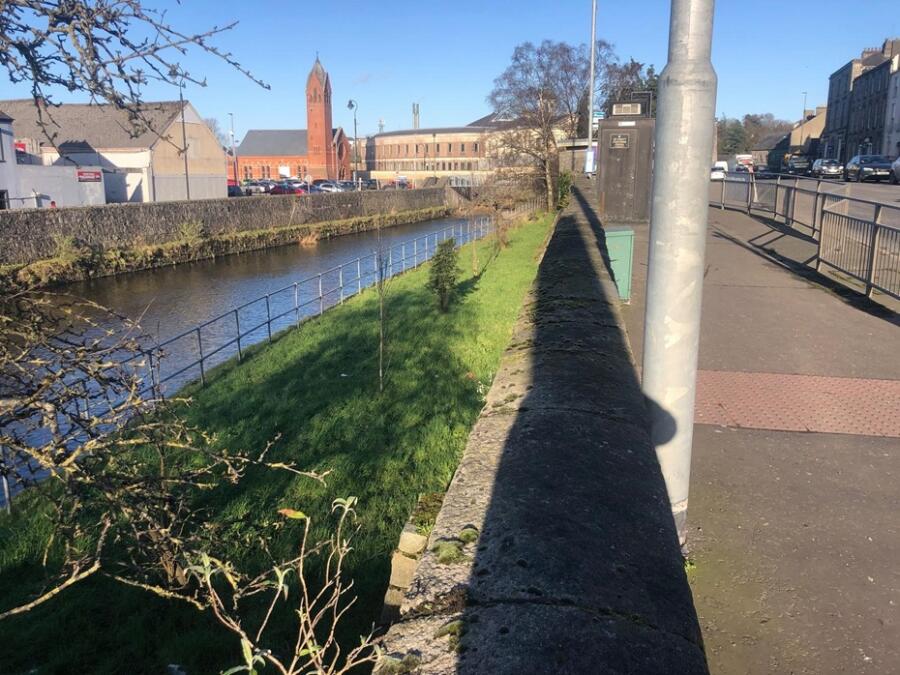
During the early 1800s, the Mill Street area in Newry saw significant development, with 16 building lots advertised along the river in 1804. One of the mills powered by the Race was the Newry Flour Mill, located on Mill Street. It had two undershot water wheels, one 20 feet in diameter and the other 18 feet, both four feet broad, with a nine-foot waterfall. A 1959 article in the Newry Reporter recalled the use of the Mill Race by the local dyeing industry, specifically Keating’s and O’Hagan’s businesses, which discharged blue dye into the water. The Mill Race and Canal water were also used to clean the town’s streets.

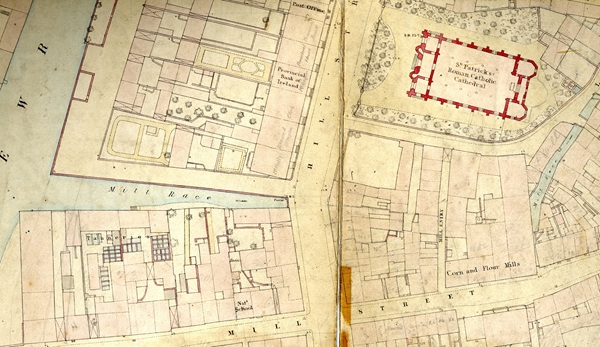
Despite its utility the Race was dangerous. In 1809, a woman’s body was found at the foot of the Mill Race, likely having fallen into the water in an unlit area. Efforts to cover the Mill Race were already underway by 1815, with £463 of the required £499 raised for the project. The estimated costs included £366 for arching, filling, and paving, £22 for curb-stone work, and £60 for pumps, among other expenses. Prominent contributors included Lord Kilmory and businessmen Dennis Caulfield and David Scott. It is unclear when work began, but additional efforts to cover the race took place in 1838–1839 as part of road-widening near Sugar Island Bridge.
By 1861, only a few open sections remained, including one near the Cathedral, another behind the Newry Corn and Flour Mills, and finally an open area where O’Hagan Street is now. In 1869, repairs were carried out on the Mill Race walls near Newry Courthouse in Trevor Hill, and in 1874, the construction of O’Hagan Bridge further enclosed the waterway, significantly altering its’ appearance.
Despite ongoing efforts to cover the Mill Race, it remained a persistent danger with various fatalities in the water street area in 1851, 1877 and 1889. By 1888, complaints from ratepayers in the Mill Street area had increased. A memorial was proposed to have the race fully enclosed, though not all town commissioners agreed on the necessity. The Mill Race at this time was also used as a sewer and the smell during the summer months was foul. That same year the Newry Reporter mockingly dubbed it the "Newry Blackstaff" and a "reeking abomination" that needed to be hidden from sight. Advertisements appear to have been made for the remaining parts of the race to be covered that year. Work was probably completed between then and 1895 when O’Hagan Street first appears to have gotten its name.

In January 1912 Mr. Kerr raised that Newry Urban Council take control of the Race, gradually filling it in and constructing new sewers as funds allowed. At the next meeting, discussions expanded to include structural failures, with the Council held responsible for repairs. Flooding in Downshire Road, Needham Place, and Hill Street that year reinforced the urgency of addressing the Race’s ownership as well as its ongoing instability. The arches and bridges had a history of collapse, with breaches recorded in 1875, 1883, and 1896. By 1915, the Urban Council’s clerk Cronin emphasized the need to close the Mill Race, but plans were delayed due to the First World War. In 1921, Rev. D. Grant of the Catholic Cathedral agreed to transfer interest in the Race to the Council in exchange for extending Water Street through to Mill Street, which was duly agreed. Work on a new sewer to replace the Race began in September 1923. By early 1924, nearly all work was completed, with house connections made and the Race filled in. In 1956 the old archway of the Mill Race which crossed Trevor Hill had to be broken down to enable pipes to be laid, but it appears to have been partially repaired and filled in.
The Museum is currently offering free tours of the main exhibition galleries on Wednesdays at 2.00 pm. These must be booked in advance by calling the Education Officer at 0330 137 4422.
Newry and Mourne Museum is open Tuesday – Saturday 10.00 am – 4.30 pm. Please call 0330 137 4422 or email museums@nmandd.org for further information, or visit their website at www.visitmournemountains.co.uk/museums/newry-and-mourne-museum