 Write a comment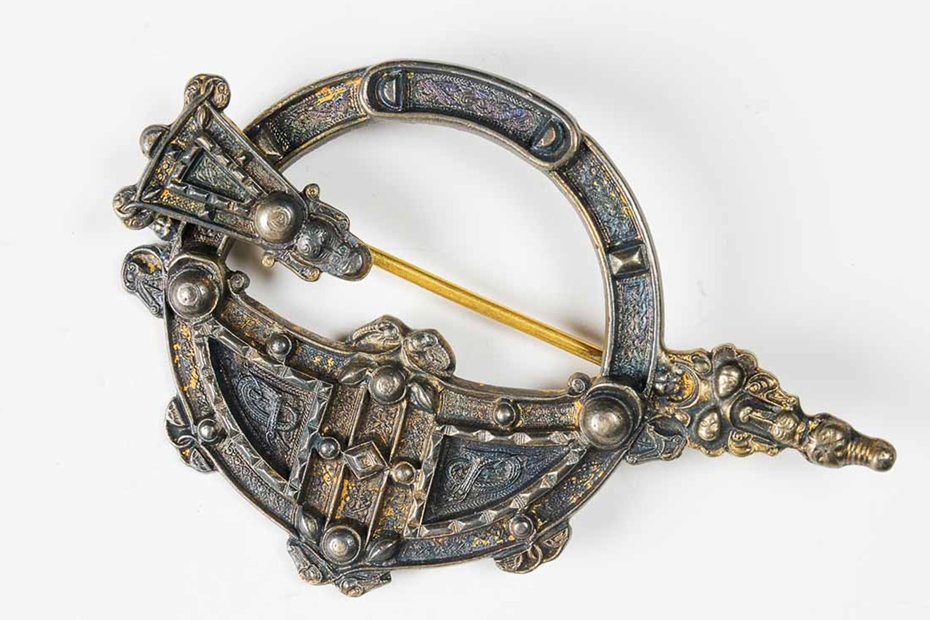
Few objects capture the brilliance of Ireland’s early medieval past quite like the Tara Brooch. Dating from the late 7th or early 8th century, this extraordinary piece is widely regarded as one of the finest achievements of early Irish craftsmanship. Often mentioned in the same breath as the Ardagh Chalice, the brooch stands as powerful evidence of Ireland’s rich artistic and cultural heritage.

Visitors to the recently opened Categorically Celtic exhibition at Newry and Mourne Museum can now admire carefully crafted replicas of the Tara Brooch, offering a rare opportunity to appreciate its remarkable detail up close. The display invites audiences to explore not just the brooch itself, but the lasting impact it has had on art, identity and design. The original Tara Brooch is a pseudo-penannular design: a hooped ring with a pin and decorative terminals. Measuring 8.6 cm in diameter, with a pin extending an impressive 33 cm, it is larger and more elaborate than most Celtic brooches of its time. Crafted from gilt bronze, silver and gold, it is decorated on both front and back with exquisitely detailed filigree, enriched with enamel, amber and coloured glass.

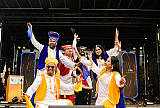
tradition and performance and this belonged to Arthur Burns of Newry. Renowned
both as a performer and as a respected adjudicator, Burns was closely associated
with Newry’s Feis and served on the Executive of Newry Musical Feis from 1960
until his death in 1990. Newry & Mourne Museum Collection.
Its surface is alive with interlacing patterns and stylised animal forms, reflecting the influence of the La Tène style, a design tradition that originated in Iron Age Europe and shaped Celtic art for centuries. The level of technical skill involved reveals a society where master metalworkers were highly valued and supported, capable of producing objects of astonishing complexity and beauty. More than an ornament, the Tara Brooch was almost certainly a symbol of high status or authority. It is believed to have been deliberately hidden during the 11th or 12th century, possibly to protect it from raiders or invaders at a time of political instability. That act of concealment may be the very reason it survived at all.
Its rediscovery in 1850 adds another layer of intrigue. According to tradition, the brooch was found buried along the beach at Bettystown, County Meath, by the children of a local woman. However, some scholars suggest it was more likely unearthed further inland, with the discovery location altered to avoid a landowner claiming legal ownership. The brooch soon came into the hands of Dublin jeweller George Waterhouse, who recognised both its cultural importance and its commercial potential. By naming it the “Tara Brooch”, he cleverly linked it to the ancient seat of Irish kings at the Hill of Tara, tapping into a growing fascination with national heritage. Waterhouse produced replicas and showcased them at major international events, including the Great Exhibition of 1851, where they caused a sensation. Queen Victoria herself purchased several examples.
These replicas became highly fashionable Victorian dress accessories and played a central role in the Celtic Revival, a movement that sought to celebrate Ireland’s ancient past through art and design.
Today, the original Tara Brooch is preserved in the National Museum of Ireland. Although it has suffered some damage over time, its extraordinary craftsmanship and visual power continue to inspire artists and designers. In the late 19th and early 20th centuries, figures such as Archibald Knox, working for Liberty & Co. in London, drew on its flowing lines and interlace patterns, helping to shape the emerging Art Nouveau style.
The Tara Brooch remains a potent symbol of artistic continuity, bridging ancient skill with modern creativity. From Irish dance costumes to contemporary tattoo art, its motifs continue to be reinterpreted in new forms. As the Categorically Celtic exhibition shows, this remarkable object is not just a treasure of the past, but a living influence at the heart of Ireland’s cultural story.
Visit before September to experience this conversation across time and tradition and to find your own thread in the knotwork. Newry & Mourne Museum welcomes individuals, families, schools, and community groups; keep an eye on social media for talks and activities linked to the exhibition.
The Museum is currently offering free tours of the main exhibition galleries on Wednesdays at 2.00 pm. These must be booked in advance by calling our Education Officer at 0330 137 4422.
Newry and Mourne Museum is open Tuesday – Saturday 10.00 am – 4.30 pm. Please call 0330 137 4422 or email museums@nmandd.org for further information.
Visit their website at www.visitmournegullionstrangford.com/