
 Write a comment
Northern Ireland Food Chain Certification (NIFCC), the primary inspection and certification provider for the region's agri-food sector, has reported a successful year marked by strategic investments in operational improvements.
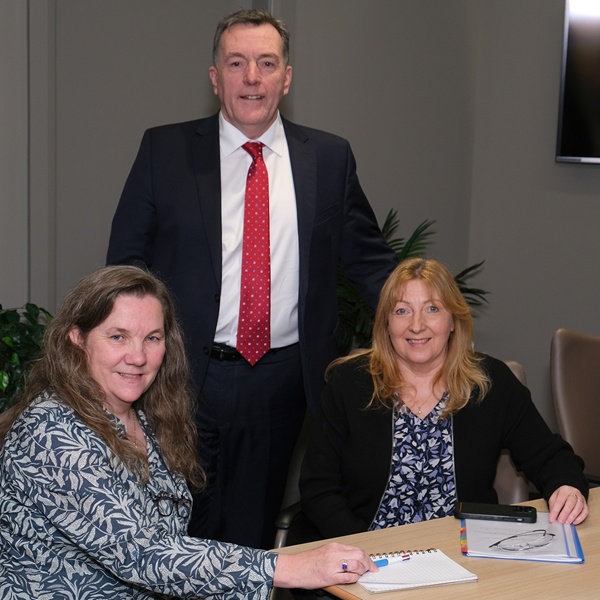
At its 23rd Annual General Meeting held in Lisburn, NIFCC Chairman George Mullan noted the organisation’s post-COVID-19 recovery. “I am pleased to report on a full recovery from the impact of Covid restrictions and that NIFCC is operating on a solid financial footing,” he said. He also praised the dedication of the Board of Directors and senior management team, including CEO Valerie McCann, Finance Manager Pearl Campbell, Compliance Manager Daphne Brennan, and Inspections Managers Robert Downey and Catherine O’Melvena.
The organisation has upgraded its LiveQ digital inspection system across all schemes and launched a revamped website to enhance efficiency and reduce time spent on farms. NIFCC also retained its 5-star BRCGS Certification Body rating following a successful UKAS accreditation audit.
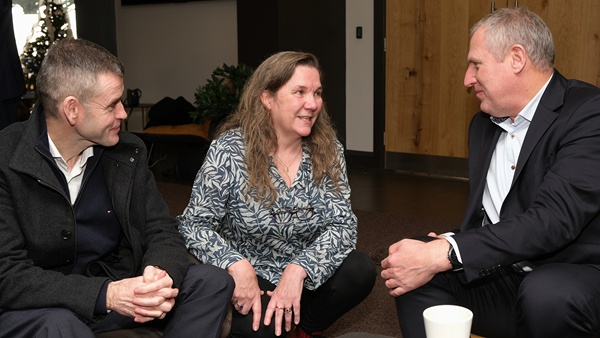
NIFCC continues to manage key schemes such as the Northern Ireland Beef and Lamb Farm Quality Assurance Scheme (FQAS) and the Northern Ireland Farm Quality Assured Cereals Scheme (FQACS). It also provides certification services for Red Tractor Dairy, Poultry, Livestock Transport, and Livestock Markets schemes. Additionally, it supports the food processing sector through BRCGS and Red Tractor Meat Processing Schemes and administers the Trade Assurance Scheme for Combinable Crops (TASCC) across Ireland.
Governance changes to the company were also announced at the AGM. David Torrens has been appointed by the Livestock and Meat Commission to act as its Owners Representative alongside Joseph Stewart. Michael Hatch replaces Liam McNeill as the new Chairman of the Certification Committee. Ian Robinson replaced Crosby Cleland as one of two Farming Representatives. Crosby steps down having served since October 2021. Sinead Furey the Consumer Representative steps down having served since October 2012.
Neville Graham, who has been a NIFCC Board Director since 2017, steps down and Paul Reaney the Processor Representative who has been on the Certification Committee since December 2020 takes up his place on the Board of Directors to represent Dale Farm. Deirdre McIvor has also been re-appointed to the Board for a further three-year term to represent the NI Pork and Bacon Forum.
During the year Thomas Douglas who represented UFU, also stepped down from the Board having served since 2016 and was replaced by Crawford Wilson who will serve out the remainder of Thomas’ term until the next AGM.
Write a comment
A notice of motion, tabled by Cllr Tim McClelland at 25 November Armagh, Banbridge, Craigavon Borough Council monthly meeting, enjoyed very strong support, as the Tandragee farmer expressed grave concerns that proposed changes to Agricultural Property Relief could spell the end of family farming for many.
The notice of motion called on the council to “stand in solidarity with our farming community in opposition to this punitive, unfair and disastrous tax”.
Cllr McClelland (Cusher DEA) introduced his notice of motion as follows: “Before I start, I would just declare an interest as the owner of an arable farming business that is affected by these changes.
“The McClelland family have farmed outside Tandragee since 1801. I’m the sixth generation of our family that is producing food for our nation.
“Rachel Reeves, the Chancellor, at the stroke of a pen has put our family business and indeed numerous other family businesses at risk.
“’No land, no farmers, no food’ is how the slogan goes, yet senior ministers in Treasury really don’t seem to care.
“Farmers right across the nation are the custodians of the environment. Without farmers, conservation and biodiversity will suffer. At the stroke of a pen, this Labour Government has imperilled our countryside.”
Cllr McClelland went on to read a poem, penned by his 13-year-old son Nathan, in which he speaks with great fondness of helping his father on the farm, and of how much the farming lifestyle means to him.
The Cusher representative continued: “Nathan is passionate about farming. Rachel Reeves has endangered his livelihood and his career as a farmer. It’s just not fair, and I would appeal for unanimous support for this motion.”
Seconding the motion, Alderman Gareth Wilson (Cusher DEA) stated: “As we’ve heard in the motion, on its own it would be bad enough, but when it’s coupled with all the other attacks on agriculture, it does bring to the issue a renewed sense of urgency, and I would reiterate what Tim has said, he has eloquently put it, bringing his own family into it and what that means for him as a farmer in our own borough.
“It is a call to action. It is a battle that will have to be fought in Westminster as well, and we’ve seen protests there.
“There will need to be a lot more of them to really ram the message home that we can’t destroy our ability to produce food in this fashion, and then import it from other parts of the world.”
Cllr Peter Lavery quoted DAERA figures on the estimated impact of the proposed fiscal changes: “The UK Budget was a bad budget for farmers, and Northern Ireland will be disproportionately affected by the change to Agricultural Property Relief.
“Despite the Chancellor’s assurance that three quarters of claims would be unaffected by these changes, DAERA data suggested that one third of farms here could be impacted, and as many as three quarters of dairy farms.
“We must continue to support and encourage young people to pursue agricultural careers, if we are to retain our thriving agri-food industry.
“Farmers are custodians of our countryside, and family farming is the cornerstone of our agricultural sector. They are essential for food security and play a key role as we transform into a greener, more environmentally-friendly society.”
The Lurgan DEA representative proposed an amendment to the motion, which was carried by a majority of 23 councillors, with 15 voting against.
The amendment stated: “The council calls on the NI Executive to support a ring-fenced budget for agriculture, agri-environment, fisheries and rural development within the 2025/26 Budget and beyond.”
Deputy Lord Mayor, Cllr Kyle Savage explained he was concerned for the future viability of his own farm: “Our family farm will also be affected by this. Farmers are the custodians of our countryside.
“We’re doing more than just stock-rearing or growing crops or whatever. We’re looking after the environment as well.
“On our own farm we have planted over 2km of hedgerows, 250 trees have been planted, and the wildlife that has benefited from that over the years has been immense.”
The Lagan River DEA representative suggested an amendment reflecting his concerns over increased national insurance contributions – he cited the example of one particular farmer who would be billed an additional £215,000.
His amendment was seconded by Alderman Gordon Kennedy (Cusher DEA), and unanimously carried.
Cllr Bróna Haughey (Cusher DEA) explained that many farmers in her constituency were greatly concerned: “The decision by the British Government to change the Inheritance Tax Relief for farmers is wrong and is causing undue stress among the farming community here, and especially those that I represent in Cusher.
“The approach of the British Government threatens to undermine the future of many of our family farms. The ability to pass down a family farm from one generation to the next is key to sustaining our farming community, now and into the future.
“These proposals come at a time when many farmers and rural communities are still struggling with the loss of EU funding which, despite assurances, has not been replaced following Brexit.
“The British Government should reconsider their current course of action, and instead they should seek to ensure that reliefs and supports for agriculture are maintained. We’re happy to support the substantive motion.”
Concluding, Cllr McClelland stated: “I think in the almost six years that I’ve been on council, it’s probably been the most agri-farmer focused council meeting that I’ve ever been at, so given what’s going on out there within our farming community, that is very much to be welcomed.
Write a comment
Around half of all farms in Northern Ireland, accounting for 80% of farmed land, could be impacted by the Inheritance Tax changes announced as part of the UK budget in October.
The Department of Agriculture, Environment and Rural Affairs (DAERA) has undertaken a deeper analysis into the impacts of the tax changes, taking into account residential property, farm buildings, machinery and livestock as well as land. This increased the average land value estimations from £15,000/acre to £21,000/acre, taking the number of farms potentially impacted from a third to around half.
As part of the UK budget on 30 October 2024, it was announced that Agricultural Property Relief (APR) and Business Property Relief (BPR) combined at 100% would be restricted to £1 million from 6 April 2026.
Speaking of this comprehensive analysis, DAERA Minister Andrew Muir said: “The initial analysis undertaken by my department painted a worrying picture, but this deeper study has truly revealed the stark reality of how many hard-working farmers could be impacted by the inheritance tax changes. I stand firmly with the agriculture sector in calling for these damaging changes to be reversed. Northern Ireland will be disproportionately impacted due to the makeup of our agri-sector and it cannot continue.”
The Minister continued:“My Department’s analysis is at odds with the Treasury figures presented which relate to 2021/22 claims for APR and BPR and almost certainly a major underestimation of the impact.
“It is important to remember that these claims are from a period when the value of agricultural property and business property made no difference to inheritance tax liability as there was unlimited relief at 100%. I have serious concerns with their use to measure the impact of the changes announced in the Budget. The context will be very different from 6 April 2026 with much more attention being given to agricultural and business property values.”
Analysis previously undertaken by DAERA based on a land value of £15,000/acre in 2026 showed that around 1/3 of farms would have a total land value exceeding £1 million and therefore would be impacted. These farms account for the majority of output of the Northern Ireland agricultural sector including around 70% of farmed land, 86% of dairy cows and 57% of beef cows.
More comprehensive analysis has now been produced which also takes into account residential property, farm buildings, machinery and livestock as well as land.
This increases the average land value estimation for 2026 to £21,000/acre. With a £1 million limit on APR and BPR combined at 100%, around half of all farms in Northern Ireland, accounting for 80% of the area farmed will exceed this limit and will be impacted by the Budget change.
Using a £2 million limit (which some, but not all, farms may obtain if they are able to divide farm assets between partners), a quarter of farms would be impacted but these farms still account for over half of the area farmed in Northern Ireland.
The Minister concluded: “I again urge the UK Government to turn back and reconsider the planned tax changes given the disproportionate impact on family farms, particularly in Northern Ireland. The ability to pass farms down through generations of farming families is crucial to securing the future of our agri-food sector. I will continue to do everything I can, working with stakeholders and my Ministerial colleagues to make representations to UK Government Ministers.”
The full analysis can be found here: www.daera-ni.gov.uk
Write a comment
Ulster Bank and the Royal Ulster Agriculture Society (RUAS) have kickstarted the countdown to the 156th Balmoral Show.
There's only four months to go until the 2025 event takes place from 14 - 17 May.
Representatives from both organisations met recently to announce some new attractions for this year’s event and to confirm Ulster Bank will remain as principal sponsor of the show – marking a sixteen-year partnership between the two organisations.
This year’s Balmoral Show in partnership with Ulster Bank will once again feature a kids’ farm, a mini–Land Rover experience, the return of the Sustainability Village, along with the usual mix of machinery displays, food exhibitions and funfair attractions.
Some new livestock classes have been added to the 2025 programme including a Breeding Heifer class which will recognise excellence in the beef industry and additional qualifiers for the Performing Irish Draught, Connemara Ridden and Working Hunter horse classes, due to their growing popularity and high standard of competitors.
Show organisers are keen to consider the needs of all visitors this year and have introduced a designated wellbeing area for those with additional need and enhanced the sensory space for younger showgoers.
Group Operations Director at the Royal Ulster Agricultural Society, Rhonda Geary, said it is important to RUAS that everyone attending the 2025 Balmoral Show has an enjoyable experience.
“The Balmoral Show in partnership with Ulster Bank attracts over one hundred thousand visitors across the four days and as show organisers, it’s our responsibility to ensure that everyone can access and enjoy the event. We have been working with our partners to introduce a new children’s sensory area and an enhanced wellbeing area for anyone wishing to find a quiet spot at the Show following a successful pilot in 2024.
“As an agricultural show, food and farming has always be the core of our activity, and this year will be no different. Thanks to the support from our principal partners at Ulster Bank, we have been able to add more exciting attractions to the programme and we are confident that this year’s Show will be a fantastic showcase of agriculture in Northern Ireland.
Cormac McKervey, Senior Agriculture Manager, Ulster Bank said he was looking forward to working with the RUAS once again to deliver this year’s Balmoral Show.
“2025 marks the sixteenth year of Ulster Bank’s title sponsorship of the Balmoral Show, and we are proud of the role we have played in the show’s development.
“Ulster Bank’s support for this sector extends well beyond the Balmoral Show and year-round, we support farming businesses and have a range of solutions available to meet their financial needs.
“Balmoral is always a great opportunity to meet with and learn from others across the supply chain and our teams of Relationship Managers will be on the ground throughout the show to engage with farmers about the future of farming and how we can better support the local industry here.”
Early bird tickets for this year’s event at Balmoral Park are already available to purchase online and the details of livestock competition entries, show opening hours, and the full programme of events will be available on the Balmoral Show website in the coming weeks.
For more information about how Ulster Bank can support your business needs, visit www.ulsterbank.co.uk
Write a comment
Two local school have reached the final of the 2025 ABP Angus Youth Challenge.
St. Joseph’s Crossmaglen are researching beef consumption and the young consumer for their finalist assignment whilst Markethill High School are looking at the theme of food provenance. They are both competing against Enniskillen Royal Grammar and Lecale Trinity Grammar School in Downpatrick.
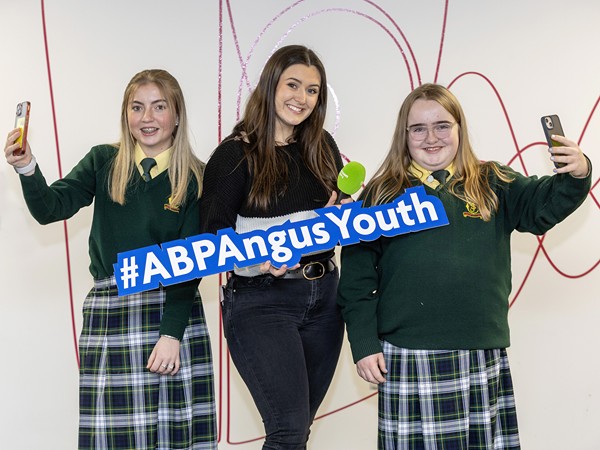
The ABP Angus Youth Challenge aims to inspire secondary level pupils who have a passion and curiosity about their local agri-food industry, to gain practical experience and expand their knowledge. Through a year-long journey, successful finalists are challenged to research farming and food production methods that can meet the changing needs of the marketplace with minimal impact on the environment. And they get to put these principles into practice with their own mini-herd of Angus cross calves to rear and sell, learning about the dynamics of a modern beef industry.
All four teams recently attended a media training workshop at the home of Cool FM / Downtown Radio. The workshop was tailored to provide the teenagers with the knowledge and tools they need to connect with audiences, both within and outside of the agricultural community on the research work they are carrying out on sustainable beef production. They were introduced to best practices in digital content creation and online safety, ensuring they understand how to engage with online audiences in a responsible and effective manner. Victoria Quinn, breakfast presenter on Downtown Country; Cool FM’s Paulo Ross, and Keith Law, Head of Creative at Bauer Media NI, shared their professional knowledge about leveraging media platforms to maximise audience engagement. The session also included hands-on exercises where the students crafted and recorded audio scripts with the help of the studio team.
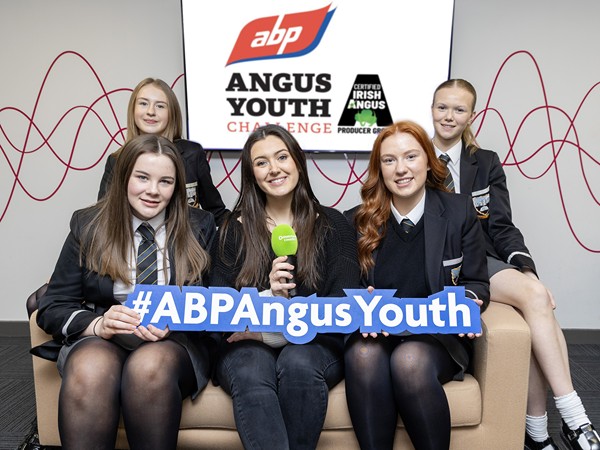
A Future-Focused Approach to Agricultural Education
The ABP Angus Youth Challenge, delivered in partnership with Certified Irish Angus, aims to do more than teach farming techniques. By equipping young people with the skills needed to navigate the digital landscape, ABP is looking to future success in an ever-evolving sector. George Mullan, Managing Director of ABP in Northern Ireland which has a site in Newry, explains, “As the next generation steps up to shape the future of farming and agrifood, equipping them with the tools to communicate is essential.”
For more information visit www.abpangusyouthchallenge.com
Write a comment
MLA Aoife Finnegan has called on the Agriculture Minister to provide clarity as to what funding he has available in the event of an outbreak of foot and mouth disease.
The MLA was speaking after the minister last week recognised this serious threat in response to a question in the Assembly, yet failed to address the risk posed by funding shortfalls.
The Newry and Armagh MLA said: “The threat of foot and mouth remains a real concern for family farms due to the devastating impact it can have on animals and livelihoods.
"With suspected outbreaks of foot and mouth in Hungary it is important that we have a level of preparedness in place."
She continued, "I am calling on the Agriculture Minister to provide urgent clarity on current funding levels to ensure we can continue to tackle foot and mouth disease."
Ms Finnegan believes a well-resourced all-island animal health and welfare strategy is crucial as well as having adequate resources in place to prevent and respond to any potential outbreak.
Concluding the Newry and Armagh public representative said,“I will continue to engage with the minister on this issue and make clear the need to prepare for potential outbreaks and for farm families to be given assurances that this planning is underway."
Write a comment
Minister of Agriculture, Environment and Rural Affairs, Andrew Muir has announced that the new Suckler Cow Scheme will commence on 1 April 2025, with the online Scheme opt-in also being available from that date.
The Scheme forms part of the Beef Sustainability Package within the Sustainable Agriculture Programme. This Package will deliver 25% of the greenhouse gas reductions from agriculture by 2027, if the uptake levels and targets within the Scheme are met.
It also aims to encourage farm businesses to improve breeding management practices to increase the percentage of eligible calving events that achieve a reduced age at first calving and a reduced calving interval over a four-year phased implementation period.
The phased implementation period of the Scheme includes a maximum age at first calving for suckler heifers of 34 months, reducing to 29 months in Year 4. The maximum calving interval in Year 1 will be 415 days, reducing to 385 days in Year 4.
Minister Muir said: “I am delighted to announce the commencement of the Suckler Cow Scheme and the opening of the online opt-in.
“This Scheme plays an important role in supporting our farm businesses on a journey of change ensuring both environmental and economic sustainability and is vital as we continue our journey to net zero.
“I would encourage farm businesses to avail of this opportunity and engage with the Department on how best to adapt their on-farm practices to meet the targets set for the Scheme."
The College of Agriculture, Food and Rural Enterprise (CAFRE) will provide focused knowledge transfer programmes to assist farm businesses to achieve the husbandry standards necessary to meet the Scheme conditions and targets.
To be eligible farm businesses must have claimed and be eligible for the Farm Sustainability Transition Payment in 2025 and the Farm Sustainability Payment from 2026 onwards. A payment rate of £100 will be made for each eligible calving event and a Northern Ireland quantitative limit of 222,000 calving events will apply in each Scheme year.
Eligible farm businesses must opt in to the Suckler Cow Scheme to receive payment and can do so from 1 April 2025 via the DAERA website at: https://www2.dardni.gov.uk/beefsustainability
Farm businesses can opt in at any time. However, a business must have opted in between 1 April 2025 and 31 March 2026 to receive payment for Scheme year 1. If farm businesses opt in and do not have any eligible calving events in that Scheme year, no penalties will apply.
A farm business only needs to opt in once for the Scheme from 2025. If a farm business has opted in, it will receive a payment for eligible calving events each year thereafter, provided all eligibility criteria have been met in that Scheme year.
Full details of the Scheme, including farm business, animal and calving event eligibility criteria are available to view on the DAERA website at: beef-sustainability-package
A video providing step by step instructions on opt-in is available at: https://www.daera-ni.gov.uk
If farmers require further help or guidance with an application, they should call DAERA’s Advisory Service helpline on 0300 200 7848 or e-mail areabasedscheme@daera-ni.gov.uk.
Notifications regarding opt-in and payments will issue by DAERA messaging only. To receive notifications by e-mail and view payment details online, farm businesses, must register with either Northern Ireland Identity Assurance (NIDA) or Government Gateway for a DAERA online account. Registration for a DAERA online account can be completed at: daera-online-services or call 0300 200 7848 for support to get registered.
Write a comment
Balmoral Show is just four weeks away and main sponsor Ulster Bank recently welcomed farmers, producers, industry leaders and policy makers to its annual pre-Balmoral Show breakfast briefing.
The event, hosted in conjunction with the Guild of Agricultural Journalists, featured Ulster Bank's Head of NI, Mark Crimmins, and Senior Agriculture Manager, Cormac McKervey, who provided a sectorial update covering the health of farm businesses across Northern Ireland.
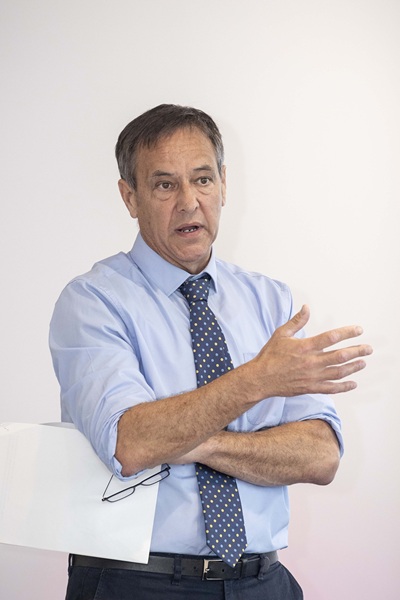
Cormac McKervey said: "Generally speaking, farming is generating good returns and is in a relatively stable position. Margins are sufficient for milk, beef, lamb, pigs and poultry and while there is still room for improvement with arables, the situation is more positive than it has been in recent years. Land prices continue to rise, and the recent spell of good spring weather has eased the pressure on field work.
"Much of this positivity is being driven by strong consumer demand for locally produced food with today's consumer placing more value on provenance than ever before. We are seeing a return to equilibrium when it comes to supply and demand and input prices, particularly animal feed, have fallen to below average prices. This buoyancy is also being reflected in bank borrowing and our message to farmers continues to be that we are open to lend and keen to support new businesses."
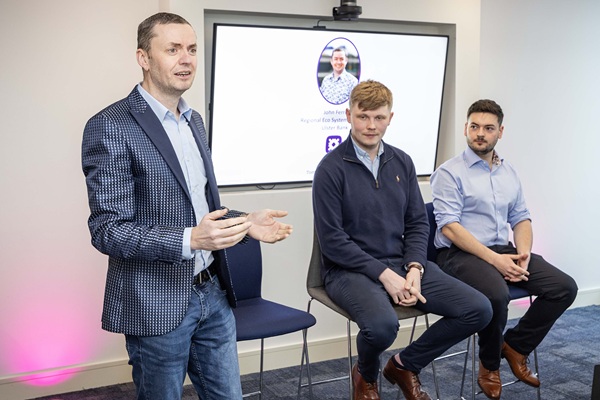
Attendees also heard about Ulster Bank's support for the agri-tech sector through its entrepreneur accelerator programme, highlighted by Farm Drive app founders Gareth McDonald and Gareth Gordon, who will be exhibiting at this year's Balmoral Show.
Mark Crimmins added: "Ulster Bank is very proud of our longstanding association with the Balmoral Show and while we are looking forward to the landmark event, it is by no means our only association with the agri-food sector which we recognise as being one of the key drivers of our local economy."
The Balmoral Show in partnership with Ulster Bank returns to Balmoral Park from 14th-17th May. For more information, visit www.balmoralshow.co.uk
Write a comment
Thanks to the support of South Armagh Farming Enterprises and donations from Mackin Feeds, Joseph Walls Ltd, Corriure Dairy Farm and Newry Veterinary Clinic, a Glasker farmer was able to raise over £4,000 for Air Ambulance Northern Ireland in Gratitude for their life saving care.
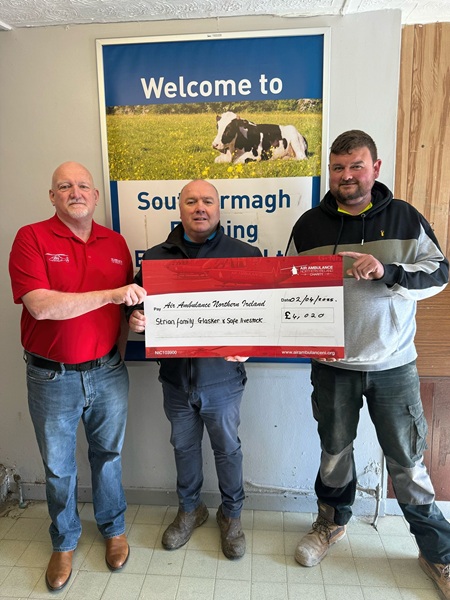
Kieran Strain and his family from Glasker, outside Banbridge raised an incredible £4,020 in aid of the charity through the donation and auction of a heifer, kindly organised with the support from South Armagh Farming Enterprises in December 2024.
Kieran chose to support Air Ambulance NI following his own experience with the service after sustaining serious injuries in a quad bike incident on his family farm on 12 September 2024. The Helicopter Emergency Medical Service (HEMS) team responded swiftly, providing critical care at the scene.
Kieran said: "When I was lying in hospital, I said to my son Aaron that I knew I wanted to do something to give back to the air ambulance for their help. Only with the support from South Armagh Farming Enterprises, and kind donations from Mackin Feeds, Joseph Walls Ltd, Corriure Dairy Farm and Newry Veterinary Clinic, were we able to raise such an amazing amount of money for the charity."
Air Ambulance NI, in partnership with the Northern Ireland Ambulance Service, responds to the most serious accidents and incidents across the region. Tasked on average fourteen times each week, at least one of these callouts typically involves a farming incident. The charity plays a vital role in delivering emergency care across Northern Ireland, particularly in rural communities. Relying entirely on public donations to remain operational, Air Ambulance NI needs £6,850 every day to sustain its life-saving service, making donations like these absolutely vital.
Amy Henshaw, Area Fundraising Manager for Air Ambulance NI, said: "We are incredibly grateful to Kieran, his family, and the local businesses for their generosity and for choosing to give back in such a meaningful way. These incredible funds will help keep our helicopter flying, reaching at least one other patient and delivering life-saving care when it’s needed most."
To find out more about Air Ambulance NI or how to get involved in supporting the service, please visit www.airambulanceni.org






 |
 |
 |