Write a comment
Christmas is a time of feasting and celebrating with family today. This was no different back in the 16th century in the home of Sir Nicholas Bagenal. Traditions of the time give an insight of how the season would have been celebrated and while many seem unfamiliar, some have continued through the centuries.

Celebrations began on Christmas Eve, when the Hall and Great Chamber would have been decorated with evergreens. Holly to represent everlasting life; ivy to keep disease away; rosemary to protect against evil, and mistletoe to bring good luck. A ‘kissing bough’ would have been prepared with mistletoe and when a couple kissed under the bough, the gentleman removed a berry. When all the berries had been removed there were no more kisses!
A yule log, a large ash log, would be decorated with hazel twigs and burned in the Hall all over the Christmas period. It was considered good luck to keep a piece to light next year’s log. All decorations were taken down and burnt on the 6th of January, except holly as this was considered ill fortune.
The twelve days of Christmas were a time of feasting. From Christmas Day to the Feast of Epiphany there was much celebration. All work stopped and would not commence again until Plough Monday, the first Monday after the Twelfth Night. The household abstained from eating meat for the last month before Christmas and on Christmas Eve, did not eat fish, meat or cheese. The cooks made two types of bread for the household, manchet bread for the Bagenal family and their guests and cheat bread, a type of wholemeal bread for the servants.
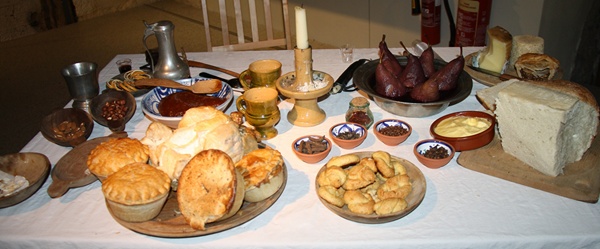
The usual meat served over Christmas was goose, venison, beef, mutton and fish. The head of a wild boar could be used as an elaborate table decoration. Mince pies in the 16th century consisted of raisins, currants, prunes and spices as well as mutton to represent the shepherds. For twelve happy months ahead, a mince pie would have been eaten on each of the twelve days of Christmas.
The spices included cloves, cinnamon, nutmeg and peppercorn. Pomanders were made from oranges and cloves and given as gifts. The spices were also used to make mulled cider which was used to ‘wassail’ the apple trees. A magnificent orchard adjoined the castle and wassailing occurred to encourage the spirits into ensuring a good harvest the following season. Singing, dancing and general merrymaking took place, and the biggest and best tree was selected, and the cider poured over its roots.
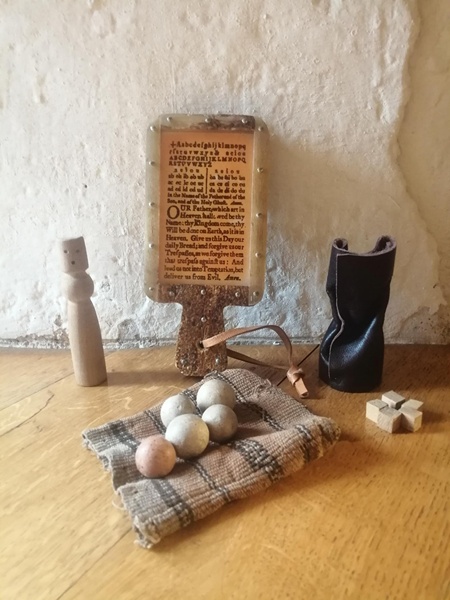
After Christmas Day, the next celebration was 1st January. The new year and new beginnings would be celebrated along with the giving of gifts. There were nine children in the Bagenal family, and they might receive gifts like Five Stones for the young boys and a small doll or poppet for the young girls. Blind Man’s Bluff was also a popular game for children within the household to play.
The Twelfth Night was governed by the Lord of Misrule, also known as the Master of Revels, typically a servant, who became the master of ceremonies overseeing the revelry. There was plenty of feasting and refreshments and mummers provided entertainment. For those who overindulged, remedies were prepared containing mint and rosemary to soothe stomach pains and headaches.
The final celebration was the Feast of Epiphany on 6th January, which indicated the arrival of the three kings to visit baby Jesus.
The Museum is currently offering free tours of the main exhibition galleries on Wednesdays at 2.00 pm. These must be booked in advance by calling our Education Officer at 0330 137 4422.
Newry and Mourne Museum is open Tuesday – Saturday 10.00 am – 4.30 pm. Please call 0330 137 4422 or email museums@nmandd.org for further information.
Please visit our website at www.visitmournemountains.co.uk