Write a comment
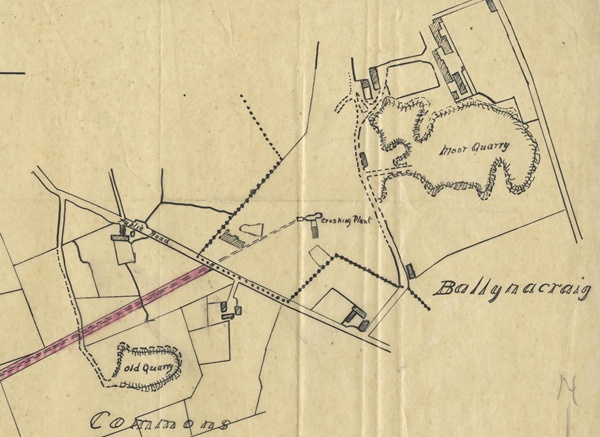
Granite found in the hills around Newry was once one of its chief exports. Variations of townlands with craig, carrick or carraig in the name would indicate a rocky area, giving a clue to where these quarries existed. A large granite deposit forms part of the hills in the Ballynacraig area, while Carrickbracken and Carrickcloughan were also places where quarrying was carried out. Used in many of Newry’s 19th century buildings, Newry granite is generally greyish-blue, with considerable variation in mineral constitution, and a variety of tints. Pinkish-grey Newry granite was used for structural work throughout Ireland and provided setts for the streets of Belfast.


At the end of the 1800s, the granite quarrying industry had been greatly developed and by 1901 there were ten different quarries operating in the Newry area. A number of new quarries had opened, and a large quantity of valuable steam-powered equipment purchased to increase productivity.

Mr. W.J. Sturgeon opened a quarry in Ballynacraig in 1891. Within ten years he employed seventy men, raising stones for building work, polishing, kerbing and paving setts. Granite from Ballynacraig retained a rough surface under traffic, while at the same time, was tough, wore well and made a very fine carriageway pavement, which didn’t become dangerously slippery under traffic, like some of the hard granites.
Other quarries had been in existence for a considerable time, such as Moor Quarry, which had been worked by Messrs. Hugh Campbell & Sons from the 1840s. In 1867, around 200 tons of granite a week were sent to builders in Ireland and various parts of England and Scotland. They also manufactured granite into monuments, building stones, and other artistic work. In the mid-1870s they built a large steam-polishing works, to produce polished granite. In 1876 a polished granite vase carved with shamrocks won a medal diploma at the Philadelphia Centennial Exhibition. A bronze medal was also awarded at the 1878 Paris Exhibition.
The Goraghwood quarries, belonging to Newry Quarries Ltd., were the oldest in the district and were mainly worked for the production of building and monumental stones. They also owned the Corrin Quarry, about three miles from Newry. Building and monumental stones were the principal products of this quarry, with kerbing and granite setts being only of secondary consideration. The company also carried on a granite manufacturing trade in Newry, cutting and carving ornamental stones for large buildings, such as Newry Post Office, the façade of which was beautifully ornamented with artistic work in granite.
The United Newry Granite Company had two quarries, one at Ballynacraig and another at Altnaveigh, which provided polished granite stones, up to 21 feet in length for Manchester Town Hall, completed in 1877. Taking on a brilliant polish, it was well adapted for all kinds of monumental and embellished work.
Messrs. Charles Ewen & Sons, quarrying and monumental contractors, were long associated with the industry in Newry, employing about twenty men in the quarry and thirteen in their monumental works in the town. They also carried out quarry operations at Crowhill, three miles from Newry, where they employed a further fifteen men.
At the turn of the 20th century, the granite industry in the Newry district give employment to about 850 men and boys, besides others who were indirectly employed in connection with the trade. Paving setts formed the principal export trade from the Newry quarries, with 26,000 tons despatched in the year ending May 1900.
The Museum is currently offering free tours of the main exhibition galleries on Wednesdays at 2.00 pm. These must be booked in advance by calling our Education Officer at 0330 137 4422.
Newry and Mourne Museum is open Tuesday – Saturday 10.00 am – 4.30 pm. Please call 0330 137 4422 or email museums@nmandd.org for further information.
You can visit their website at www.visitmournemountains.co.uk