

 Write a comment
Located on Carlingford Lough, Warrenpoint and Rostrevor emerged as important seaside resorts in the 19th century, attracting visitors from far and wide.
Warrenpoint, the larger of the two, began to develop as a town after 1767 with the building of a tidal dock. By 1820, Warrenpoint had grown quite rapidly as a seaside resort with the majority of businesses being public houses, lodging houses and grocers. People were employed as tidewaiters (harbour customs officials), ship builders, carpenters, captains, chandlers, mariners and boatmen.
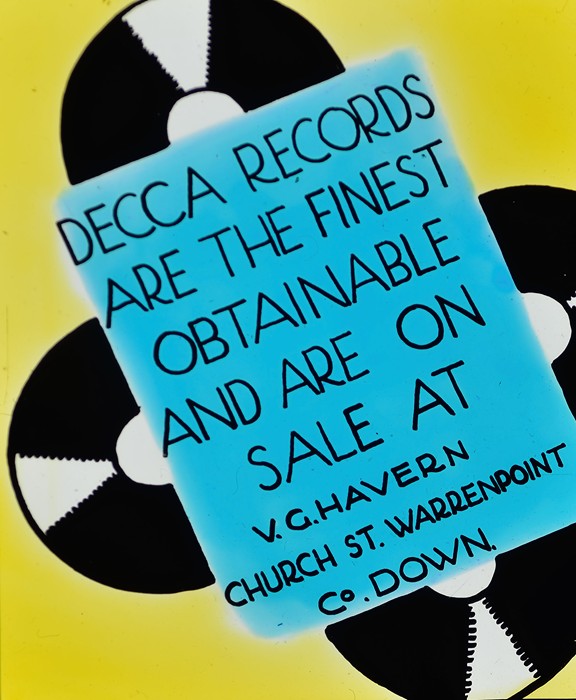
The 1840s saw further commercial development of Warrenpoint. In 1845, a Patent Slip was constructed for the building and repair of vessels and in 1849 the railway between Newry and Warrenpoint was opened. A horse drawn tramway linked the Great Northern rail-head at Warrenpoint with Rostrevor between 1877 and 1915. By the late 19th century there were seven hotels in Warrenpoint and three hotels in Rostrevor, the Mourne (Great Northern), Woodside and Rostrevor.
Although Warrenpoint was primarily a seaside attraction, there was also local industry, with McClelland’s coach builders, Hunter’s ship building yard, Greer’s Corn Mill and a busy port which mainly dealt with exporting cattle and importing coal. The pier at Rostrevor was used to export timber and potatoes and import coal. In the vicinity of the village there were linen industries, with a bleach works at Kilbroney, a beetling mill at Newtown and a dyeing and finishing establishment at Forestbrook.
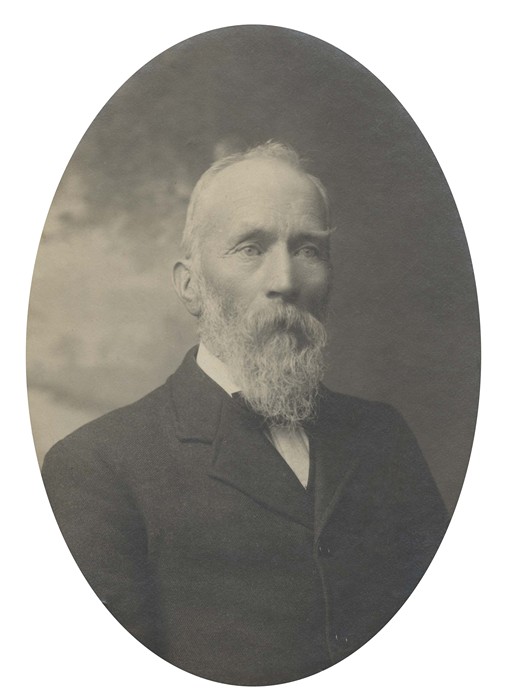
By 1920 there were twenty boarding and lodging house owners in Rostrevor and twenty-seven in Warrenpoint. The latter also had eleven boatmen, who rowed tourists and day trippers back and forth to Omeath on the other side of Carlingford Lough. There were also a range of businesses geared toward the local population, as well as the seasonal trade, including grocery shops and pharmacies.
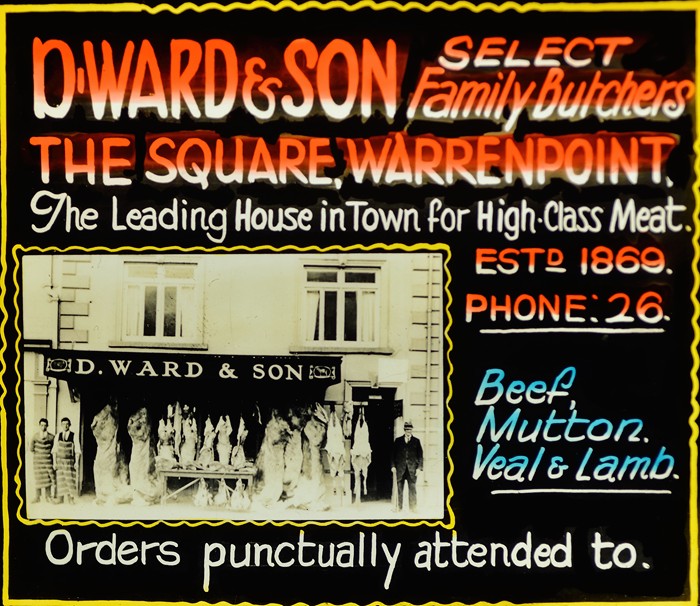
In the first half of the 20th century, Warrenpoint and Rostrevor continued to be popular destinations for tourists and day trippers. The closure of the Newry to Warrenpoint line in January 1965, coupled with the increased popularity and accessibility of foreign holidays, saw a decline in Warrenpoint as a holiday resort. Its role, however, as a port became more influential with the closure of the Newry Ship Canal in 1974 when all international shipping trade was transferred from Newry to Warrenpoint port which has continued to expand.
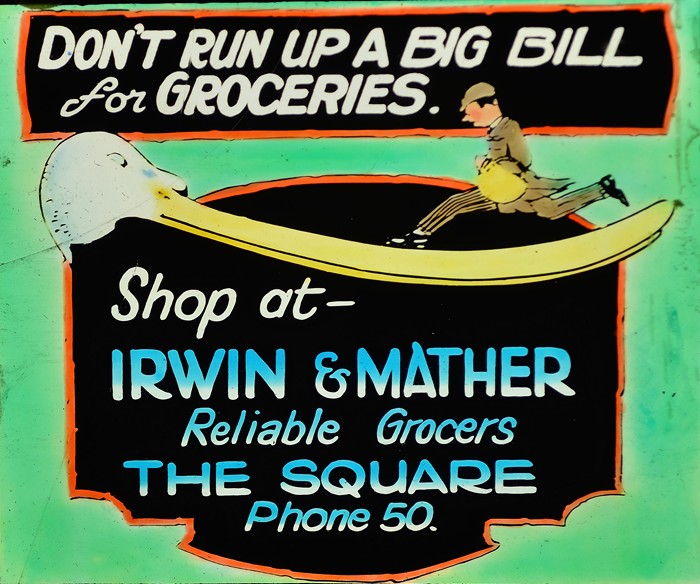
Warrenpoint and Rostrevor today remain popular summer resorts for day trips and have retained much of their original character.
The Museum is currently offering free tours of the exhibition galleries on Wednesdays at 2.00 pm. These must be booked in advance by calling our Education Officer at 0330 137 4422.
Newry and Mourne Museum is open Tuesday – Saturday 10.00 am – 4.30 pm. Please call 0330 137 4422 or email museums@nmandd.org for further information.
Visit their website at www.visitmournemountains.co.uk
Write a comment
A selection of artefacts reflecting the work of the Kilkeel Knitting Mills have gone on display at Newry and Mourne Museum. The collection includes a knitting machine and examples of knitwear produced by the factory in the later decades of the 20th century.
Kilkeel Knitting Mills was established by Edith and Kurt Sekules in 1950. Before World War II the Sekules family had been part of the Jewish community in Vienna, settling in Northern Ireland in 1947 after spending the Second World War in detention camps in Russia.
During the 1950s and 1960s the business continued to expand, developing an international customer base. The factory began by making Argyle socks but went on to knit tartan hose worn by pipe bands and from 1957, cashmere and Aran sweaters. In the 1980s, Edith and Kurt’s son Walter became more involved in the business. Following the death of his parents, Walter continued to run the factory until it eventually closed in the autumn of 2022. He passed away in July 2023.
Artefacts donated to the Museum by Walter Sekules at the time of the factory’s closure include a knitting machine used when the factory opened in 1950, which was still in use in 2022, a wages book from the 1950s and various socks and sweaters. Of particular significance is a cardigan worn by Edith Sekules at her Golden Wedding anniversary celebrations in 1986. This was one of five designs by Irish designer Paul Costelloe, produced by Kilkeel Knitting Mills. As personal designer to Diana, the late Princess of Wales, a cardigan from the range made at Kilkeel was worn by Diana in the same year.
Commenting on the donation and display, Newry, Mourne and Down District Council Chairperson, Councillor Valerie Harte said, “We are indebted to the late Walter Sekules for his generosity in donating these wonderful artefacts to the Museum. Kilkeel Knitting Mills made a highly valuable contribution to the local economy in providing employment to so many people in the Kilkeel area and I am delighted that the fascinating story of the factory is now preserved in the Museum Collection.”
Newry and Mourne Museum Curator, Dr Ken Abraham, added, “Kilkeel Knitting Mills supplied many top international fashion outlets with knitwear and this donation of examples of the factory’s products is a very important addition to the Museum Collection. It helps us demonstrate the part played by various entrepreneurs in the development of the local economy in recent decades.”
The knitting machine from Kilkeel Knitting Mills is on permanent display while the knitwear is on display until June 2024.
Entry to Newry and Mourne Museum remains free of charge. For information on opening hours, upcoming events, exhibitions and other services please telephone 0330 137 4422.
Write a comment
Golf clubs were first established in Ireland in the 1850s and the game increases in popularity through the second half of the 19th century. This was no less true in the Newry area where three clubs were formed in the 1890s.
Warrenpoint Golf Club was founded in 1893 and was originally a 9-hole course before being extended to 18-holes in 1920. The re-design was undertaken by Pat Ruddy & Tom Craddock resulting in the splendid 18-hole Parkland course that we see today. Instituted in 1893 and affiliated in 1894, the ‘Golfing Annual’ 1894-95 lists Warrenpoint for the first time. It records a foundation date as 1893, with Major Hall as President and Colonel Cattell as Captain, with seventy-five members.
In the early 1900’s, nobody was more alive to the plus-value of golf than the Great Northern Railway, and it was thanks to them that Warrenpoint became a mecca for holiday golfers. By 1907, the club could afford to spend £16 on a horse-drawn mower and still show a profit for the year of £24-6s.
Then several years later the club took its first big gamble. Membership had grown to 240, nearly half of them ladies, so it was decided to replace the old clubhouse with a brand-new model at a cost of £640. This was a lot of money then, but a benevolent landlord and president, Captain Hall, was demanding no more than one shilling a year in rent, so members were certain that the debt would be paid off quickly and that was the case.
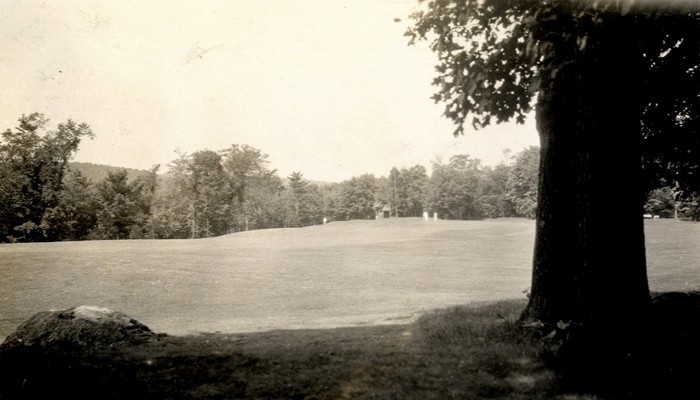
By the mid-20’s bar takings at ‘the Point’ stood at a record £750 for the year, but Tom Richardson, Treasurer of the day, still kept an eagle eye on things, especially those who failed to pay their sub promptly. A quote in the minute book states that “Tom watches them as a cat watches a mouse, and if they are a day late, he pounces”. After that the club went from strength to strength right up to the 1963 fire which gutted the glorious old clubhouse.
A twelve-hole course was also laid out in the Ballyedmond estate, near Rostrevor, in 1892. The Tyrone Courier reported that, on Saturday 29 April 1893, the first of the monthly competitions for the Great Northern Railway Challenge Cup, open to members of recognised Irish clubs, would take place on the links of the Rostrevor Golf Club. The value of the cup is £20.
On Saturday 23 November 1895 the competition was played for the Narrow-Water Challenge Cup, won by Mr Dempster. On the 30th November 1895 the Challenge Cup was competed for on the Ballyedmond course. The winner was Dr. Martin who defeated F Henry by 3 and 2. The putting greens were in first class condition and much credit was given to the green-keeper Johnny Fleming. However, the Rostrevor Golf Club ceased to exist in 1897.
Newry Golf Club was founded in 1892. According to an article in the Ulster Echo dated 22nd October 1892 the opening competition took place at Newry Golf Club located on the links on Camlough Road and was won by a Mr J Stewart from neighbouring Royal County Down club.
A description of the course provided by the Newry Telegraph newspaper in October 1892 stated that the course comprised nine holes and as “hazards are numerous and the links well looked after, a very good game can be enjoyed”.
by Mark O’Neill
The Museum is currently offering free tours of the main exhibition galleries on Wednesdays at 2.00 pm. These must be booked in advance by calling our Education Officer at 0330 137 4422.
Newry and Mourne Museum is open Tuesday – Saturday 10.00 am – 4.30 pm. Please call 0330 137 4422 or email museums@nmandd.org for further information.
Please visit their website at www.visitmournemountains.co.uk/museums/newry-and-mourne-museum
Write a comment
Newry Historian Hugh McShane has published a thought provoking new book documenting the history of the Sugar Island area of Newry from the 1700's to the 2000's.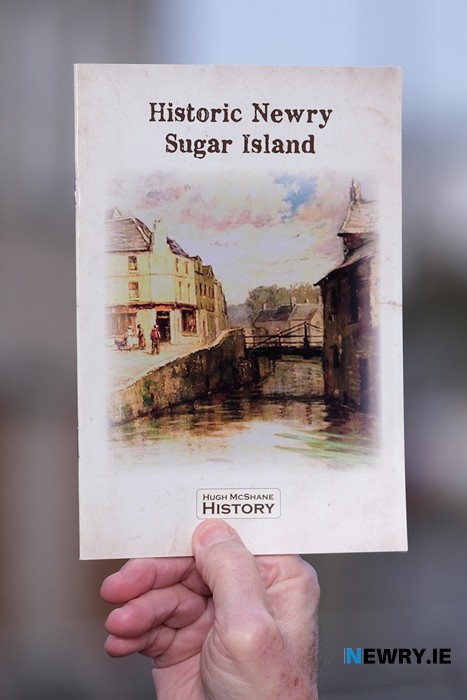
McShane's book contains many gems of information about this unique part of our city. There's the time in 1891 that the Mayor of New York, Hugh J. Grant called by to visit his aunt who lived there at the time. It was noted in the Northern Whig report that it was a private visit and Mrs Dempsey was in "a precarious state of health"
Sugar Island contributed greatly to the towns prosperity with the area the residence and workplace of many merchants. 'There are mills, foundries and manufactories; and the town is the busiest and most thriving that I have seen in Ireland.’ said William Makepeace Thackeray who visited the town in 1842.
The book contains an extensive list of who lived where in Sugar Island, Sugarhouse Quay, Bank Parade, Canal Quay and Basin Walk.
Boot Maker William John Donley (54) lived in number 8 Sugar Island with his wife Anne (40), daughters Ida (13), Carrie (11), Marjorie (7) and Elsie (4) as well as relative James Riddle (22), and Michael Patrick Clark (33) both listed as Boot Makers.
Catherine Thompson (29), a Wine and Spirit Merchant lived in number 6 while across the road in number 7 was the Temperance Hotel with proprietress Dora Perry. It was important to keep the balance right no doubt.
The Canal forms the centre piece of the entire Sugar Island area and McShane details how the Council in 1956 agreed to purchase the three bridges between the Albert Basin and Sugar Island. Three years later the "new £18,000 super concrete bridge" was completed at Sugar Island in just 86 days and remains there till this day, cementing shut any chance of Newry Canal being navigable ever since.
We can but dream that an opening structure is put back in place here and elsewhere on the canal over the course of 86 days in the future.
Perhaps with lessons learned from the past, the new Minister in the Department for Infrastructure will overturn current plans to build a fixed bridge over the canal as part of the Southern Relief Road.
To Buy
Historic Newry - Sugar Island is available in Newry from Fiveways, Boyds Stores, John Mitchell Place and The Grotto, Hill Street.
Delivery, post, collection are also available. email: hmcshane1@hotmail.co.uk Text: 07763497086
Check out hughmcshanehistory on Facebook.
Write a comment
This is the first of a series of occasional articles profiling some of the contemporary artists featured in Newry and Mourne Museum’s temporary exhibition, ‘Newry Artists Past and Present’. The series begins with Anna Marie Savage discussing her work.
I am a visual artist who lives in the village of Omeath, Co. Louth, Ireland. I was born in 1966 and am a Fine Art graduate of the University of Ulster, where I received a First-Class Honours Degree in 2009. A core thread that weaves through my work is a probing of identity, ranging from the personal through to the cultural and political sometimes albeit in a romanticized, reminiscent concept. I have come to realise how the effect of a geographical location can have on the emotions and behaviour of the individual and how this relatable connection to the land and, this ever-present psychogeography has now become apparent within my own practice.

Growing up in the border town of Newry, Co. Down in the 1970s and 1980s I was always fascinated by the Army Watchtowers which were located along the border and, in particular, the icon imagery that has been left behind, now that the watchtowers have been dismantled. In 2019 I was accepted for Drawn from Borders which was part of the Understanding the Decade of Centenaries project, supported by the European Union’s Peace IV Programme, which asked visual artists to respond to the concept and reality of borders, specifically the border created 100 years ago by the Partition of Ireland.
In 2021, I was selected to show my work, Semtex and Powdered Milk at the RCC, Letterkenny. Frontier Work was a four-person collaborative project curated by historian Garret Carr which was part of the ‘Decade of Centenaries’ project supported by the Arts Council of Ireland and Artlink, Fort Dunree, Donegal. For this project I commissioned a drone photographer to capture images of the now decommissioned thirteen army watchtower sites based along the south Armagh border.

Newry and Mourne Museum’s latest exhibition, Newry Artists Past and Present shows two of my paper pieces from the series, Túír Faire (Watchtowers). I used to walk past a ‘watchtower’ structure almost every day in my local village and photographed it in every type of light, weather and season. It was actually a disused, tall climbing tower in the old Táin Village Holiday Centre, Omeath, Co. Louth but reminded me of the old army watchtowers I used to see as a child when I crossed the border at Cloughouge Bridge, Newry. I wanted to recreate an image incorporating the tools that the British Army would have used in surveillance from their watchtowers and experimented with different filters and played about with the photographic images. I eventually settled on a solarized filter; this is similar to the results an army thermal vision camera would have given as it detects temperature change and translated these explorations onto paper. The circle is prevalent throughout all the work as it is synonymous of the night vision camera lens used by the army.
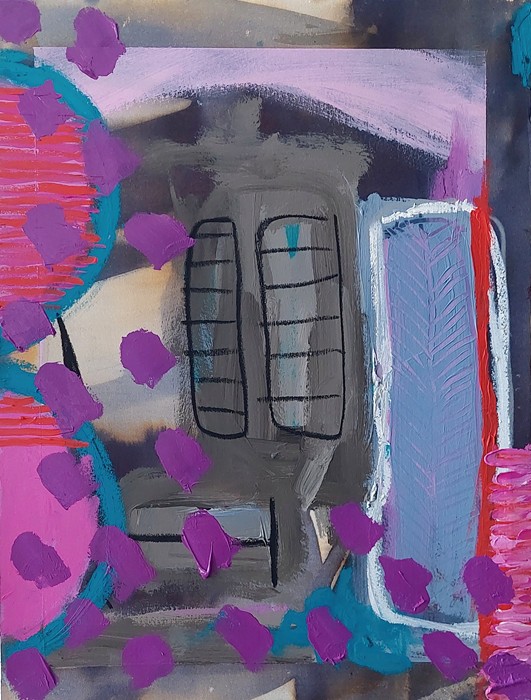
I have continuously expanded and explored this topic for the past four years with my work Próiseas (Process) and most recently, Utopian Spaceships and I am currently collaborating on a project with Leeds University on an illicit fuels project and its damage to the environment on the Mexican, African and Irish borders.
‘Newry Artists Past and Present’ is on show at Newry and Mourne Museum until the end of April 2024.
To view more of Anna Marie Savage’s work please visit www.annamariesavage.com
The Museum is currently offering free tours of the main exhibition galleries on Wednesdays at 2.00 pm. These must be booked in advance by calling our Education Officer at 0330 137 4422.
Newry and Mourne Museum is open Tuesday – Saturday 10.00 am – 4.30 pm. Please call 0330 137 4422 or email museums@nmandd.org for further information.
Please visit their website at www.visitmournemountains.co.uk
Write a comment
In 2022, the Collection at Newry and Mourne Museum was enhanced by the donation of knitwear, knitting machines and archival material from Kilkeel Knitting Mills. These artefacts were donated by Walter Sekules whose parents, Edith and Kurt Sekules, established the Knitting Mills in 1950.
Before World War II the Sekules family had been part of the Jewish community in Vienna and settled in Northern Ireland in 1947. Edith Sekules was born in Vienna in 1916. Both her parents were descendants of Jewish families which had emigrated to Austria from eastern Europe in the late 19th century. In 1936 Edith married Kurt Sekules, a wireless engineer, who she had met a few years before. Their first child, Ruth, was born in 1938.
During these years the political situation in Austria was worsening with the increasing dominance of the Nazis in Germany and resultant pressure on Jews. Like other Jewish families, Kurt, Edith and their infant daughter, attempted to leave Vienna. They were eventually able to leave for Tallin in Estonia in September 1938 where Kurt had found work. However, the outbreak of hostilities between Russia and Germany in 1941 meant that they became enemy aliens. In July 1941 the Sekules family were sent to Harku Detention Camp, near Tallin. The family were to spend the remainder of the Second World War in a number of detention camps in Siberia.
In January 1947, the Sekules family, were able to return to Austria with 200 other internees. Kurt and Edith had decided to join Kurt’s parents who had emigrated to Londonderry in the late 1930s.

Edith was encouraged to set up a knitting factory, and after considering a number of towns in which to establish a factory, Edith settled on Kilkeel in county Down. She set up business in early 1950. Twelve knitting machines were delivered from England and Edith and Kurt began to recruit and train local women.
During the 1950s and 1960s the business continued to expand. As well as making Argyle socks, the company began to knit tartan hose worn by pipe bands and, from 1957, cashmere and Aran sweaters. The customer base also developed to include leading retailers in London, Scotland and America. In 1968, the company moved into larger premises in a former school.

In 1981, Edith reached the age of 65 and had decided to retire. Attempts to develop the company at this time proved unsuccessful and Edith invited Walter to take an increased role in the running the factory. A high-profile order during these years was the knitting of a cardigan for the late Princess Diana in 1986. This was one of a range of five designs by Paul Costello. However, the company was not commercially viable, and Walter made it into a limited company – Tartan Hose Ltd. By this time cashmere was becoming too expensive and Walter focused on Argyle socks. The company was liquidated in 1993/4 and Walter bought out his parents’ shares.

Kurt Sekules died in 2001 and Edith died at the age of 91 in 2008. Walter continued to run the factory until it eventually closed in the autumn of 2022, but not before it had fulfilled an order for dancing socks worn by dancers at the Edinburgh Military Tattoo in 2022. Walter Sekules died in July 2023.
The oldest of the knitting machines and examples of knitwear are on display at Newry and Mourne Museum.
The Museum is currently offering free tours of the main exhibition galleries on Wednesdays at 2.00 pm. These must be booked in advance by calling our Education Officer at 0330 137 4422.
Newry and Mourne Museum is open Tuesday – Saturday 10.00 am – 4.30 pm. Please call 0330 137 4422 or email museums@nmandd.org for further information.
Please visit their website at www.visitmournemountains.co.uk
Write a comment
Since the nineteenth century, Kilkeel harbour and the accompanying maritime industries have played an important role in the economic development of the Kilkeel area.
Before the construction of Kilkeel harbour, Annalong and Derryogue were the most important harbours in the areas. The second half of the nineteenth century saw the development of Kilkeel as a major fishing port and construction work on the harbour began in the 1850s. The harbour flourished and plans were made for a new pier. A survey of the proposed site in 1865 estimated the cost of construction at £5,400. Half of this amount was to be contributed by the Board of Works and the other half raised by subscription or taxation on the district, or a combination of both. The Board of Public Works eventually took the construction of the pier into its own hands under the superintendence of Mr. David Henry and, by 1868, Kilkeel’s first pier had been completed, allowing the fishing industry to flourish.
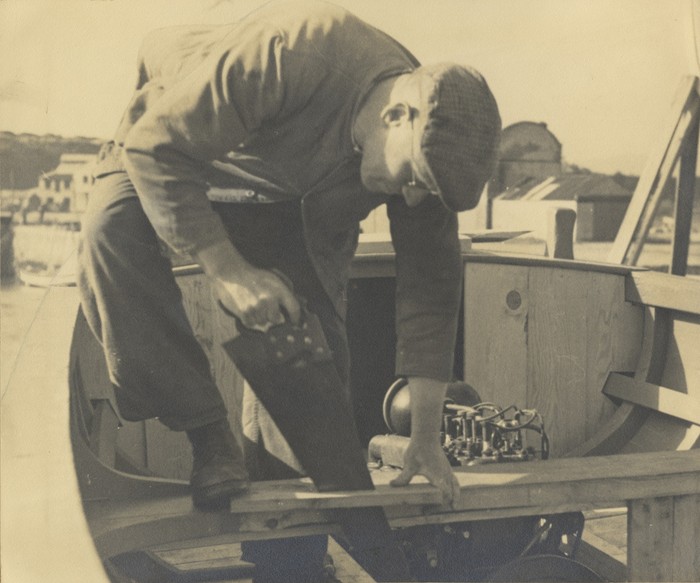
In 1869 the Newry Commercial Telegraph reported that the Treasury had granted an additional sum for the purpose of constructing a basin and other works in connection with the pier.
Improvements to the harbour continued to be made from 1872. In 1885 the south pier was constructed, and the north pier extended to provide accommodation for coastal trading schooners exporting local produce. An architectural drawing illustrating the improvements and extension made to the north pier is on display in Newry and Mourne Museum. In 1886 the Old Dock was constructed.
In the early days schooners traded with Liverpool, Scotland, Cornwall and Kinsale, trading goods such as potatoes, grain, granite and importing coal, etc. This trade meant that warehouses and stores began to appear in the harbour area. These included buildings belonging to Lees of Swansea, who exported potatoes, and Spillers & Bakers Ltd who were flour millers.
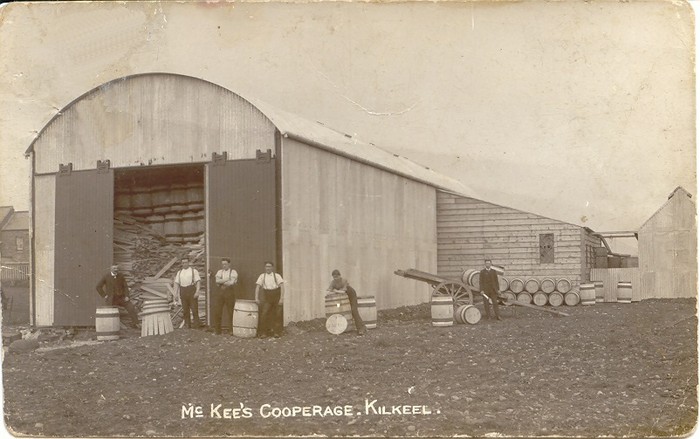
Kilkeel also was home to local boat builders and cooperages, as well as all the related trades needed to maintain boats. In 1875, William Paynter from St. Ives in Cornwall, established a boat-building yard at Kilkeel which built Cornish-style luggers, also known as ‘nickies’ which were more suitable for herring fishing. By 1890 the fishing industry at Kilkeel accounted for more than a third of all the herring landed in Ireland.

In 1916 the Old Dock was extended to form in inner basin, which was improved the capacity of the harbour for commercial growth. A 1918 map of the harbour on display in the Museum shows the inner basin. Also featured is the location of Lord Kilmorey’s boat house and the names of tenants of adjoining properties.
There was further expansion in 1955 when the long quay was built. The fleet grew to over 115 boats in the 1990s and a new slipway completed in 2008.
In recent decades the rural economy has diversified with tourism and production of artisan foodstuffs and specialist crafts becoming important. However, the fishing fleet in Kilkeel remains the largest in Northern Ireland today.
The Museum is currently offering free tours of the main exhibition galleries on Wednesdays at 2.00 pm. These must be booked in advance by calling our Education Officer at 0330 137 4422.
Newry and Mourne Museum is open Tuesday – Saturday 10.00 am – 4.30 pm. Please call 0330 137 4422 or email museums@nmandd.org for further information.
Please visit the museum website at www.visitmournemountains.co.uk
1 Comment
Newry man John McCabe has revealed that thanks to the Department for Communities, Historical Environment Division and NMDDC his request for the listing of Newry's 14 surviving Municipal Boundary stones has been approved.
The nidirect site explains that buildings of special architectural and/or historic interests are 'listed' to protect the best of Northern Ireland’s architectural heritage for future generations.
John reflected "Since childhood attending St Patrick's Primary School Newry I became fascinated with one of these MB stones I passed at the top of the Bricky Loanan. I later learnt in life it was a Municipal Boundary stone one of a set in the town which over years I observed their vulnerability being exposed to modern development with some removed or partially buried."
John went on to explain the historical background to these stones whch he described as being part of the very fabric of old Newry.
"Newry Town Commissioners the forerunners of our Urban Councillors under the Act for lighting and watching etc, proposed the adoption in 1828 of a boundary, much within the limits of the Borough where basic services could be provided.
"Afterwards in 1831 finding this to be too extensive (the expenses of lighting and cleansing the outskirts not being defrayed by the tax levied on the houses there) they restricted the taxable limits within a still narrower boundary.
"In 1871 town Commissioners appointed Robert Baird (Ballinacraig Quarry) to 'furnish eighteen cut granite stones, for borough boundary marks according to specifications' (The Newry Commercial Telegraph October 3 1871). These stones the Department for Communities (Historic Monuments) believe are today's existing MB stones albeit of different individual finishing."

John continued "In my Facebook history group I launched 'The Summer 2019 Big MB Stone Hunt' engaging with members who came back with locations and other useful information on not only MB stones but also Mile Stones. The late Jim Boyd being a fountain of knowledge on such matters.
"Later in March 2021 Newry.ie also assisted with our investigations publishing a story and appeal 'Investigating Newry's Municipal Boundary Stones' which was of great assistance."
Request to HED for Listing
In October 2023 John mailed the DfC Historic Environment Division asking if the stones were protected and if not could they be considered for listing. An archeologist with the Department replied that the Municipal Boundary stones were not currently designated as Protected Historic Monuments but that his request would be considered and forwarded to HED Second Survey.
John explained that since then he has been in regular contact with a historian at the Heritage Buildings and Designation Branch, revealing that they were aware that only four stones existed and were grateful of him supplying photos and detailed locations of the 14 surviving stones.
John was then informed in early December 2023 that acting on his supplied information a site survey of the stones was carried out in November 2023 by the HED who said it was unique to find an existing set of these stones.
The stones were approved for listing by the Historic Buildings Council and have now cleared the final hurdle of approval 'Listings of Buildings of Special Architectural or Historic Interest' with Newry Mourne and Down District Council at the Council Planning Committee in January 2024.
Potential Newry Museum display
One interesting revelation to come out of the queries in relation to the MB stones it transpired that one of them was in Council storage which John also reported to the HED who were not interested given it was not in-situ at its original site.
John concluded "I'm hoping that the stone in storage can be given a new lease of life on display at Newry Museum with detailed information about Boundary stones, Newry Town Commissioners and the significance of the development of Newry within these very Boundary stones."
Now that the stones have been listed you can find information compiled by Department for Communities (HED) on them via their Buildings Database and Historic Environment Map Viewer.
The remaining Municipal Boundary Stones in Newry
1 - Drumalane Park on Drumalane Road.
2 - Dublin Road, bottom of Glen Hill.
3 - Doran's Hill, Barcroft Park in front of Barcroft Community Centre.
4 - Pound Road (Inserted in wall) opposite the foot of Bull's Hill
5 - Armagh Road, opposite Vimy Terrace at top of Violet Hill Avenue.
6 - Armagh Road, between Nos. 28 & 30
7 - Windsor Hill, beside Windsor Court.
8 - Windmill Road (Inserted in wall)
9 - Temple Hill Road (Inserted in wall)
10 - Temple Hill Road
11 - Courtney Hill in front of a Republican memorial and corner of Hawthorn Villas.
12 - Warrenpoint Road at St Mary's Cemetery wall.
13 - Chapel Road, close to Carnagh Park, opposite St Mary's High School (Almost buried)
14 - Downshire Road, entrance to Clanrye Vets (Almost buried)
* - At least one Municipal Boundary stone in Newry Mourne and Down District Council storage.
Write a comment
Foster Newell, Newry’s premier department store, was created by a merger in the mid-1960s of two longstanding Newry clothing retailers Foster and Newell. By 1967 the Foster Newell store had been completed modernised over a two-year period, masterminded by the Managing Director, Barry Edwards, and employed seventy people. In this article, and a future one, we will be focusing on the content of a twenty-four-page advertising supplement of that year entitled ‘The new Foster Newell’s Moderisation Event’. The following quotes from the supplement show that many of the employees were highlighted for their contribution to the success of the store and their back story.
‘Motor rallying is a hobby actively participated in by the bachelor John Aiken, who is the buyer in the men’s and boy’s wear department. A Ballymena man he came to Newry about 20 years ago to serve his time in Fosters. John who also plays golf and badminton, took up rallying about a year ago. He drives a tuned Ford Angelia and is a member of Newry Motor Club, rallying all over the North. So far, he has chalked up one win – the night navigation rally in South Down. During the summertime he plans to go rallying about once a week. Deeply interested in social work, John lends a hand to the local Multiple Sclerosis Society, and he is one of the young men attempting to form a Lions Club in Newry. Members are usually young business and professional men interested in social work and in giving a hand to the needy.’

‘Mrs. Rya Arnold of Dora Avenue, Newry, the buyer in the lingerie and corsetry department spent twelve years in Canada. She returned to her hometown about two years ago and re-joined the firm last October. She has a department of which she can be really proud. The displays are attractive, and the lingerie has a magnetic attraction, each item seeming to be more fascinating than the last! A widow, Mrs. Arnold has a little girl Sandra who is eight and naturally most of her after hours’ time is devoted to her. Mrs. Arnold began her career as an apprentice with the firm and spent seven years with them before moving to Coleraine as a buyer with the firm of Tweedy Achesons.’
‘The days ahead are going to be busy and exciting ones for Miss Naomi McDowell of Warrenpoint, who is planning an Autumn wedding. She has been with the firm for the past seven years and progressed to buying wool and haberdashery department over four years ago. Stocked in the department is virtually everything from a needle to an anchor. Here women will find something many don’t know even exists – a gadget for pulling up and down a back zip. Very handy indeed. Working among all kinds of wool in all colours it is surprising that Miss McDowell wants to even hear the word mentioned after six o’clock – but in her spare time she enjoys rug making and knitting.’

Some customers were asked for their opinion about the store, ‘Mr. Francis V. Harty has been in business as a coal importer and ship broker in the town for the past 32 years and among the authorities of which he is a member is the South Down Hospitals Management Committee. He had this to say: “Shopping in Foster-Newells means that you get satisfaction. When I come in, I am very well looked after and never have any complaints.”’

In the next article, we will continue to highlight some of the people who contributeed to the success of Foster Newell.
The Museum is currently offering free tours of the main exhibition galleries on Wednesdays at 2.00 pm. These must be booked in advance by calling our Education Officer at 0330 137 4422.
Newry and Mourne Museum is open Tuesday – Saturday 10.00 am – 4.30 pm. Please call 0330 137 4422 or email museums@nmandd.org for further information.
Visit their website at www.visitmournemountains.co.uk/museums/newry-and-mourne-museum



 |
 |
 |