

 Write a comment
Newry Drama Festival evolved out of the drama section of Newry Musical Feis. The growing popularity of drama during the 1940s saw the development of numerous dramatic societies in Newry and beyond, including Newpoint Players, The Abbey Players, Colmcille Players and the Iveagh Players. The drama section outgrew the Feis, becoming so large that another festival was needed to accommodate everyone. A separate committee was formed under the Chairmanship of Mrs J H Collins, and in 1949 Newry Drama Festival was inaugurated.
In its first year, the festival had 50 entrants. Competitors included local schools, dramatic societies, drama schools and youth groups. Plays were performed in both English and Irish. Over a period of twelve days, performances took place day and night. This was reduced to six nights in 1961, but later increased to nine. The plays in Irish disappeared from the programme in the mid-1950s and the Junior Section and One Act Plays by the end of the 1970s. Today performances take place over six nights of the festival.

Quality of adjudication is an important aspect of the festival, exemplified by the national and international stature of the adjudicators. The first adjudicator, Frank Harwood, performed the inaugural ceremony on 14th February 1949, commenting that Newry Drama Festival was far ahead of the most up-to-date English festivals in planning, schedule and entries. In 1950, Cyril Cusack’s adjudication was a performance in itself, followed in 1951 by Hilton Edwards, co-founder of Dublin’s Gate Theatre with Micheál Mac Liammόir.

The Troubles took their toll on the festival in the early 1970s. The Town Hall was badly damaged by an arson attack in February 1972 and the festival did not take place between 1972 and 1975. It was revived in 1976 and was joined by the newly established One Act Drama Festival. Its return was not without problems and there was difficulty filling a full programme of plays. On one of the nights when there was no play, the adjudicator, Gerda Redlich, a firm favourite of the festival, coming to Newry no less than five times, gave a one-woman performance, An Evening with Gerda: The Adjudicator Entertains, telling her life story on stage, regaling the audience with how she escaped from the Nazis in 1938 by skiing over the Alps and spent eighteen months with a travelling circus in Italy.

A team of dedicated and enthusiastic people work tirelessly behind the scenes to achieve and maintain the festival’s high calibre. Whilst the committee members have changed over the years, many executives have all served for long periods of time. Of particular note, Violet Durkin, who served as Vice Chair for over 40 years and Eileen Mooney, who was Secretary between 1976 and 2019, and who continues as Vice Chair.
Over the years, challenges faced by the Troubles and Covid pandemic led to five missing years of the festival. Three quarters of a century later, the 70th annual Newry Drama Festival continues to offer a platform to many groups from all over Ireland.
The Museum is currently offering free tours of the main exhibition galleries on Wednesdays at 2.00 pm. These must be booked in advance by calling our Education Officer at 0330 137 4422.
Newry and Mourne Museum is open Tuesday – Saturday 10.00 am – 4.30 pm. Please call 0330 137 4422 or email museums@nmandd.org for further information.
Please visit their website at www.visitmournemountains.co.uk
Write a comment
The Feast of St. Patrick inevitably brings to mind the name of the city of Newry, in Irish Iubhair Cinn Tragh, which derives from the tradition that St. Patrick planted a yew tree at the head of the strand above the Clanrye River. This is not recorded in any early source and only appears in 1162 when the Annals of the Four Masters report that the Cistercian monastery at Newry was destroyed by fire along with ‘the yew tree which Patrick himself planted.’

However, the annals were recording a tradition which had been embedded in the area for some time and the site may have been a place of pilgrimage before the 12th century. The tradition was strong enough for the monastery, which was founded in 1153, to be dedicated to St. Patrick as well as being dedicated to St. Mary and St. Benedict which were the more prevalent Cistercian dedications.
The dedications of the medieval monastery reflect the history of the site and this is further amplified in artefacts from the monastery which are on display in Newry and Mourne Museum. The earliest artefact from the monastery is a grave slab inscribed with a Latin cross and dating from the 12th century. Such a stone would have marked the grave of a dignitary or an important ecclesiastic. It is too ornate to be associated with the Cistercians and may have come from an earlier monastic foundation. This may add credence to the tradition that a Benedictine foundation preceded the Cistercian abbey. Several other abbeys in Ireland were also Benedictine before being re-founded as Cistercian communities.
In more recent times, this stone was located in the external wall of a shop on Castle Street in Newry. It was known locally as the Promise Stone at which deals were struck on market days. When the shop was demolished in the mid-20th century, the stone was moved to its current location in the former premises of the McCann’s Bakery where it remains as one of the displays in Newry and Mourne Museum.

Another artefact from the Cistercian monastery preserved in the walls of Bagenal’s Castle is a section of 13th century roll moulding. Originally part of a pillar, doorway or window, and now out of situ, the section of moulding seems to have either been re-used during the building of the Castle or during refurbishment of the building at some point in its history. The moulding illustrates the style of architecture of the abbey in the 13th century and the standard of patronage exercised by the Cistercian community.
Patronage is also reflected in a stone carved with the head of a high-status lady and heraldic animal. This is stone was probably one of a pair used as’ label stops’ on a hood moulding above a window or doorway. Similar stones can still be seen in situ on a window in the east church at Killeavy, near Newry.
The stone dates from the 15th century and may be from a rebuilding when at least part of the abbey was destroyed by fire shortly before January 1454. Little is known of the lady depicted; she may have been a member of the local nobility who had provided funds for the reconstruction of the abbey after the fire. The stone suggests that the abbey community was investing significantly in building works at this time.
When placed in context these three artefacts provide a brief insight into the history and development of the monastic establishment in Newry. They are also part of the tradition of the association of St. Patrick with the foundation of Newry and the area’s subsequent Christian heritage.
The Museum is currently offering free tours of the main exhibition galleries on Wednesdays at 2.00 pm. These must be booked in advance by calling our Education Officer at 0330 137 4422.
Newry and Mourne Museum is open Tuesday – Saturday 10.00 am – 4.30 pm. Please call 0330 137 4422 or email museums@nmandd.org for further information.
You can visit their website at www.visitmournemountains.co.uk
1 Comment
In this second article on Foster Newell in Newry Newry Museum takes a further look at members of staff which made this business so successful.
Fosters was founded in 1870 by Robert Foster who had a drapers and outfitters shop in North Street. After many expansions and fire damage, a new three-storey building opened in Hill Street. From the 1900s until the early 1960s Foster’s employees could live in, as there was staff accommodation at the rear of the building. Robert Foster died in 1919 and, by 1966, his daughter Ida Foster, then aged 85 was the only surviving member of six children. In that year, the firm merged with Newell, and the premises was rebranded Foster Newell.
Newells was also a long-established business, originally founded by three brothers, with drapery shops in Margaret Street, Newry and The Arcade, Warrenpoint. The brother most closely associated with the Newry business was Sam Newell, who retired in 1963 at the age of 80.
In a supplement promoting a ‘Modernisation Event’ Mr. W. V. Hogg (President of Newry Chamber of Commerce) regards Foster Newell ‘as a feather in the cap and a compliment to the people, that the owners have invested a large amount of money in improving the premises in view of the high unemployment figures. The firm, so far as employment was concerned was very necessary in the town, especially young boys and girls leaving school. In the store they got a training equal to that obtainable in a high-class city store. The town residents had the advantage of having a store which could not be bettered anywhere’ added Mr. Hogg. The supplement also highlights the contribution of other members of staff as follows:

‘Responsibility for the eye-catching window displays rests with Ita O’Hare (22) of Mayobridge, who has been with the firm six years, and her assistant Bronagh Bailey (19) of Monaghan Street, who began three years ago. Both girls play camogie, while Ita also goes to “Keep Fit” classes. Two days a week are given over to thinking up ideas for the displays and preparing to put them into practice.’
‘In the dispatch department is Mr. George Hewitson, a Belfast man who came to Newry in 1948. Since then, he has had a varied career with the firm, climbing the ladder from caretaker to his present post – in charge of a newly created department. A veteran of both World Wars, he lives at Hill Street.

In 1916 he joined the Second Bn. Royal Irish Rifles as a band boy but was invalided out over a year later. At the outbreak of the Second World War, he joined the Navy and was invalided out in 1942. Mr. Hewitson is chairman of the Servies committee, and chairman of the Legion Club.‘

‘The buyer in the knitwear and separates department is Miss Miriam Kelly (28) of Lisnagree, Poyntzpass, who commenced her career with Newells in 1954. Miss Kelly has been a buyer since 1959. Around Christmas she became engaged to a farmer. No date has yet been fixed for the wedding. Among her hobbies are dancing and youth work.’
Some customers were asked for their opinion about the store, ‘Mrs. Florence Ewen, owner of a monumental sculpturing business and a past president of the local Soroptimist Club, considers that the people of Newry and district are lucky to have the most up-to-date shop of any provincial town, capable of competing with a city store. She spoke of the courteousness of the staff commenting: “Dealing with Foster Newells means satisfaction.” Mrs. Ewen was extremely appreciative of the Coffee Lounge, adding that should she only come in to meet some friends for coffee, she was bound to see something else in the store and make a purchase before leaving.’
The Museum is currently offering free tours of the main exhibition galleries on Wednesdays at 2.00 pm. These must be booked in advance by calling our Education Officer at 0330 137 4422.
Newry and Mourne Museum is open Tuesday – Saturday 10.00 am – 4.30 pm. Please call 0330 137 4422 or email museums@nmandd.org for further information.
Please visit our website at www.visitmournemountains.co.uk
Write a comment
Over the next two weeks, Newry and Mourne Museum will be looking at the two Great Northern Hotels that were built in the local area. For our first article, we will be taking a closer look at the Great Northern Hotel in Warrenpoint.
With the development of the railway line to Warrenpoint, the Great Northern Railway Company planned on capitalising on the popularity of the area as a seaside resort. One method of achieving this was to buy several hotels in Warrenpoint, Rostrevor and Omeath and update them at a cost of £50,000. Two of the hotels became known as Great Northern Hotels. Between 1877 and 1915 a horse-drawn tramway linked the railway in Warrenpoint with the Great Northern Hotel at Rostrevor providing better public transport and connections between the two hotels.
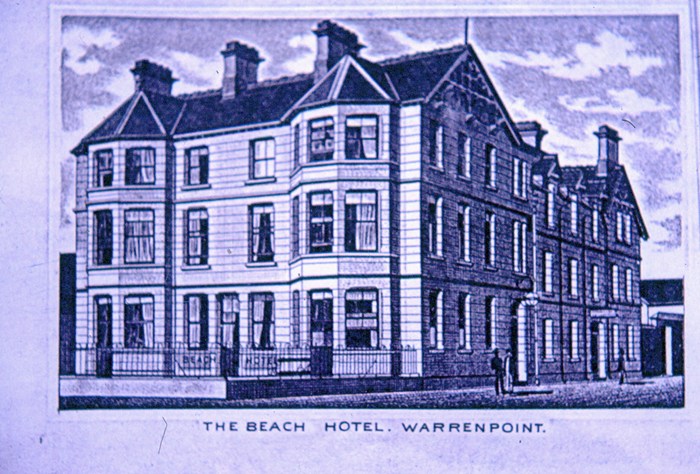
The Great Northern Hotel at Warrenpoint was originally known as the Beach Hotel, which opened with fifty rooms on Easter Monday, March 1885. The building was designed by local architect W.J. Watson and built by Alexander Wheelan, at a cost of almost £5,000. Features of the hotel included baths, (hot, cold, salt, and freshwater options were available), a billiard room and a smoking room. The hotel offered an uninterrupted view of Carlingford Bay, Rostrevor, and the local mountains. The owner, Henry Stanley, went bankrupt in 1886 and the hotel was purchased by the Great Northern Railway Company, who took the initiative to enlarge the building. Watson was also behind the design of the gabled and turreted three-story section added to the hotel at this time. The name changed to the Great Northern Hotel at some point in the late 1890s.
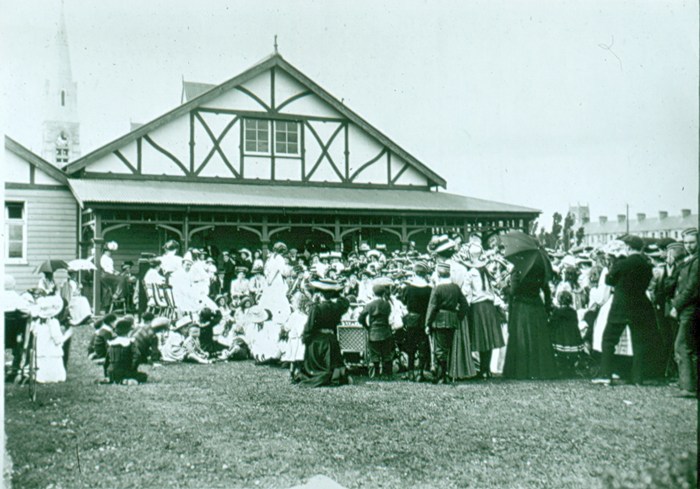
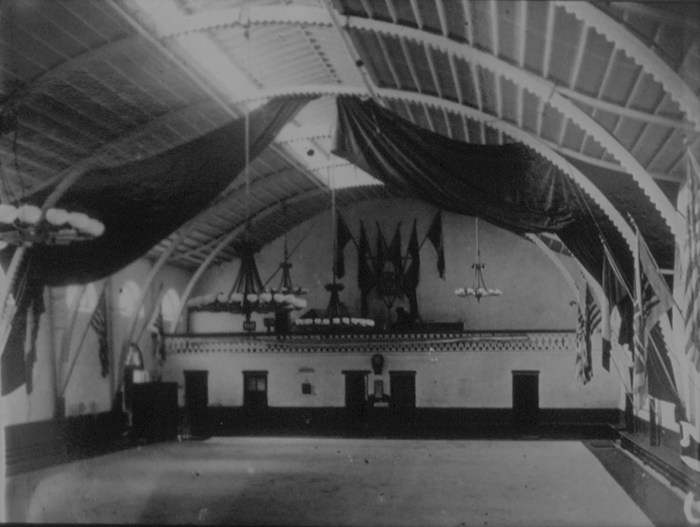
Another method of attracting holidaymakers and day-trippers was the Pavilion. The Pavilion was built in the grounds of the Great Northern Hotel in 1906 and served as a tearoom, dance hall and entertainment centre. The Newry Reporter had several articles over the years listing the events that the Pavilion hosted such as a weekly dance in 1906 and a biweekly cinematograph exhibition during the winter months in 1912.
In 1923 the hotel closed. The local papers advertised a clearance sale which listed all room furnishings for sale including the billiard table (complete with accessories), the grand piano, silver and E.P. Ware. The hotel was sold to the Sisters of Mercy to use as a school which opened a year later as Our Lady of Lourdes Boarding School.
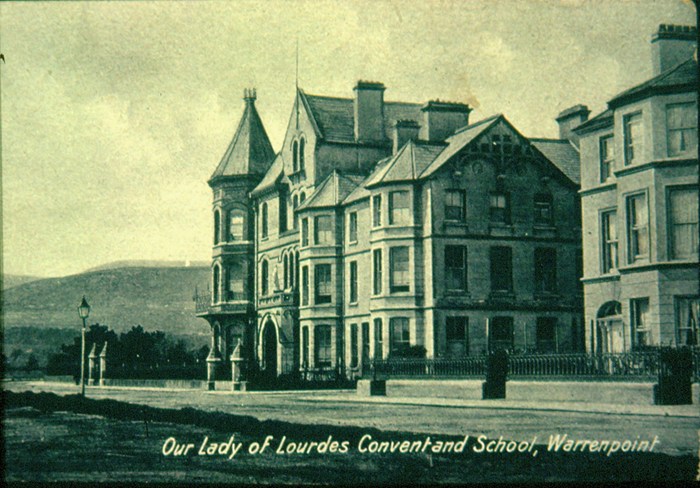
The school relocated in 1930 to the Convent of Mercy in Newry. In 1938 the former hotel became St. Joseph’s Home for elderly men. The home eventually allowed women to be admitted as residents in 1985 and is still operational today.
When the hotel was bought by the Sisters of Mercy, the Pavilion was converted into a classroom and then into a school. The Star of the Sea Girl’s Primary School then amalgamated with St. Peter’s Boy’s Primary School and the two became St Dallan’s Primary School which opened in September 2000.
The Museum is currently offering free tours of the main exhibition galleries on Wednesdays at 2.00 pm. These must be booked in advance by calling our Education Officer at 0330 137 4422.
Newry and Mourne Museum is open Tuesday – Saturday 10.00 am – 4.30 pm. Please call 0330 137 4422 or email museums@nmandd.org for further information.
Visit their website at www.visitmournemountains.co.uk
1 Comment
In the second of two articles looking at the two Great Northern Hotels that were built in the local area, we explore the history of the Great Northern Hotel in Rostrevor.
Built on the site of the Old Quay Hotel to designs of local architect William James Watson and originally known as the Mourne Hotel, the Great Northern Hotel was bought by the Great Northern Railway Company (G.N.R.C) in the late 1800s along with the neighbouring Woodside Hotel and restaurant. It was Rostrevor’s largest hotel.
The hotel was designed with a frontage of 150ft facing towards Carlingford Lough and sat at the foot of Slieve Ban. The centre portion was designed to be one storey higher than the wing portions, to artistically break the skyline. Some other notable distinctive features of the hotel included ornamental balconies, dormer windows and a vestibule separated from the entrance hall by an ornamental mahogany screen. The rest of the internal woodwork was made of pitch pine and the entrance hall and ground floor passages were covered with encaustic tiles. However, it could be argued that the most striking features were the long and multi-arched corridors that ran from end to end of the building on each storey.
After six months of extensive structural renovations and a remodelling of the sanitary arrangements (under the eye of Mr. J. Finlay Peddie, a sanitary expert and engineer) the hotel reopened in 1899 to visitors. Mr. and Mrs. H. Llewellyn Booth were the managers and Mr Malar was the chef.

Focusing on attracting visitors, the hotel highlighted its modern new baths, the ample stabling and cycling accommodation, and the accessibility to the Mourne Mountains. They also advertised how close the hotel was to local golf courses and of the trout fishing opportunities nearby. Guests were also invited to enjoy the skating rink that was located next to the Woodside Hotel. The 2,000-capacity rink was built by the 3rd Earl of Kilmorey and had been repaired and re-roofed by Mr. Mahood with funding from the G.N.R.C. The rink also served as a dance hall with skating became less popular and hosted several events for visitors during rainy days. In December 1903, the rink and the adjoining public bar (known as the Rink Bar) were destroyed in a fire.
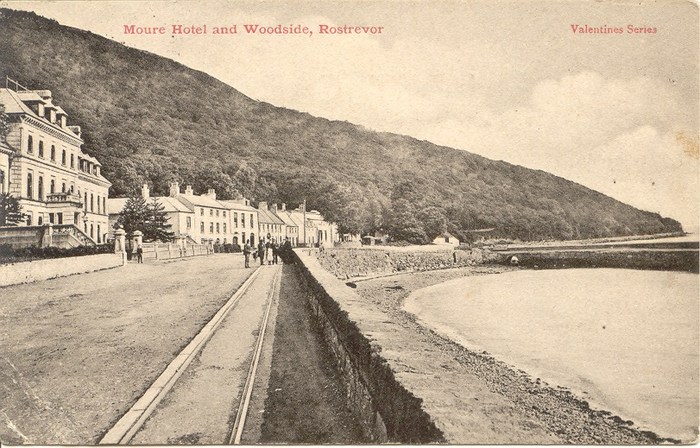
Over the decades the Great Northern Hotel became one of the most iconic in south Down and was purchased in 1971 by Sir William Hastings (founder of Hastings Hotels) along with five other former railway hotels in Northern Ireland from the Ulster Transport Authority. The Great Northern Hotel had been renamed the Rostrevor Hotel and was destroyed by a firebomb on the night of Friday 29th December 1977. It never reopened.
The Museum is currently offering free tours of the main exhibition galleries on Wednesdays at 2.00 pm. These must be booked in advance by calling our Education Officer at 0330 137 4422.
Newry and Mourne Museum is open Tuesday – Saturday 10.00 am – 4.30 pm. Please call 0330 137 4422 or email museums@nmandd.org for further information.
You can visit the Museum website at www.visitmournemountains.co.uk
Write a comment
Profiling Céline Traynor and her work as a jewellery artist, this is the second in a series of occasional articles looking at the work of some of the contemporary artists featured in Newry and Mourne Museum’s temporary exhibition, ‘Newry Artists Past and Present’.
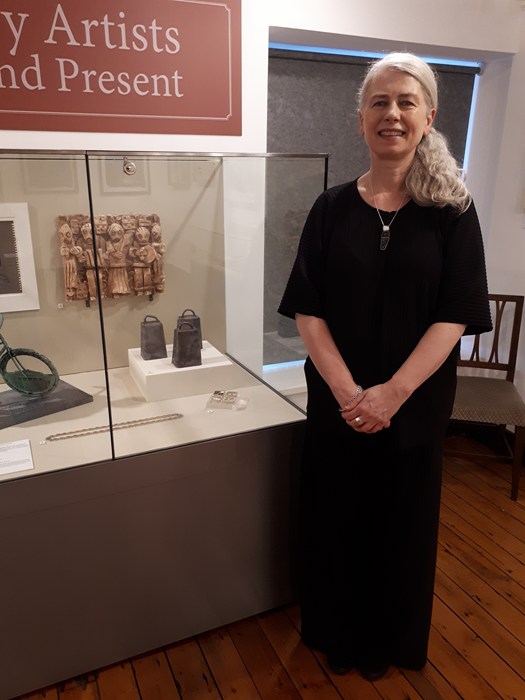
Céline Traynor was born and attended school in Newry, then studied at the University of Ulster, Belfast, graduating in Fine Craft Design in 1988. She relocated to Dublin and worked as an apprentice jeweller at Emma Stewart Libertys in Powerscourt Townhouse. In 1997, she joined the Rubicon Design Studios in Dublin, with a group of like-minded, self-employed, individual jewellers.
Céline’s business subsequently expanded, with exhibitions, trade and craft fairs. She was involved in many projects initiated by the Crafts Council of Ireland, aimed at showcasing Ireland’s contemporary designer makers at home and abroad. Various retail, private and corporate commissions continued throughout this time, including prestigious gifts presented to Irish Presidents Mary Robinsons and Mary McAleese, various jewellery pieces for the film ‘Moll Flanders’, and a pectoral cross, commissioned by the Auxiliary Bishop of Liverpool, the Right
Reverend Thomas Williams. In 2002, Céline returned to Belfast and worked alongside her brother, goldsmith Garvan Traynor. Although having separate businesses, they also worked on various projects together, including significant commissions for film and TV such as 'City of Ember', 'Closing the Ring' and 'Game of Thrones'.
Céline has diversified in the last decade to include facilitating jewellery and art workshops in the community. This practice is very different from bench work, but she finds this work really satisfying as an individual artist. She continues to exhibit, and design and make commissions for clients. Her jewellery pieces have won awards, are held in public and private collections, and are seen in a variety of publications.
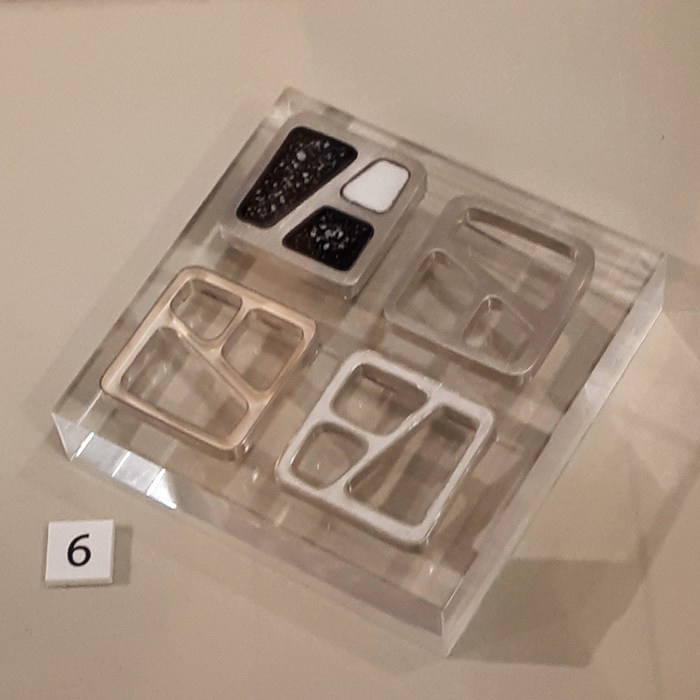
Two of Céline’s pieces of jewellery are in Newry and Mourne Museum’s Collection and are currently on display in the exhibition ‘Newry Artists Past and Present’ at the Museum. They are part of a body of work relating to her memories of Canal Street and Céline here describes the inspiration behind these works:
“I was born and lived for twenty-four years in a Victorian terrace house on Canal Street, Newry, Co.Down. A black and white, minimal tile design on a now closed shop front further down the street, Wylies Electrical, which I walked passed on many, many occasions, invokes strong memories. I’m not sure if this influenced my graphic, minimalist design ethic, or if that was already in me and was awoken by the tile shapes, arrangement and mute colours! After seeking permission, in the knowledge that the building is to be demolished, I peeled of a number of these tiles as a catalyst to design and make new work. The 4 brooches, “FORM, Going, Going, Going…”, represent the demise, not only of the building that the tiles were removed from, but of the town itself, and many town and city centres across the country. Some great buildings and fine architecture have been sacrificed for progress.
The top left brooch shows the tiles intact. In the top right brooch the tiles are missing. The bottom right brooch exposes the tile grout that was holding the tiles in place, and the bottom left brooch is down to the bare bones. The 4 brooches are arranged in the original pattern.
I made the silver “Brick Work, A Civic Chain” to honour my memories of living on Canal Street, just as a mayor is bestowed a civic chain while representing a town or city’s residents.
The names and places I have stamped on the brick shaped links are not a snapshot in time but a jumbled up construct of my memories through the years, of those buildings and people that meant something to me. The names are in the right positions on both sides of the street, represented by two strands of silver chain, but not necessarily at the same time.
The brass brick that represents our house, No.48, was actually from a piece of metal I used as part of my jewellery degree show, a satisfying amalgamation of two aspects of my life from that time.”
‘Newry Artists Past and Present’ is on show at Newry and Mourne Museum until autumn 2024.
To view more of Céline Traynor’s work please visit www.celinetraynor.com
The Museum is currently offering free tours of the main exhibition galleries on Wednesdays at 2.00 pm. These must be booked in advance by calling our Education Officer at 0330 137 4422.
Newry and Mourne Museum is open Tuesday – Saturday 10.00 am – 4.30 pm. Please call 0330 137 4422 or email museums@nmandd.org for further information.
Visit their website at www.visitmournemountains.co.uk/museums/newry-and-mourne-museum
Write a comment
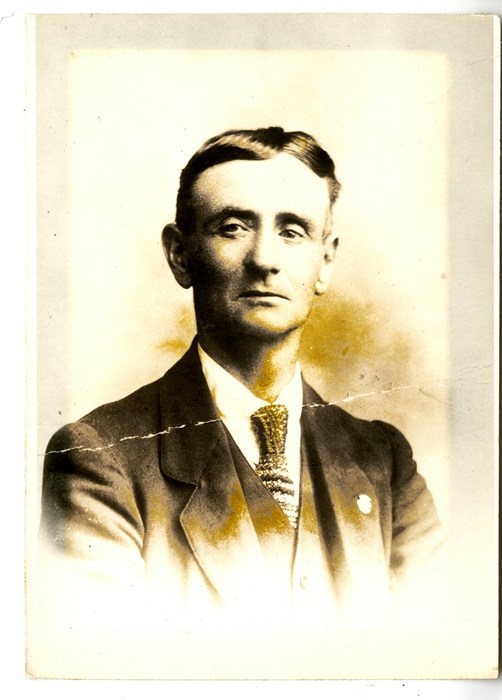
This week’s article, written by Brian M. Walker, Professor Emeritus of Irish Studies at Queen’s University Belfast, explores the significance of a photograph taken of James Craig, the first Prime Minister to Northern Ireland, and the members of Newry Urban District Council at Newry Town Hall in 1927.
Among the collections in Newry and Mourne Museum is a photograph which records a significant event in Newry on 8th February 1927. It shows members of Newry Urban District Council with Viscount Craigavon, Prime Minister of Northern Ireland, on his visit to the town. They are standing in front of the Town Hall after a reception and lunch for their visitor.
In January 1926 the election for Newry Urban Council had surprising results, reflecting the relevance for many of the social and economic issues over constitutional matters. The outcome was the return of not only six Nationalist and six Unionist Councillors but also six Labour Councillors, led by W.F. Cunningham, Chairman of the local Trades and Labour Council.
This resulted, after much debate, in the election of Unionist William Robinson as Chairman, the first Unionist Chairman for over twenty years. He was managing director of the Newry firm of Foster & Co. Ltd. The Nationalist Terence Ruddy was elected Vice-Chairman. Appointments to standing committees resulted in three members of each party in each committee.
On 24th January 1927, James Craig, recently elevated to the peerage as Viscount Craigavon, announced plans for a ten-day tour of local authorities to assure them that their interests would not be neglected by the government. He would be accompanied by Sir Dawson Bates, Minister of Home Affairs.
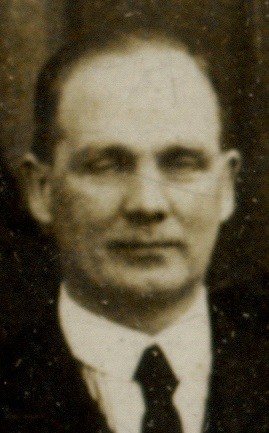
On the morning of 8th February, after visiting Kilkeel and Warrenpoint, the two men travelled to the Town Hall in Newry. They met Chairman William Robinson and members of the Urban Council in private conference. At 2.00 pm the visitors and a large representative company of Newry organisations were entertained to luncheon.
After lunch, according to the Newry Reporter, Robinson ‘submitted the usual loyal toast, which was followed by the singing of ‘God save the King’’. He then made a speech and thanked the government for their ‘liberal grants’.
Craigavon replied to express gratitude for their welcome. He urged people to work for prosperity for Northern Ireland. He added: ‘Might he also say that they in Ulster of all creeds and classes were sufficiently broadminded to say that they also hoped for prosperity for the whole of Ireland (applause)’.
Subsequently, politics in Newry continued along conciliatory lines. Shortly before the January 1929 Urban Council elections, it was announced that William Robinson would stand down and leave Newry. He had been appointed managing director of the Bank Buildings department store in Belfast.
At his last Council meeting tribute was paid to the ‘able, dignified and impartial manner’ in which he had discharged the duties of the Chair.
The 1929 election saw again the return of six Councillors from each party. The new Chairman was Nationalist Hugh J. McConville. The Unionist James Boland was elected Vice-Chairman.
At the 1932 election, the return of the parties was the same, with no contest. Again, a Nationalist chairman and Unionist Vice-Chairman were elected. In 1938 Labour Councillor W.F. Cunningham was elected Chairman.
This 1927 photograph allows us to recall a special, largely forgotten, moment in the history of Newry and Northern Ireland. It deserves to be appreciated.
This article is based on a longer article written by Professor Walker in ‘The legacy: Newry 1920-30’, published by Newry and Mourne Museum in 2021. PDF copies of this booklet can be obtained by contacting the Museum at museums@nmandd.org
The Museum is currently offering free tours of the main exhibition galleries on Wednesdays at 2.00 pm. These must be booked in advance by calling their Education Officer at 0330 137 4422.
Newry and Mourne Museum is open Tuesday – Saturday 10.00 am – 4.30 pm. Please call 0330 137 4422 or email museums@nmandd.org for further information.
Visit their website at www.visitmournemountains.co.uk
Write a comment
In the later 19th and early 20th centuries, the society magazine, Vanity Fair, published caricatures of leading celebrities of the day as a supplement to its weekly editions. On 26th October 1876, a caricature appeared of Francis Charles Needham, Viscount Newry and Mourne, who was then well known in the world of London theatre.

Francis Charles Needham was born in London in 1842, the son of Francis Needham, heir to Francis Jack, second Earl of Kilmorey. Francis Charles became his grandfather’s heir when his father died in 1851 and was then able to use the courtesy title of Viscount Newry and Mourne. After attending Eton, Lord Newry went on to Christchurch College, Oxford. Between graduating in 1863 and gaining his MA in 1867, he travelled widely, including America during the final stages of the Civil War. In 1866 – 1867, he was in the retinue of Prince Alfred, Duke of Edinburgh, a son of Queen Victoria, on a world tour.
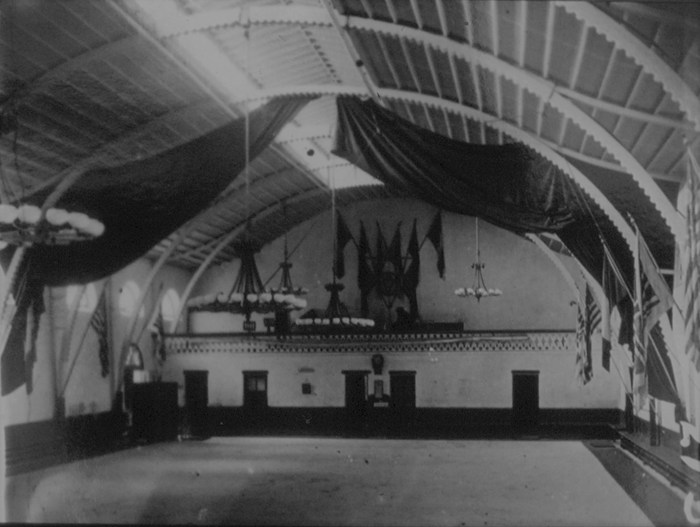
Despite his travels and Royal service, Lord Newry did not neglect his position in Shropshire and south Down where his family had their estates. He was commissioned in 1865 in the Shropshire Yeoman Cavalry and was an officer in the South Down Militia. Following in the footsteps of his father and grandfather, he represented Newry in parliament and was M.P. for the borough from 1871 until 1874.
Lord Newry lived mostly in London in a succession of properties before settling c.1896 at 5 Aldford Street in Mayfair which remained the Kilmorey town house until 1924. His connections at Court may have been one reason for his focus on London but perhaps the main reason was his involvement in the theatrical life of the capital. He was a highly successful theatre owner and impresario; among other ventures, he was involved in the building of the Globe Theatre and leased the St. James Theatre. From these two theatres, he was reaping an annual income of £7,000 (just over £900,000 today) by 1885. Notable among his other theatrical interests, was his support for the Royal Opera House and the Royal Albert Hall.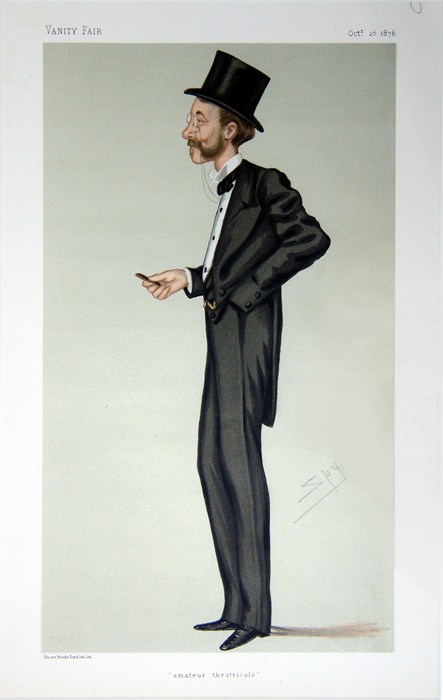
Francis Charles became the third Earl of Kilmorey on the death of his grandfather in 1880 and, in 1881, married Ellen Constance (Nellie) Baldock, daughter of Edward Holmes Baldock, M.P. for Shrewsbury. Together they re-established the Kilmorey family at Mourne Park, near Kilkeel, and played a greater role in local affairs. Lord Kilmorey was a Justice of the Peace and a Deputy Lieutenant for County Down. He was an avid supporter for Unionism in the face of Home Rule and was instrumental in raising a strong contingent of the Ulster Volunteer Force in the area. As commandant of the South Down Nursing Corps, Lady Kilmorey played a significant role in supporting the wounded of the Ulster Division during the First World War.
Lord Kilmorey took a closer interest in the economic potential of south Down during these years. He was particularly interested in the development of Rostrevor as a tourist resort and gave financial backing to the Warrenpoint and Rostrevor tramline and the Mourne Hotel (later the Great Northern Hotel) with the adjoining ice rink. However, declining land values curtailed many of Lord Kilmorey’s other ambitions for the area.
Lord and Lady Kilmorey also maintained their connections with Royal circles. With the support of Edward, Prince of Wales, Lord Kilmorey became a Knight of the Order of St. Patrick in 1890 and was appointed an aide-de-camp to Edward when he became King in 1901. The Kilmoreys had a close friendship with the family of the Duke of Teck, particularly Prince Frederick, a brother of the future Queen Mary, and a frequent visitor to Mourne Park.
In the days when the lives of the aristocracy were documented in the Court Circular, published daily in The Times, it was announced on 22nd July 1915 that the Earl of Kilmorey was ‘seriously ill, suffering from an attack of pneumonia. His son, Viscount Newry, had been recalled from the front’. The Court Circular for 23rd July reported that the Earl had had ‘a good night’ and ‘a restless night’ on 26th. On 29th July, it was announced that Lord Kilmorey had died the previous day at his London home. The funeral took place at Kilkeel and a memorial service was held for him on 31st July in the Chapel Royal at St. James’ Palace.
The Museum is currently offering free tours of the main exhibition galleries on Wednesdays at 2.00 pm. These must be booked in advance by calling our Education Officer at 0330 137 4422.
Newry and Mourne Museum is open Tuesday – Saturday 10.00 am – 4.30 pm. Please call 0330 137 4422 or email museums@nmandd.org for further information.
Visit their website at www.visitmournemountains.co.uk
Write a comment
A combined public archive which brings together several thousand years of Northern Ireland’s history and heritage has been officially unveiled in Belfast this week.
Communities Minister Gordon Lyons opened the new shared space for the Historic Environment Record of Northern Ireland (HERoNI) at 2 Titanic Boulevard.
HERoNI is now co-locating with the Public Record Office of Northern Ireland (PRONI), utilising a purpose-built archive centre in the heart of the Titanic Quarter. HERoNI holds information on all elements of Northern Ireland's historic environment in the form of databases, written records, maps, photographic, drawn and digital material.
Communities Minister Gordon Lyons visited PRONI this week and viewed some of the HERoNI archives. Minister Lyons said: “This is a welcome co-location bringing together two archives into one purpose-built centre in the Titanic Quarter. This move combines these two important archives under one roof, housing a wealth of Northern Ireland’s history and heritage. In doing so, it will facilitate ease of access for the public and provide a comprehensive resource for interested researchers.
“The HERoNI archives hold information on thousands of years of Northern Ireland’s historic environment. A taster of what is on offer includes records, images and drawings relating to archaeological sites, listed buildings, Industrial and defence heritage, to name but a few.
“I would encourage anyone interested in history to visit and explore the HERoNI and PRONI historic documents.”
Over the past 12 months, HERONI archivists have been carrying out the extensive task of documenting and transporting all the items held in their collections.
HERoNI also brought along its library, a fantastic resource with publications covering all aspects of Northern Ireland’s historic environment. This is the first time that the library will be open for public browsing.
You can visit a special exhibition which is showcasing some of the fascinating collections held in HERoNI. These include:
Find out more about HERoNI and the resources available at www.communities-ni.gov.uk



 |
 |
 |