







 Write a comment
The huge restrictions on travel in 2020 and an emphasis on ‘staycations’, have given us the opportunity to appreciate our own surroundings on a much greater scale and in a way that we maybe haven’t in a long time. This gives us a chance to look back on how tourism guided the decisions of many to stay and travel to and from our own local area in years gone by.

The building of Newry Canal in 1742 and the development of the port of Newry, provided the stimulus for the town’s economic growth in the 18th and 19th centuries. Further investment brought the railways to Newry, and after the opening of the Newry – Warrenpoint line in 1849, the town became an important junction for several railway lines, linking Newry with Belfast, Dublin, Warrenpoint and Armagh and other parts of Ireland.

The railways were not only of huge benefit to local business but also facilitated travel and leisure. A port was constructed at Greenore on the north coast of county Louth in the 1860s to provide a link by sea with Heysham, Holyhead and Liverpool. The opening of the Dundalk, Newry and Greenore Railway in 1873 meant that Greenore became an important terminus for people travelling to and from the Newry and Mourne area.

The railway companies built hotels and many women opened boarding houses in the seaside resorts at Warrenpoint, Rostrevor and Omeath on Carlingford Lough. A horse-drawn tramway linked the rail-head in Warrenpoint with Rostrevor between 1877 and 1915. By the late 19th century there were seven hotels in Warrenpoint and three in Rostrevor, the Mourne (Great Northern), Woodside and Rostrevor.
In 1907 Warrenpoint Municipal Park with its bandstand opened to the public and this was followed by the opening of a saltwater swimming pool in 1908. These new facilities provided excitement and entertainment throughout the summer season for locals and visitors alike.

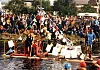
By 1920 there were twenty boarding and lodging house owners in Rostrevor and twenty-seven in Warrenpoint. The latter also had eleven boatmen, who rowed tourists and day trippers back and forth to Omeath on the other side of Carlingford Lough. During the summer of 1924 the Great Northern Railway carried a total of 39,145 passengers on organised excursions to Warrenpoint.

People from all over Ireland and farther afield flocked to the seaside on high days and holidays.
Other popular destinations were places like Cranfield, near Kilkeel, the most southernly townland in county Down. This became an attractive spot to bring caravans and to this day remains a popular site for static and touring caravans alike.
The Newry and Mourne area has a rich tourism heritage and, hopefully, our newfound appreciation of our local area, whether it be beaches, parks or mountains, can be sustained and supported for many more years to come.
Newry and Mourne Museum is temporarily closed.
by Dympna Tumilty