

 Write a comment
In 2019 Newry and Mourne Museum acquired two important additions to its collection of World War II uniforms. One was the tunic from the uniform worn by Bramwell Baird from Newry, who served with the Royal Air Force and other is a blouse and cap from the American Army’s 563rd Motor Ambulance Company worn by James Quinn, originally from near Kilkeel, county Down.

Born on 3rd September 1924, Bramwell Baird worked as a clerk with The British and Irish Steamship Company in Merchants Quay in Newry after leaving school.
He became a member of the Air Training Corps (the Home Guard) but, after the outbreak of World War II in September 1939, he joined the RAF at the age of seventeen. He was initially trained in radar before being sent to Deal, near Dover, where he received training on bomb targeting equipment directing ‘pathfinders’. ‘Pathfinders’were target-marking squadrons in RAF Bomber Command and they located and marked targets with flares, which improved bombing accuracy.

A family story relates how Baird guided an RAF plane back to base which was on fire after having been under enemy fire. No one wanted the responsibility of guiding this plane back as it was assumed that it would crash being so badly damaged. Baird succeeded and the plane with its crew landed safely.
While stationed in Europe, Baird sustained a serious head injury when he was thrown from a truck which had hit a bomb crater. After being nursed in France for six weeks, he was sent to England where he recuperated in hospital for nearly a year, before returning to Newry in 1946.
Baird’s former employers transferred him to Dublin but he later got a job with the Ministry of Finance in Belfast. He remained there until he retired in his early fifties. Bramwell Baird died on 10thMay 1993.

From Tullyframe, near Kilkeel, James Quinn emigrated to America in May 1927 just over a month before his twentieth birthday. He settled in New York where he opened a grocery business with an annual turnover of $30, 000. In 1936 he became an American Citizen.

From 1943 until 1945 Quinn served with the American Army in the 563rd Motor Ambulance Company and was involved in the Allied advance across Europe into Germany after the D-Day Landings in 1944. Attached to the 96th Evacuation Hospital Unit, he was an ambulance driver and mechanic. He was in engaged in driving casualties from the evacuation point back to where the hospital was stationed. Quinn was discharged from the American Army in October 1945.

In 1950 James Quinn returned to Kilkeel where he opened a shop and bought a farm in Corcreaghan townland. He married Susan Murphy and had one daughter, Anne. He died in 1975.
These uniforms are now on display at Newry and Mourne Museum.
The Museum is currently offering free tours of the exhibition galleries on Wednesdays and Thursdays at 11.00 am. These must be booked in advance by calling our Education Officer at 0330 137 4422.
Newry and Mourne Museum is open Tuesday – Saturday 10.00 am – 4.30 pm. Please call 0330 137 4422 or email museum@nmandd.org for further information.
Write a comment
The generosity of local people has resulted in Newry and Mourne Museum becoming home to many artefacts from two department stores, R.J Sloan in Kilkeel and Foster – Newell in Newry, which were famous in the area for much of the 20th century.
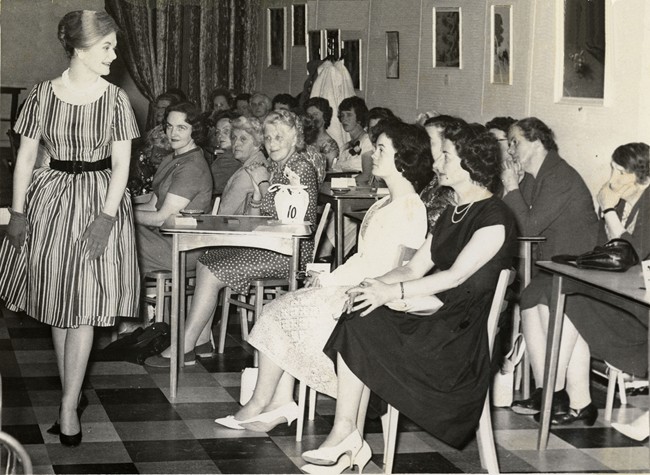
In 1887 Robert James Sloane, who was originally from near Rathfriland, opened a shop on Newry Street in Kilkeel selling fabric and dressmaking and tailoring supplies. In the early years of the 20th century he moved to larger premises on the opposite of Newry Street and began to sell all types of ladies and gentlemen’s clothing. The first shop in Kilkeel to have gas lighting installed, R.J. Sloane’s specialized in high quality goods.
The shop continued in Kilkeel for almost a century, being run by Jeannie, one of R.J. Sloane’s two daughters, after his death in 1952. Jeannie died in about 1981 and the shop closed.
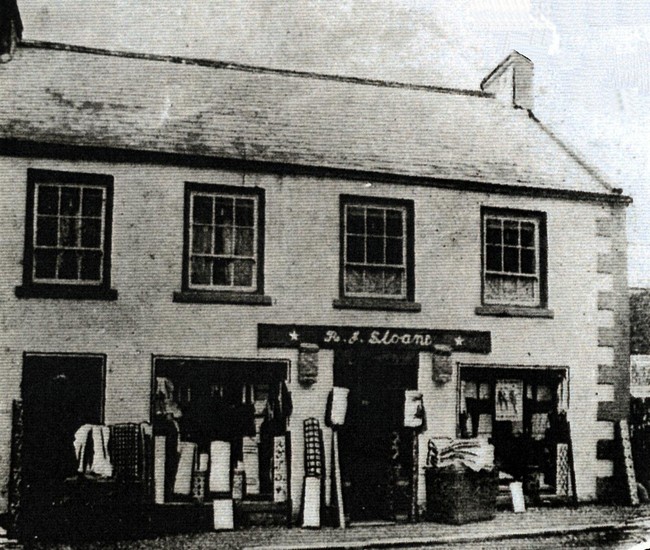
At the time of closure, the shop still contained the original fittings and still had merchandise from the early decades of the 20th century. Much of the surviving merchandise and the fittings were donated to the Ulster Folk and Transport Museum and a replica of the shop was built at the Museum.
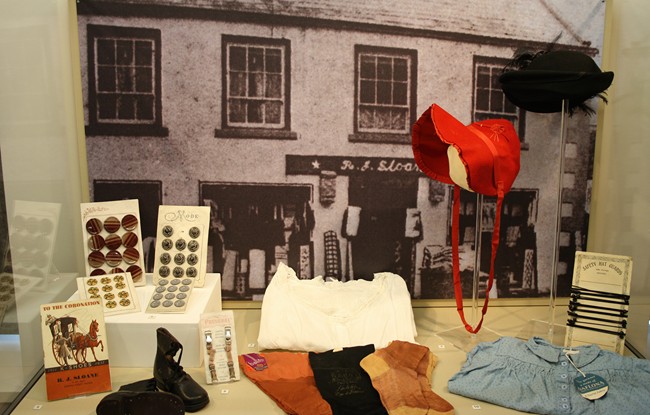
Over the past few years, a number of people from Kilkeel have generously donated various items purchased in the shop to Newry and Mourne Museum. These include ladies and gentlemen’s clothing, hats, shoes and accessories, mainly dating from the 1900s up to the 1950s. Currently on display in the museum are a pair of ladies’ leather lace up boots and a poster advertising Sloane’s, shop, both from the 1900s.
Like Sloan’s, Foster – Newell’s in Newry sold high quality clothing and goods. The company dated back to 1870 when Robert Foster started a draper’s and outfitter’s shop in North Street but soon his expanded his business to Hill Street. In 1907 the business became a limited company, and Foster, along with his son, John, and Sir William Robinson, became the directors. In December of that year fire gutted two of the three shops, causing £20,000 worth of damage. A new, three-story building opened in Hill Street two years later. Designed by Samuel Wilson Reside, a local architect, two of the plans for the building are part of the Museum Collection.
Robert Foster died in 1919 and the firm merged with Newell and the premises in Hill Street was rebranded as Foster- Newell. Newell’s was also a long-established business, originally founded by three brothers, with drapery shops in Margaret Street, Newry and The Arcade, Warrenpoint.
By 1967 the Foster-Newell store had been completely modernised over a two-year period, masterminded by the Managing Director, Barry Edwards. The store’s open plan layout held at least ten different departments ranging from cosmetics, lingerie and corsetry, ladies fashion to household goods. Each department had a buyer, and there were also staff who looked after the window displays, for which Foster-Newell was famous.
Foster-Newell continued to be popular shopping destination throughout the 1960s and 1970s, but was destroyed, along with a number of other shops, in an incendiary blitz on Hill Street in April 1976.
Artefacts in the Museum from Foster – Newell’s include a wedding dress, a poster for a charity fashion show in 1966 and a hat brush from the 1900s.
The Museum is currently offering free tours of the exhibition galleries on Wednesdays and Thursdays at 11.00 am. These must be booked in advance by calling our Education Officer at 0330 137 4422.
Newry and Mourne Museum is open Tuesday – Saturday 10.00 am – 4.30 pm. Please call 0330 137 4422 or email museum@nmandd.org for further information.
Write a comment
In advance of a planned extension to Carnbane Industrial Estate on the outskirts of Newry, an archaeological excavation was undertaken in 2011 by Irish Archaeological Consultancy on land adjacent to where previous research had revealed a Bronze Age landscape consisting of multiple ring ditches, cemeteries and burnt mounds.
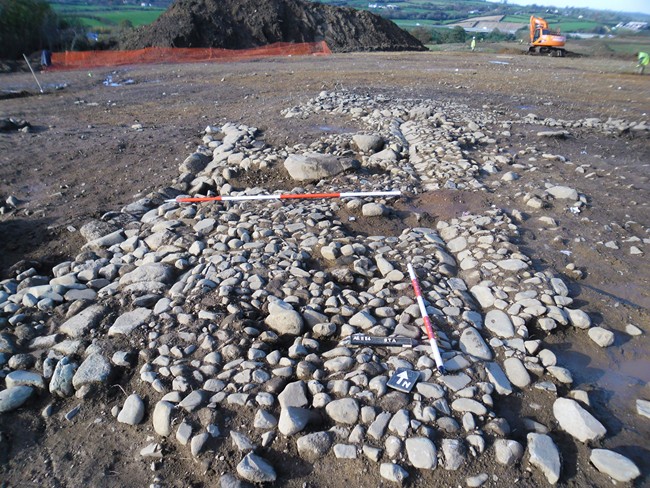
The subsequent excavations revealed the site to be an extensive multi-phased archaeological landscape. The bulk of the finds date to the early medieval period (Early Christian) but there was evidence of continual human occupation from as far back as the Mesolithic (7000 – 3500 BC), when people where hunter-gatherers, until the 17th century when the site became part of a military encampment.
Mesolithic activity at the site was indicated by the discovery of a pit accompanied by various flint tools including a large leaf-shaped blade. This may show that the area had a strong Mesolithic presence, perhaps with the Clanrye River as the main attraction as a source of fish for food.
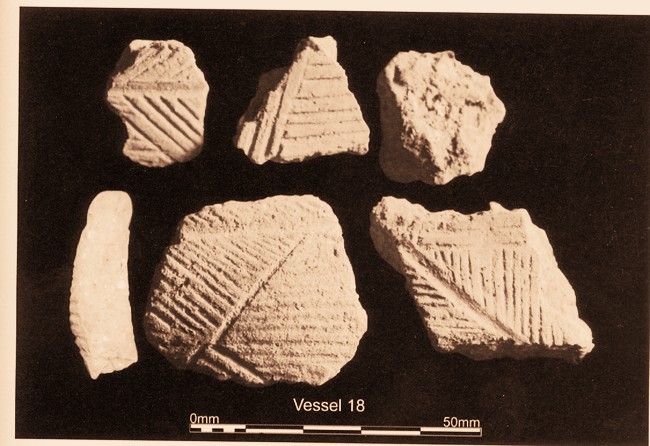
The Carlingford region is famous for its cluster of megalithic tombs, dating from the Neoltihic period (4000 – 2500 BC), in the Mournes, Slieve Gullion and the Cooley Peninsula. There appears to have been significant Neolithic settlement in the lowland areas too and a court tomb was recorded in the townland of Carnbane in the 18th century. No trace of this tomb survives today but quantities of Neolithic pottery and flint tools were discovered during the excavations. Evidence for two wooden buildings was also uncovered.
Bronze Age (2500 – 300 BC) settlement at the site was revealed by the presence of Beaker pottery and two cremation burials. One of the cremation burials was of a juvenile and the other contained two individuals, one a juvenile and the other a young adult. These burials were probably associated with a larger, probable Bronze Age, burial site discovered in the Carnmeen/Lisduff area by a previous excavation.
Central to early medieval (or Early Christian) settlement on the site, was a large rath. Archaeologists have interpreted raths as farmsteads and the example at Carnbane contained evidence for at least two timber-framed houses and two souterrains (underground tunnels used for refuge). Quantities of early medieval pottery, known as ‘souterrain ware’, were also found in addition to evidence for metal working.
There is strong evidence that the rath was re-used in the later medieval period and in the 16th century. A cobbled surface was discovered along with later medieval and 17th century pottery and evidence for an impressive timber-framed building dating from the later years of the 16th century was also found. It is possible that the site had military significance during the Nine Year’s War (1593-1603) and may represent the encampment near Newry which Lord Deputy Mountjoy referred to as ‘Carrickbane’ in 1600.
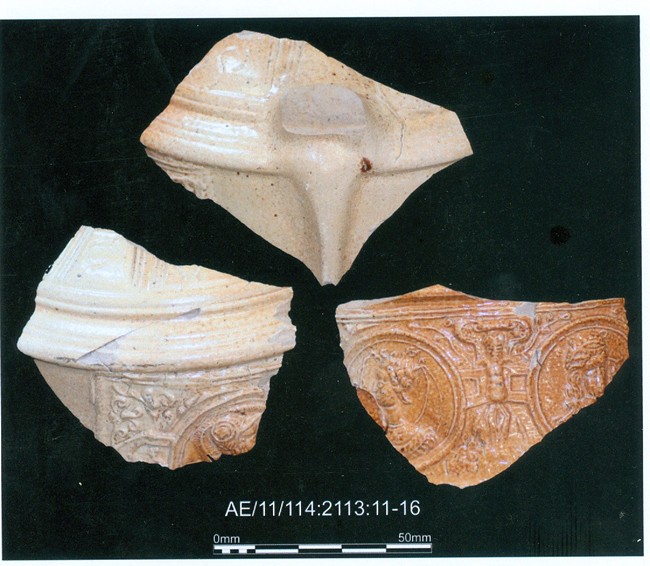
These excavations are very important for understanding prehistoric and medieval settlement in the Newry area and pottery and other artefacts from this site are on display in Gallery 1 at Newry and Mourne Museum.
The Museum is currently offering free tours of the exhibition galleries on Wednesdays and Thursdays at 11.00 am. These must be booked in advance by calling our Education Officer at 0330 137 4422.
Newry and Mourne Museum is open Tuesday – Saturday 10.00 am – 4.30 pm. Please call 0330 137 4422 or email museum@nmandd.org for further information.
Write a comment
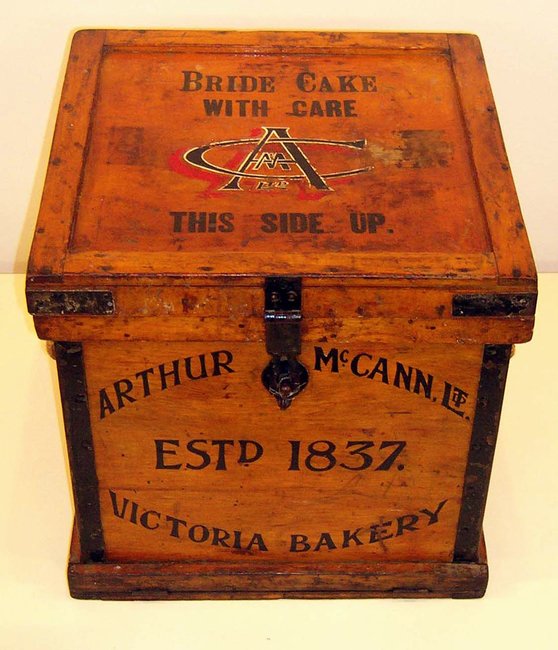
Newry and Mourne Museum today occupies the site of the former McCann’s Bakery in Castle Street, Newry. Newry and Mourne Museum continue their series of occasional articles on the history of the Bakery by briefly looking at the business in the 1940s and 1950s.
At the end of the 1930s much of the production practices at McCann’s Bakery had changed little since the 1890s: the ovens were on the ground floor with confectionary and dough mixing located on the first floor. However, changes were made, and these included a new central stores area and the purchase of new machinery in 1938 – 1941. Furthermore, the 1930s had witnessed a gradual decline in the use of horse-drawn transport by the Bakery for deliveries and, by 1939, ten electric bread vans were in use.
With the outbreak of World War II in 1939 and the introduction of rationing, production of at the Bakery was affected by shortages and rising prices. Sugar was in short supply and the main source of sugar for baking was Dutch fondant. Sugar was also extracted from dried fruit. Dried eggs came from America and potatoes were also used in the baking of various products.
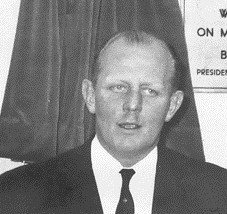
Miles, the second son of Matthew McCann, had joined the Bakery in 1940 but joined the Royal Air Force shortly afterwards. Whilst serving in the Far East, he was captured in 1942 and held in a Prisoner of War Camp in Sumatra until 1946. He returned to the family business in 1948 when he succeeded his father as Managing Director.
The late 1940s and early 1950s were still times of shortages and rationing. National Flour was used (grey in colour) and restrictions on the use of white flour were not lifted until the mid-1950s. Business for the baking trade, however, was good. McCann’s invested in new machinery at a cost of £6,207 which included new ovens, dough mixing units and slicing and wrapping machinery for loaves.
This investment increased production capacity; batch bread and pan loaves were now produced at a rate of around 1,000 per hour. Door-to-door deliveries still predominated in the Bakery’s outlet. About sixty per cent of production was sold to individual households, especially in the rural areas of south Down and south Armagh, and forty per cent was sold wholesale. By 1948 fourteen delivery vans were in operation.
The 1950s saw increasing competition between large flour millers and many smaller bakeries either closed or were taken over by larger companies. In Newry T.P. Willis was bought by Inglis & Co in Belfast. McCann’s Bakery survived this trend and continued as a family-owned business.
The next article will trace further expansion of McCann’s Bakery in the 1960s and its history up until its closure in the mid-1990s.
The Museum is currently offering free tours of the exhibition galleries on Wednesdays and Thursdays at 11.00 am. These must be booked in advance by calling our Education Officer at 0330 137 4422.
Newry and Mourne Museum is open Tuesday – Saturday 10.00 am – 4.30 pm. Please call 0330 137 4422 or email museum@nmandd.org for further information.
Write a comment
Gallery Three in Newry and Mourne Museum tells the story of Newry and the local area in the 20th century. South Armagh and south Down have supported a vibrant agricultural economy for centuries and part of the gallery is dedicated to artefacts that explore farming and fishing in this area. This article focuses on artefacts on display which relate to Clanrye Mills (or Sands’ Mill) which was closely connected with the agriculture in south Armagh and south Down.

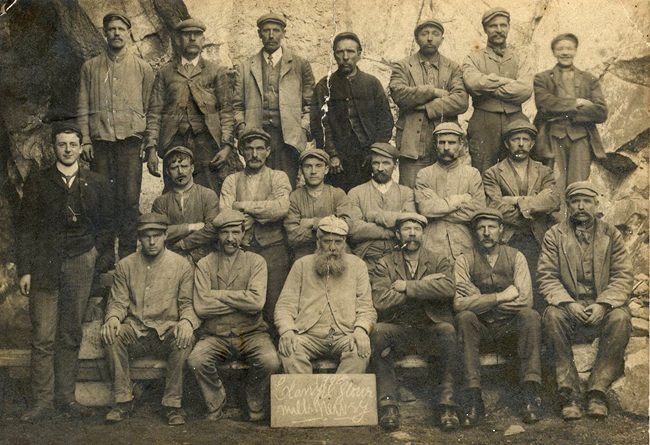
Located on the corner of New Street and Canal Quay, the building which was once Clanrye Mills is still one of Newry’s most imposing buildings. Built in 1873, it was originally built for Sinclair and Son, a milling company whose premises had burnt down in 1872. The new building was built at cost of £10,000 and designed by the Newry architect, William Watson, in the Venetian style. After Sinclair’s business closed, Robert Sands purchased the property and continued milling. Sands had come to Newry in 1878 to work for R Walker and Sons and then, subsequently, for Abraham Sinclair and Son. In 1884 Sands opened his own grain store on Merchants Quay with one employee. The business expanded rapidly and within three years he had purchased the nearby Sinclair mill. A photograph of the Sands’ Mill taken in 1908 is on display in the Museum along with one of the employees in the same year.
When Robert Sands died in 1915 his wife eventually sold the milling business to four senior employees, Messers Breakey, Corkey, Craig and Lyons. The Mill continued to develop in the following decades and, by 1953, the Mill had changed from steam to electricity. All meal was packed in hundred weight bags, either jute or hessian except for chick mash which was packed in cotton bags. These bags were filled from a spout, direct from the mixer, then weighed and ‘sewn’ with a packing needle and jute cord. This was all done by hand. Later, half-ton bags and bulk delivery were introduced and semi-automatic machinery was installed for sewing the bags.

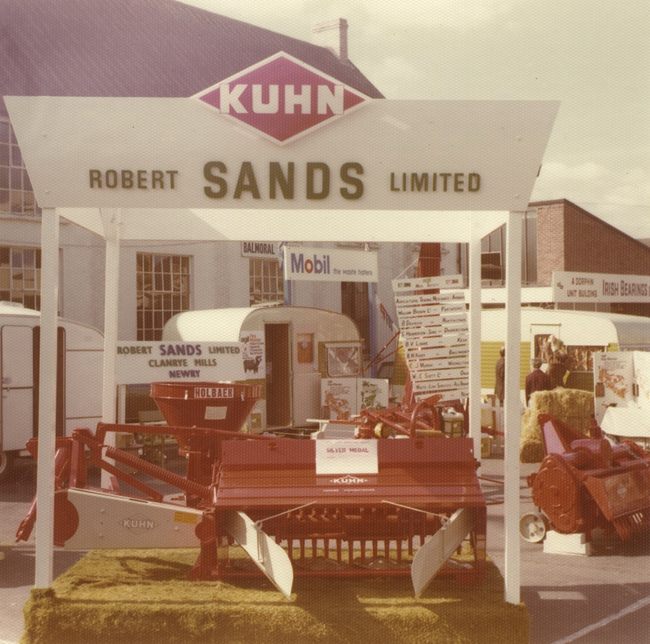
During the Troubles, in 1972, an incendiary device completely destroyed the offices and a large store. About 1974 the Mill started selling farm machinery and were appointed main distributors for Kuhn Farm Machinery. In 1977 a new company was formed called Robert Sands Machinery Ltd. Photographs of the company’s stands at Balmoral Show in the 1970s can be seen in Gallery Three of the Museum.
In the early 1980s business had become very difficult for independent mills and Sand’s Mill was bought by Fane Valley Co-operative in 1981/2.
A range of butter-making equipment and agricultural implements on display at the Museum will feature in next week’s article.
The Museum is currently offering free tours of the exhibition galleries on Wednesdays and Thursdays at 11.00 am. These must be booked in advance by calling our Education Officer at 0330 137 4422.
Newry and Mourne Museum is open Tuesday – Saturday 10.00 am – 4.30 pm. Please call 0330 137 4422 or email museum@nmandd.org for further information.
Write a comment
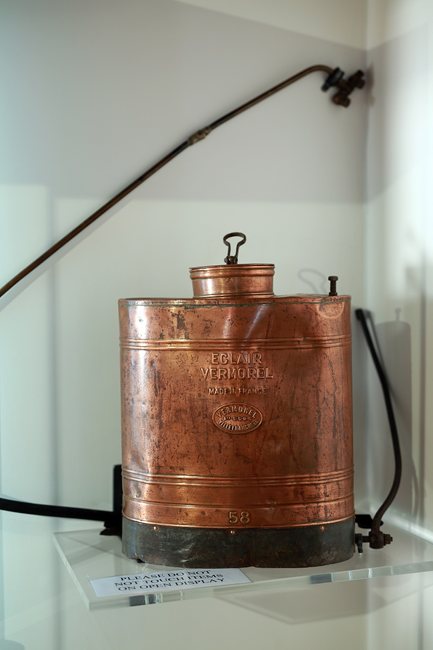
Following on from last week’s article on Sands’ Mill and local agriculture, this week we look at some agricultural implements and butter-making equipment which are on view in the Newry and Mourne Museum. In 2017 a Vermorel knapsack sprayer was donated to Museum. Made of copper and manufactured by Éclair Vermorel in Villefanche-sur-Saone in France, the sprayer was used to spray potatoes and other crops on a farm owned by the White family in Ballynaskeagh in south Down in the 1950s. First produced in the early 20th century, ‘Vermorel’ sprayers are said to have been used to neutralise trenches and dugouts which had been contaminated with chlorine gas during the First World War.
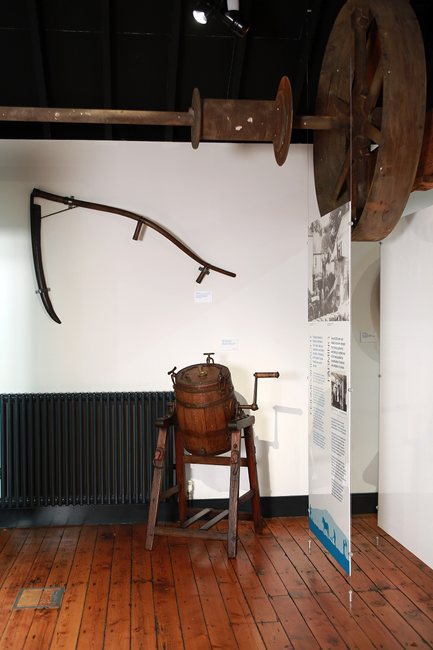
One of our many prized artefacts in Gallery Three is our timber oak butter churn made by Waide and Sons, Leeds. This wooden barrel churn is revolved on a timber stand and has a small window on the side to allow the maker to check on the progress of the butter without having to open the lid. The study of butter churns by historians has identified different shaped churns based on regions in Ireland and, in the 20th century, a new type of churn called an end-over-end was introduced. This is the type of churn which is on display in the Museum and was once a common sight in many houses in the countryside.
Evidence for butter making in Ireland dates to early times. Bog butter has been found and dated to 1000BC. The butter was stored in the bog before the convenience of modern refrigeration. In times past many houses in rural Ireland, including south Armagh and south Down, even those not on a farm, would have had a small piece of land - enough to grow some vegetables and keep a cow for milk. The milk produced by the cow was used by the household and frequently the milk was used to make butter. Butter making was just one of the many household jobs seen as women’s work and usually one day a week was set aside for butter making.
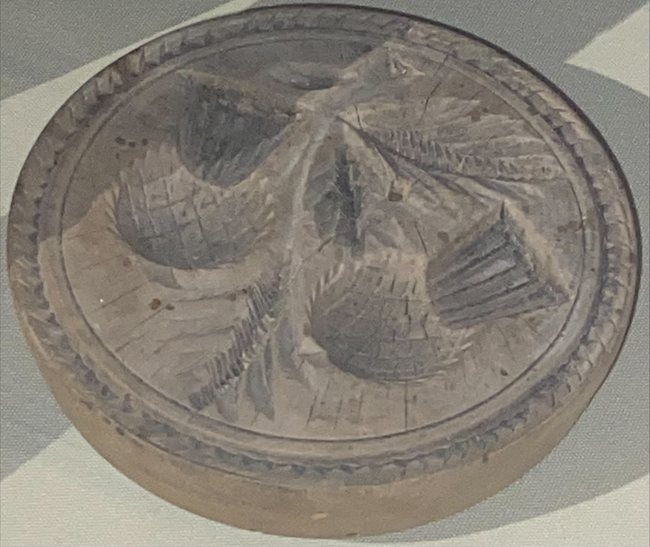
On display in the Museum is a range of butter-making equipment including butter pats, a butter cooler with terracotta lid with ceramic tray and a wooden circular butter stamp with a thistle motif. Once the butter had been finished churning, it was washed several times, salt added and then formed into blocks using timber butter pats. The butter pats were also used to make individual butter balls for serving at the table, especially when having visitors. If the butter was going to be sold it was formed into one-pound blocks, stamped with the makers personal decorative stamp (much like manufacturers brand their products today), and wrapped in greaseproof paper. These butter stamps or butter prints as they are also known as were made by woodturner. Each farmer would have had their own individual motif and our butter stamp with its thistle motif came from a farm in from south Armagh.
Other artefacts reflecting farming and rural life in the Newry and Mourne area which are on show include a scythe, chaff riddle, spinning wheel and tilley lamp.
The Museum is currently offering free tours of the exhibition galleries on Wednesdays and Thursdays at 11.00 am. These must be booked in advance by calling our Education Officer at 0330 137 4422.
Newry and Mourne Museum is open Tuesday – Saturday 10.00 am – 4.30 pm. Please call 0330 137 4422 or email museum@nmandd.org for further information.
Write a comment
Markets and fairs have been part of the fabric of the economy of the Newry and Mourne area for centuries. Although the market in Newry has medieval origins, the modern market can be traced back to the right to hold a market every Thursday in Newry which was granted to Arthur Bagenal in 1613 by King James I. The strategic position of Newry with its hinterland in counties Down, Louth and Armagh meant that its markets through the centuries served a wide geographical area.

Lord Kilmorey built the Butter Crane Quay in 1808 to accommodate Newry’s large butter trade business. A butter taster was appointed whose duty it was to taste the butter in each cask or crock and mark it according to its quality. A record from the 1830’s states that thousands of casks of butter were exported to Liverpool. Markets were now held every Tuesday, Thursday and Saturday.

The Town of Newry Byelaws for the Regulation of Markets in 1874 illustrates the wide range of markets in the town in the late 19th century. Needham Street Market was a wholesale market for grain, meal, pork and grass-seed. Needham Street - West comprised live pigs and sheep. Butter Crane Quay Market was for the sale of butter in firkins, butts, crocks, boxes and barrels. It also sold flax. Mary Street Market – South sold potatoes, vegetables and fruit, fish, game, turkeys, chickens, wildfowl and rabbits. At Mary Street – North you could get hay, straw, turf, bog-wood, flax-bands, vetches, grass, green-feeding for cattle, buttermilk, cooper’s, wood-turner’s and carpenters work, farming implements, earthenware, baskets, rods and tin-ware. Old and new furniture, ‘wearing’ apparel and marine stores were available in Hide Terrace Market. And finally, in Market Street Market, print and lump butter, cheese and eggs were for sale, with a retail market for fruit and vegetables.
Newry monthly fair for the sale of all livestock was held on the first Monday of each month, throughout the year, in the Markets at East and West Needham Street. There were many regulations included in the byelaws including, for example, butcher’s shops were to be washed at least once a week, no fish to be coloured, no dogs, swearing or smoking in any market.

The market rights were transferred to the Town Commissioners in 1881. The market for some items, such as pork, flax and fowl, were taken off the streets and moved to a more suitable location within the town. Another change was the setting aside one day in the months of January, April, June, August and November for the sale of cattle and horses only.
Not only were fair and markets used to sell goods and livestock, there were also hiring fairs in the town where farmers bargained for labour, much on the same lines as buying and selling cattle. The hiring fairs took place in and around Mill Street, Hill Street and North Street. Hiring fairs were important to the rural economy and, in next week’s article, we will be looking at markets and fairs in the towns and villages in south Armagh and south Down.
The Museum is currently offering free tours of the exhibition galleries on Wednesdays and Thursdays at 11.00 am. These must be booked in advance by calling our Education Officer at 0330 137 4422.
Newry and Mourne Museum is open Tuesday – Saturday 10.00 am – 4.30 pm. Please call 0330 137 4422 or email museum@nmandd.org for further information.
Write a comment
Many small towns and villages in south Armagh and south Down held fairs and market days in the 19th century and for much of the 20th century. An important part of the rural economy, charters were granted to some towns enabling them to hold to a marker and stimulate economic growth in the area. For example, Kilkeel received such a charter in 1767, Rostrevor in 1769 and Warrenpoint in 1776.
One of the most important market towns in south Down was Rathfriland. In Bassett’s Guide and Directory to County Down, published in 1886, Rathfriland is described as ‘one of the best inland market towns in Ulster’.

This is reflected in the diaries of James Harshaw, a farmer in the Donaghmore area, north of Newry, which date from the 1840s up to the 1860s. These are peppered with references to numerous family shopping trips to Rathfriland, particularly to drapery stores. As a farmer and flax grower, Harshaw was also a frequent visitor to the markets at Rathfriland. The market was originally held on Wednesday but, by 1886, Bassett tells us that markets were also held on Tuesdays and Saturdays when farm produce was sold. Livestock and fowl were sold on Wednesdays. A fair was held on the first Wednesday of every month and James Harshaw also mentions an annual ‘Gooseberry Fair’ which was held in late July or early August.
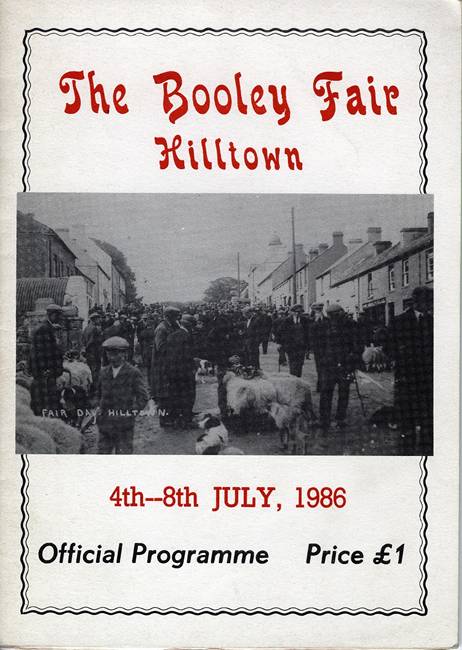
The fair at Hilltown was one of the best fairs in the north of Ireland. Flocks of sheep were brought to Hilltown fair from Donegal, Antrim, Derry and Tyrone, as well as from all parts of Down and Armagh. The fair usually commenced about ten o’clock in the morning and continued to four o’clock in the afternoon. There was a cattle, sheep, pig and horse fair, with donkeys and goats sold at the same fair. The fair was also a social occasion and, when business was completed, people stayed well into the night to make new and old acquaintances; dice was thrown, music played and ballads sung.

By 1800 Kilkeel had a fine Market House and markets held in the town became an important outlet for the produce of farmers in the Mournes. A market for potatoes, oats live pigs was held in the town each Wednesday and flax market when in season. A fair for cattle, sheep, horses and produce took place the on last Wednesday of each month.
The main markets for farmers in south Armagh in the 19th century were held at Crossmaglen and Newtownhamilton. A market took place every Friday at Crossmaglen for butter, eggs, fowl and for grain and grass seed when in season and a fair was held on the first Friday of each month for cattle, sheep, pigs and horses. At Newtownhamilton a free market was held every Saturday for butter, eggs and fowl and a fair on the last Saturday for cattle, sheep, pigs and farm horses. A hiring fair was held on the last Saturday of May and November.
South Armagh and south Down no longer has its network of markets and fairs. However, important livestock sales still take place at Hilltown and Rathfriland and the tradition of the fair has been revived in the Booley Fair which has been held in Hilltown since the 1980s.
The Museum is currently offering free tours of the exhibition galleries on Wednesdays and Thursdays at 11.00 am. These must be booked in advance by calling our Education Officer at 0330 137 4422.
Newry and Mourne Museum is open Tuesday – Saturday 10.00 am – 4.30 pm. Please call 0330 137 4422 or email museum@nmandd.org for further information.
by Ken Abraham and Dympna Tumilty
Write a comment
The Staff at Newry and Mourne Museum have been saddened by the recent death of Hal O’Brien, former Editor of the Newry Reporter who, over the years, gave the Museum much valued support and encouragement. With a deep interest in history and heritage, Hal rarely missed a lecture or an exhibition launch. He was always keen to know what new events were planned and was among the first to book a place once booking for a lecture opened or to send a reply when invited to a launch.

However, Hal’s interest in local history chiefly manifested itself in a series of generous donations which he made to the Museum in the years leading up to the opening of the new Museum at Bagenal’s Castle. Believing in the preservation of local material culture for future generations and its educational value, Hal was particularly enthusiastic about the development of a new museum for the Newry and Mourne area. This stimulated him to donate over three hundred artefacts to the Museum Collection.

The items donated by Hal reflect his childhood and early family life in St. Mary’s Terrace in Newry during the 1930s and 1940s, his career as a journalist and Editor of the Newry Reporter his interest in photography. The oldest items date from the 1930s and more especially, from World War II when Hal’s father, Henry, was an ARP Warden in Newry. The donation includes various certificates and leaflets from Henry O’Brien’s work. Included too is a child’s ‘Mickey Mouse’ gasmask, a booklet from the popular wartime radio series, ITMA (It’s that Man Again) and a wireless license from 1946.
Hal’s career as a journalist put him in a unique position to collect material from many aspects of local life. He reported on many significant events and developments in the history of the Newry and Mourne area and, as Editor of the Newry Reporter, was invited to many important occasions. The archival material donated by Hal relates to various Council and civic events, church events, the opening of new businesses, particularly factories, and the number of programmes from productions by local drama and musical groups attest to the importance of the local performing arts in Hal’s personal and professional life. The material donated by Hal also contains bus and train timetables and various tickets, some of which date from the 1950s early 1960s when the local transport network saw many changes.
Throughout his life Hal had an interest in photography and was a founder member of the Newry Camera Club which first met in the Snack Bar in Hill Street in the 1950s. He was Secretary of the Club and continued as a member until it closed in the 1990s. Hal donated a number of cameras and various pieces of photographic and developing equipment to the Museum which he used when a member of the Club.

The artefacts donated by Hal O’Brien are, in many ways, a commentary on the social and economic history of Newry and its hinterland from the 1950s up to the 1990s. As such, many of them have been featured in various exhibitions, including our current temporary exhibition on World War II. We are indebted to Hal for being so public spirited and leaving such an invaluable legacy to the people of the Newry and Mourne area.

The Museum is currently offering free tours of the exhibition galleries on Wednesdays and Thursdays at 11.00 am. These must be booked in advance by calling our Education Officer at 0330 137 4422.
Newry and Mourne Museum is open Tuesday – Saturday 10.00 am – 4.30 pm. Please call 0330 137 4422 or email museum@nmandd.org for further information.




 |
 |
 |