

 Write a comment
Using material from the Museum’s Collection, Newry and Mourne Museum has opened a new temporary exhibition focusing on the Partition of Ireland and it’s impact on society in the local area in the years afterwards. Visitors to the exhibition will see how the Newry and Mourne area was affected by the events that shaped modern Ireland including Partition, the War of Independence, the Treaty negotiations, the Boundary Commission and the Land Commission.

Included in the artefacts on display are a selection of papers from the Éamon Donnelly Collection. Donnelly, who was from County Armagh and whose family lived in Newry, was a leading anti-Partitionist and acted as the election agent for Michael Collins in the 1921 general election. Among the items in the exhibition are a description of Michael Collins which was issued for circulation by the Royal Irish Constabulary in 1921 and telegrams sent to Éamon Donnelly by his eldest daughter, Eleanor, reporting on the polling, count and result of the 1925 election when Donnelly won the Armagh seat.

The Reside Collection at the Museum contains a number of draft pro-Partition submissions made to the Boundary Commission in 1924. Many of these submissions emphasised the economic links between south Armagh and south Down with Northern Ireland. Such an argument can be seen in the submission from The Newry and Bessbrook Tramway Company, which was chosen for display, which highlights the importance of business with the Port of Belfast.
Related to the Boundary Commission is the ‘Not an Inch’ cup presented to Sir James Craig, Prime Minister of Northern Ireland by the Unionists of Newry and the Orangemen of Newry No.9 District ‘as a token of their appreciation of his unswerving stand on the boundary’. The cup is on loan from National Museums Northern Ireland until March 2022. Also on display, is a photograph taken outside Newry Town Hall, marking the visit of Sir James Craig in February 1927 to meet with members of Newry Urban District Council and other local public bodies.

Through a series of maps and other documents mainly from the Reside Collection, the exhibition also covers the local impact of the Land Acts in the 1920s. One of the maps on display is of the townland of Cornamucklagh in north county Louth, which was prepared after the passing of the 1923 Irish Land Act. Part of the estate of Captain Roger Hall of Narrow Water, the map shows tenancies which were vested for sale under the Act. Another document details land to be sold to tenants under the 1925 Northern Ireland Land Act in the townland of Altnaveigh, owned by the Earl of Kilmorey.
The exhibition also makes reference to culture and sport which were important aspects of life in the Newry area in the 1920s. A football jersey and cap are included which belonged to Frank McEvoy, from Chapel Street in Newry, who played for teams such as Newry Town, Dundalk and Glentoran in the 1920s. Cultural life is explored through material relating to Newry Musical Feis, which was set up in 1928, Irish language and bands in the area.
In addition to the exhibits, there isan interactive for younger visitors comprisinga jigsaw of the Newry region. By assembling this, they will see how some of the townlands mentioned in the exhibition became part of either Northern Ireland or the Irish Free State.
Entry to the exhibition is free and runs until 27thAugust 2022. A booklet with articles commissioned by leading historians in this field complements the exhibition. The exhibition and booklet has been supportedwith funding from TheExecutive Office (TEO), via Newry, Mourne & Down District Council’s Good Relations Plan and the National Lottery Shared History Fund.
The Museum is currently offering free tours of the exhibition galleries on Wednesdays and Thursdays at 11.00 am. These must be booked in advance by calling our Education Officer at 0330 137 4422.
Newry and Mourne Museum is open Tuesday – Saturday 10.00 am – 4.30 pm. Please call 0330 137 4422 or email museum@nmandd.org for further information.
Write a comment
Last week’s article was an overview of the content of Newry and Mourne Museum’s new temporary exhibition – The Legacy: Newry 1920 – 1930 – which explores the impact of Partition in the local area. This week, Brian Walker, Emeritus Professor of Irish Studies at Queen’s University Belfast, begins a two-part edited version of his article on the visit of James Craig, Viscount Craigavon, to Newry in 1927 which is published in the exhibition booklet.
Among the Collections in Newry and Mourne Museum is a photograph which records a significant event in Newry on 8th February 1927. It shows members of Newry Urban District Council and members of other Newry public bodies with Viscount Craigavon, Prime Minister of Northern Ireland, on his visit to the town. They are standing in front of the Town Hall after a reception and lunch for their visitor.
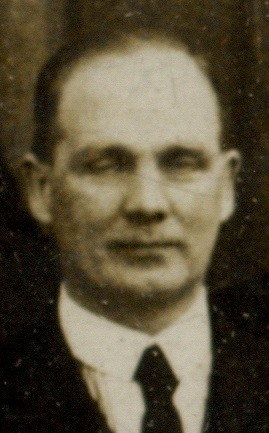
The photograph captures an important moment in the history not only of Newry but also of Northern Ireland. At this time Newry council was a rare example of what we would call today a ‘power-sharing’ council with a Unionist Chairman, William Robinson, and a Nationalist Vice-Chairman, Terence Ruddy. The council was made up of six Nationalist, six Unionist and six Labour councillors.
This visit of Craigavon arose as part of a ten-day tour to various parts of Northern Ireland. It occurred when, after the tumultuous period 1920-5, there were efforts to encourage political accommodation and reconciliation. These endeavours achieved certain success, as seen in Craigavon’s visit to Newry in 1927, but in the end political relations became highly polarized and confrontational.
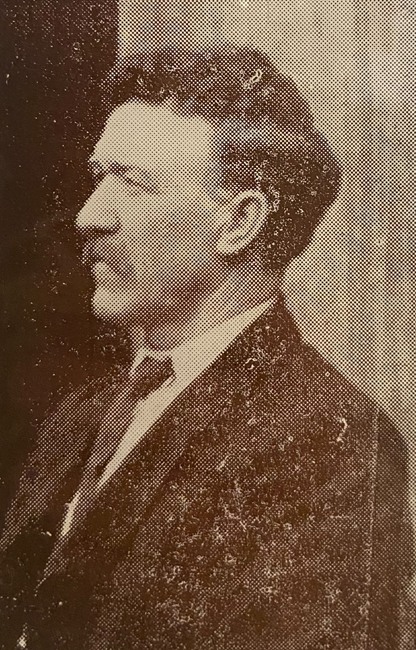
The years 1920-2 witnessed considerable violence and political conflict in Newry and district. The next years were marked with much political uncertainty over the Boundary Commission. The outcome in late 1925 of no change to existing boundaries was met with disappointment by Nationalists and relief by Unionists. In January 1926, however, the election for Newry council had surprising results, reflecting the relevance for many of social and economic issues over constitutional matters.
The outcome was the return of not only six Nationalist and six Unionist councillors but also six Labour councillors, including W.F. Cunningham, Chairman of the local Trades and Labour Council. There followed heated meetings over two days to elect the next Chairman. After different suggestions to break the deadlock, such as drawing lots, a secret ballot was held.
This led to the election of Unionist William Robinson as Chairman, the first Unionist Chairman for over twenty years. He was managing director of the Newry firm of Foster & Co. Ltd. The Nationalist Terence Ruddy was elected Vice-Chairman. Appointments to standing committees resulted in three members of each party in each committee.
In 1922 Sir James Craig conducted a tour of the border areas but subsequently he was involved in annual tours of all the counties of Northern Ireland. On 24th January 1927, Craig, recently elevated to the peerage as Viscount Craigavon, attended a public luncheon in Belfast City Hall. He announced plans for a ten-day tour of local authorities to assure them that their interests would not be neglected by the government. He would be accompanied by Sir Dawson Bates, Minister of Home Affairs.
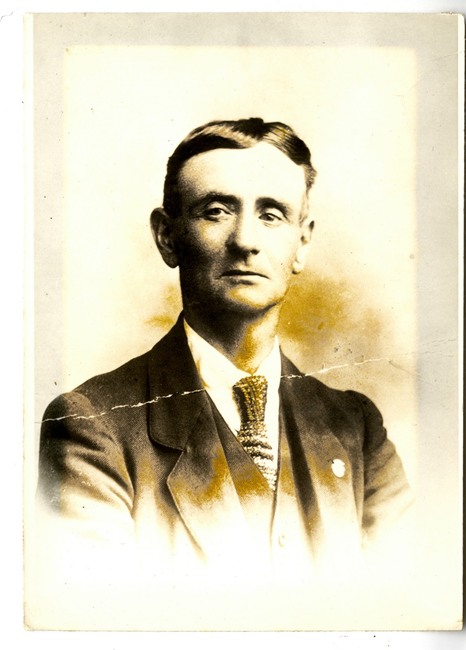
In concluding remarks, he declared: ‘Not only did peace reign in their midst, but Protestants and Roman Catholics were working together for the common good and Ulster might now be looked upon as one of the best parts of the Empire’.
On the morning of 8th February Craigavon and Bates travelled to Kilkeel where they met members of the local Board of Guardians, who raised concerns about the fishing industry. The next visit was to Warrenpoint where they were greeted by members of the Urban Council. Edward Byrne, Nationalist Chairman, welcomed Craigavon.
He stated: ‘They might not always have seen eye to eye on political matters but they believed that his lordship was, and would continue to be on the side of peace and goodwill’. He urged support for the port.
The Nationalist Vice-Chairman, Francis Connolly, paid tribute to Bates as ’the man who, in the darkest hour in the history of their province, with his back to the wall, used his strong hand in putting down crime of all sorts’. Craigavon promised to back port improvements. The two visitors then proceeded to Newry.
Next week Professor Walker will consider the events of Viscount Craigavon’s visit to Newry.
The Museum is currently offering free tours of the exhibition galleries on Wednesdays and Thursdays at 11.00 am. These must be booked in advance by calling our Education Officer at 0330 137 4422.
Newry and Mourne Museum is open Tuesday – Saturday 10.00 am – 4.30 pm. Please call 0330 137 4422 or email museum@nmandd.org for further information.
By Brian M. Walker
Write a comment
Brian Walker, Emeritus Professor of Irish Studies at Queen’s University Belfast, continues his account of the visit of James Craig, first Prime Minister of Northern Ireland, to Newry in 1927.
On 8 February 1927, Prime Minister James Craig, Viscount Craigavon, along with Sir Dawson Bates, visited Newry as part of a ten-day tour. The two men arrived at the Town Hall, where first they met the Chairman William Robinson and members of the Urban District Council in private conference. At 2.00 pm the visitors and a large representative company were entertained to luncheon by Robinson, ‘the catering being excellently done by Mrs Truesdale, of the Clanrye Café Newry’.

Present were members of the council, including Vice-Chairman Terence Ruddy and W.F. Cunningham, the Newry Port and Harbour Trust, the Carlingford Lough Commission and the Newry Chamber of Commerce, together with officials of these bodies. Office bearers from neighbouring rural district councils, Down and Armagh county councils and Newry Board of Guardians were there.
After lunch, according to the Newry Reporter, the chairman, William Robinson, ‘submitted the usual loyal toast, which was followed by the singing of ‘God save the King’’ while the Frontier Sentinel referred only to the toast of ‘The King’.
Robinson next proposed ‘Prosperity to Northern Ireland’ and then made a speech. He thanked the government for their ‘liberal grants’. He discussed the work of the council, such as the recent erection of forty-one workmen’s dwellings. He called for support for more housing.
Craigavon replied, to express gratitude for their welcome. He said that it was good to get away from politics and to help local authorities to get on with their work. He urged people to work for prosperity for Northern Ireland. In conclusion he added: ‘Might he also say that they in Ulster of all creeds and classes were sufficiently broadminded to say that they also hoped for prosperity for the whole of Ireland (applause)’.

This visit of Craigavon to Newry in February 1927 can be seen as evidence of efforts to improve relations after the troubled early 1920s. During the 1930s, however, politics and society in Northern Ireland became increasingly polarised. This outcome was due to heightened conflict over the constitutional/national position and north south tensions, as well as contemporary party dynamics, internal and external.
As regards Newry, we can note that politics continued along conciliatory lines. Shortly before the January 1929 urban elections it was announced that William Robinson would stand down and leave Newry. He had been appointed managing director of the Bank Buildings department store in Belfast.

At Robinson’s last council meeting tribute was paid to the ‘able, dignified and impartial manner’ in which he had discharged the duties of the Chair. In May he was presented with an inscribed silver salver for his services to the town. Robinson, who died in 1961, was knighted in 1946, in recognition of ‘outstanding public service in many fields’.
The 1929 urban election saw again the return of six councillors from each party. The new chairman was Nationalist Hugh J. McConville, a former Chairman, a Justice of the Peace, and, later in the year, a Deputy Lieutenant for Co. Down. The Unionist James Boland was elected Vice-Chairman.
At the 1932 elections, the return of the parties was the same, with no contest. Again, a Nationalist Chairman and Unionist Vice-Chairman were elected. In 1938 Labour councillor W.F. Cunningham was elected Chairman.
This 1927 photograph allows us to recall a special, largely forgotten, moment in the history of Newry and Northern Ireland. It deserves to be appreciated.
The Legacy: Newry 1920 – 1930, a temporary exhibition exploring the impact of Partition on the local area continues at Newry and Mourne Museum until 27 August 2022.
The Museum is currently offering free tours of the exhibition galleries on Wednesdays and Thursdays at 11.00 am. These must be booked in advance by calling our Education Officer at 0330 137 4422.
Newry and Mourne Museum is open Tuesday – Saturday 10.00 am – 4.30 pm. Please call 0330 137 4422 or email museum@nmandd.org for further information.
By Brian M. Walker
Write a comment
Christmas is a magical time of the year steeped in history and tradition. Every family has their own Christmas traditions which can vary hugely. This article examines some of the local customs, traditions and stories over the years. We hope you enjoy reading them and that they may bring back some long-lost Christmas memories of your own.
A Victorian Christmas
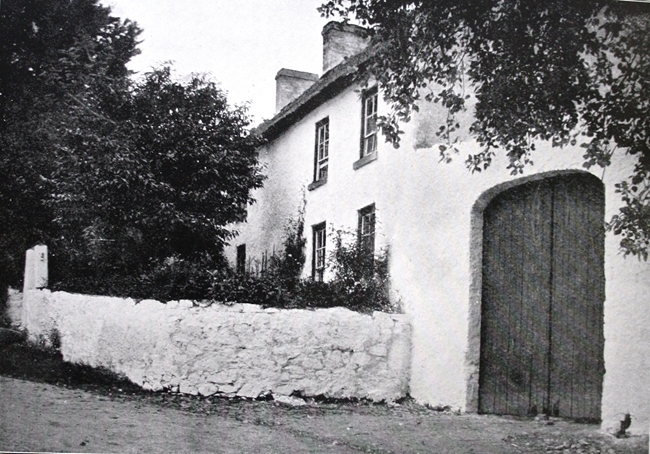
Many of the Christmas traditions that we know today were concepts first thought of in the Victorian Era. In 1841, Prince Albert, the husband of Queen Victoria, popularised Christmas trees in Britain, a tradition current in his native Germany. In 1843 the publication of A Christmas Carol by Charles Dickens, promoted Christmas as a season of goodwill and merriment. On a more local level, James Harshaw, who was a famer and landowner in Donaghmore, north of Newry, and an Elder in Donaghmore Presbyterian Church, kept a diary from 1841 spanning over twenty years. An excerpt from his diary gives an insight into how he spent Christmas Day in 1860:
“Keen freeze and snow still continues, breakfasted with James Martin . . . attended a prayer meeting in the meeting house classroom where I gave-out a portion of the 145th Psalm - which was sung by the Blind boy Samuel McGaw - Read the 1st Chapter of Ephesions and prayed - called on Mr Arch. Murdock . . . A Douglass, James Martin, John and children dined here, with the other members of the family, and I spent a pleasant evening with them all talking about Absalom [James Harshaw’s son Samuel who had emigrated to America]. James Alexander and Johns children played around us.” [spelling and punctuation as in the original].
Christmas cooking
Certain foods are associated with Christmas, some of which date back hundreds of years. Rich foods, such as Mince Pies, Christmas Cake and Plum Pudding which are made with spices, dried fruits and nuts, were kept as a treat at Christmas. Newry and Mourne Museum’s Collection includes a cookery class book from Newry Municipal Technical School (now the Sean Hollywood Arts Centre) dating to December 1904. The book, which belonged to fifteen-year-old Mary Ann Scott of St. Mary’s Street, Newry, contains many recipes for a range of dishes popular at that time. Another recipe book, which was first compiled by members of the Crawford family from Clonallan, near Warrenpoint, in 1905, shows how the family recipe for Christmas Pudding was adapted over the years to suit changing tastes.
Memories of Christmas in Newry
Over the years, the Museum has collected memories of people within the locality and here are some memories of Christmas around Newry.
Fosters Shop, Hill Street
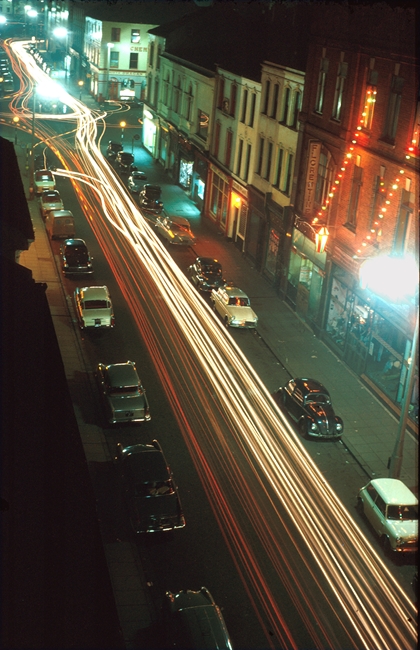
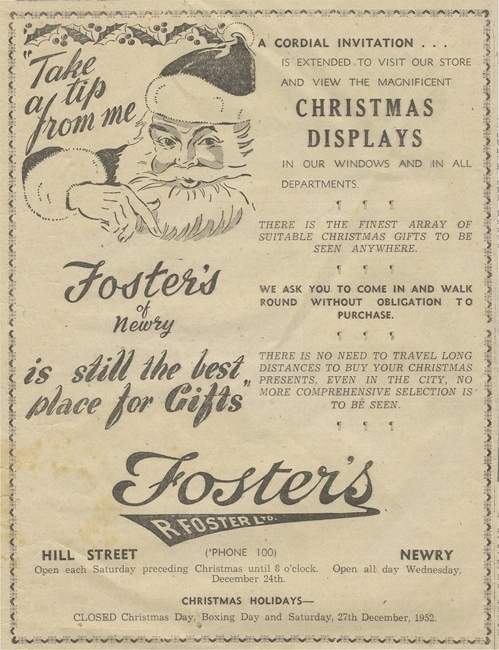
“Foster’s at Christmas was decorated and lit up the whole length of Hill Street. I remember them having the first Santa you could visit in the store and it was open to 11 o’clock Christmas Eve.”
Decorations and presents
“The decorations would have been in the house for 20 or 40 years. You know they would be all put away in a big box and packed away every Christmas . . . we would get apples and oranges . . . You’d be lucky if you got a chicken. That would be a big thing to get a chicken, that maybe a friend or neighbour brought from a farm. You got thru’ pence, and an orange in your sock, so that was it. Maybe sometimes I was lucky because I had grown up brothers and sisters I might get a wee box of sweets…”.
The turkey
“You bought the turkey alive, and you had to carry the turkey home, feathers and all, . . . you kept it alive until maybe a day or two, or three days before Christmas and your father would kill the turkey. But, we used to earn a lot of money by going down to the market and the women would be buying the turkeys and they wouldn’t carry them home. We carry them home for them and you’d get six pence for carrying home a turkey, you know. A lot of them got away on us and would be running up the street, and us running after them you know, and them alive”
The Staff at Newry and Mourne Museum would like to wish everyone a Merry Christmas and Happy New Year and thank you for your support throughout the year.
The Museum is currently offering free tours of the exhibition galleries on Wednesdays and Thursdays at 11.00 am. These must be booked in advance by calling our Education Officer at 0330 137 4422.
Newry and Mourne Museum is open Tuesday – Saturday 10.00 am – 4.30 pm.
Please call 0330 137 4422 or email museum@nmandd.org for further information.
Write a comment
At this time of year Newry and Warrenpoint are usually looking forward to hosting their annual pantomimes. The Museum Collection has many artefacts and photographs from pantomimes staged in the two towns over the years.
The origins of pantomime date back to Middle Ages and developed from the traditions of the Italian Commedia dell’art in the 16th century, with comedic moments, customary characters and great physicality. By the Victorian era, pantomime had become a typically Christmas custom. They were based on fairy tales or folk legends with some of the more popular being ‘Cinderella’ ‘Aladdin’, ‘Dick Wittington’ and ‘Snow White’. Although they had become predominantly aimed at children, adults enjoyed them too.
The earliest pantomimes performed in Newry were staged in the Assembly Rooms on the upper floor of the Savings Bank, now the Sean Holywood Arts Centre in the later part of the 1800s. In April 1877 performances of ‘Cinderella’ were held under the patronage of Colonel Kent and Officers of the 77th Regiment.
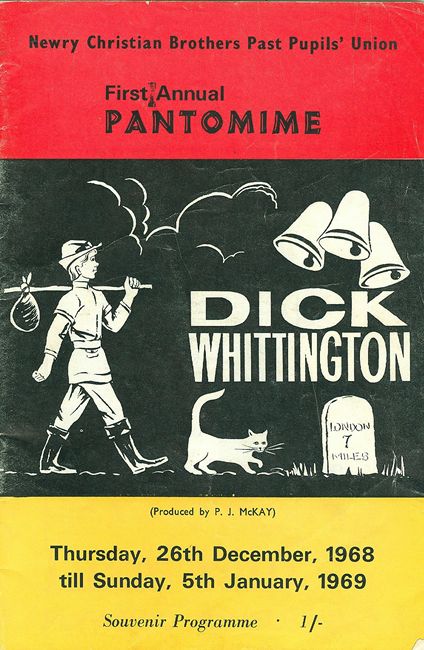
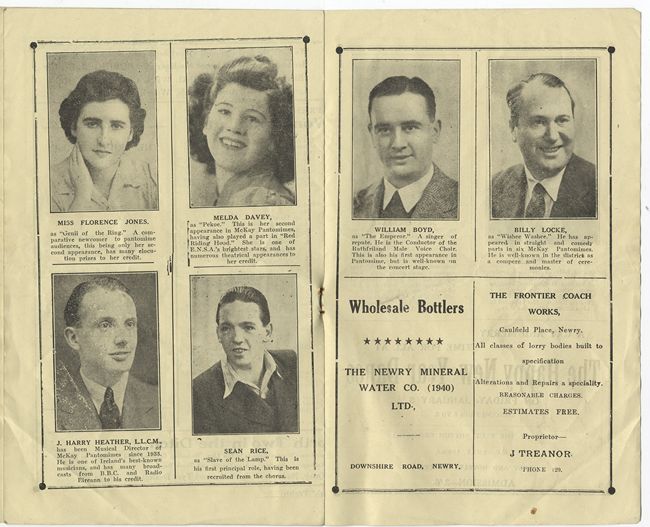
From the mid-1930s P.J. McKay staged pantomimes in the town, with Harry Heather as Musical Director. These pantos continued throughout the Second World War. In 1942 the drama took place off stage when the principal boy, Mrs Kathleen Clark, sacrificed her part and dashed by ship, plane, train and car to the bedside of her wounded husband, Flight Sergeant Arthur Clark.
Pantomimes were often staged with a local twist. A 1957 production of ‘Sinbad the Sailor’ by Glanree Pantomime Group had Sinbad shipwrecked off the coast of the Mournes before making his way to Newry Market.
In the late 1950s Charlie Smith became involved in local pantomimes with Sean Canavan. By the late 1970s the ‘Troubles’ had adversely affected the social and cultural life of Newry. Paddy O’Hagan, Clerk of the Newry and Mourne District Council, asked Charlie Smyth if he could put on a show in Newry to raise people’s spirits. Along with the Glenn Youth Club a pantomime was produced and performed in the Town Hall beginning an annual tradition that has continued ever since.

‘Jack and the Beanstalk’ was the first pantomime performed in Warrenpoint Town Hall in 1951. It had a three-night run which was incredible for a small town at the time and buses ran to the performances from Newry, Kilkeel and Mayobridge. During the ‘50s and ‘60s, the Warrenpoint panto travelled to Newry Town Hall, St. Louis Grammar School in Kilkeel and Darraghcross, near Saintfield, to raise funds for St. Vincent De Paul Society, a new hall and to fund the Arthur Burns School of Dancing’s trip to Rome. Frank Hanna produced all the pantomimes until his sudden death in 1984 when Liz Boyle took over productions.
The main exhibitions at Newry and Mourne Museum include a poster advertising the 1979 Charlie Smyth production of ‘Cinderella’. The production ran for a week and tickets cost £1 for an adult and 50p for a child.
The Museum is currently offering free tours of the exhibition galleries on Wednesdays and Thursdays at 11.00 am. These must be booked in advance by calling our Education Officer at 0330 137 4422.
Newry and Mourne Museum is open Tuesday – Saturday 10.00 am – 4.30 pm. Please call 0330 137 4422 or email museum@nmandd.org for further information.
Write a comment
Castle Street in Newry can be traced back to the 1500's but development of the 'new' road at Abbey Way in 1969 led to many of its old buildings being demolished.
Before the building of Newry Canal and the development of Hill Street (then known as the ‘Low Ground’) in the 18th century, the town of Newry was centred on Castle Street, High Street and North Street. Both High Street and North Street are probably medieval in origin and are shown on the earliest known map of Newry drawn by the surveyor Robert Lythe around the 1560s. The beginnings of what was to become Castle Street can also be traced on this map which shows the town in the early stages of its expansion by Sir Nicholas Bagenal.

The street was evidently called ‘Castle Street’ because of the proximity of the castle built by Sir Nicholas Bagenal although the name is not recorded until the 1730s when Robert Nedham leased property there to a number of tenants. Confusingly it is marked as Boat Street on the maps of the town drawn by John Rocque in 1760 and by his pupil, Matthew Wren, a year later.

There are a number of important landmarks highlighted on the maps by Rocque and Wren such as the Shambles (more or less opposite the site of the Museum at Bagenal’s Castle) where animals were slaughtered. The original Butter Crane was also located in Castle Street and remained there until 1808 when it was relocated to along the Canal. Another notable building in existence was the Meal Market House (later rebuilt) located at the head of Hyde Market (now St. Colman’s Park). From around the mid-18th century the Corry family leased property at the east end of Castle Street in the area known as Abbey Yard.
Although large-scale commercial activity was located on the quays on either side of the Canal, the 1820 business directory for Newry reveals details about the type of businesses in operation in the Castle Street at that time. These included butchers, public houses, grocers and spirit dealers, as well as homes for some of the merchants of the town. A Kilmorey estate rental from the same year, now in the Museum’s Reside Collection, includes the names of those renting buildings and land along the Street. The rental includes the names of Glenny, White, Atkinson, Beathe, Murtagh, Anderson, Hutchison and Corry.

Source material in the Museum Collection suggests that Castle Street continued to be a blend of small family-run businesses and residential housing from the later decades of the 19th century until most of the street was demolished in the late 1960s. Businesses included The Victoria (McCann’s) Bakery (which expanded over the decades until its closure in the 1990s), Collins’ butchers, McRobert’s furniture dealers, McAteer’s Dairy, Patterson’s general smith’s and hardware business, and a number of grocers run by families such as the Butterfields, Farrells, Keenans and McCarrolls. There were also a number of public houses owned by the Clarkes, Murtaghs and O’Hares. One business with a long history, Patrick Murphy & Son in Abbey Yard, still continues today.
Many former residents of Castle Street have memories of the sense of community which characterised life on the Street. This was swept away when most of the buildings along its route, some of which may have dated back to the 18th century, were demolished c.1969 to make way for the construction of Abbey Way. Some have survived such as numbers 18, 20 and 22, the Georgian town houses in Abbey Yard, the warehouse built by Joseph Doyle, a florist, in the 1830s and the adjoining Bagenal’s Castle. The two latter buildings became home to Newry and Mourne Museum in 2007.
The Museum is currently offering free tours of the exhibition galleries on Wednesdays and Thursdays at 11.00 am. These must be booked in advance by calling our Education Officer at 0330 137 4422.
Newry and Mourne Museum is open Tuesday – Saturday 10.00 am – 4.30 pm. Please call 0330 137 4422 or email museum@nmandd.org for further information.
6 Comments
In 1839 a Poor Law Bill was passed to address the growing levels of poverty throughout Ireland. The law divided Ireland into 130 Unions, each with it’s own workhouse and Board of Guardians. Kilkeel Poor Law Union was established on 29th July 1839 and paved the way for the development of Kilkeel Workhouse.
The architect George Wilkinson, who had previous experience designing workhouses in Wales, became the architect to the Poor Law Commissioners in Ireland and was commissioned to build the Kilkeel Workhouse in 1840. Located on Newry Street, the building was designed to accommodate three hundred paupers, it’s construction was to cost £4050, with £767 for fixtures and fittings. Wilkinson believed that his “gabled roofs, elevated chimneys and mullioned windows” gave a “pleasant and picturesque appearance”. The design included cells near the wards for male and female “idiots”.
The first inmates arrived at Kilkeel Workhouse on 1st September 1841. The Workhouse was overseen by a Board of Guardians, which comprised elected and appointed members who were elected by those who subscribed to the poor law rate. The Guardians met weekly in a boardroom on the second story on the front of the building.
For inmates of the Workhouse, it was literally the last place they wanted to be. The Board of Guardians designed the initial timetable, where inmates rose at 7am and bed at 8pm. In between, inmates were never to be idle. All inmates were segregated, the Master oversaw the males and the Matron oversaw the females. The building was split, the left side of the building for males, the right for females. Families were also split. Children age 6-12 had their own section while under 5s were either in a section of their own or with the females.
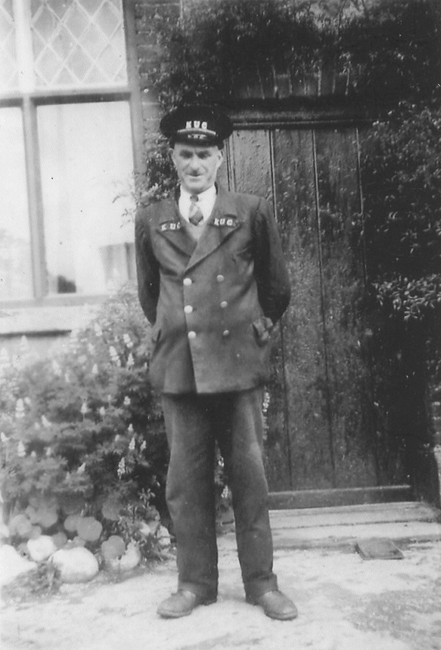
There were strict rules to follow, meals had to be eaten in silence and no wandering or communication was permitted between wards. Bad language, disobedience and waste was punished by confinement or reduced rations. There were two, occasionally three meals a day. Breakfast consisted of 7oz of oatmeal and dinner of 3.5lb of potatoes, served with a pint of buttermilk.
Work was grueling, when the inmates had completed all the work around the House, other tasks were found such as stone breaking for the men and knitting for the women. The system aimed to teach children to earn their own living. Girls were prepared for domestic service and taught sewing. Boys were taught carpentry, tailoring or shoemaking.
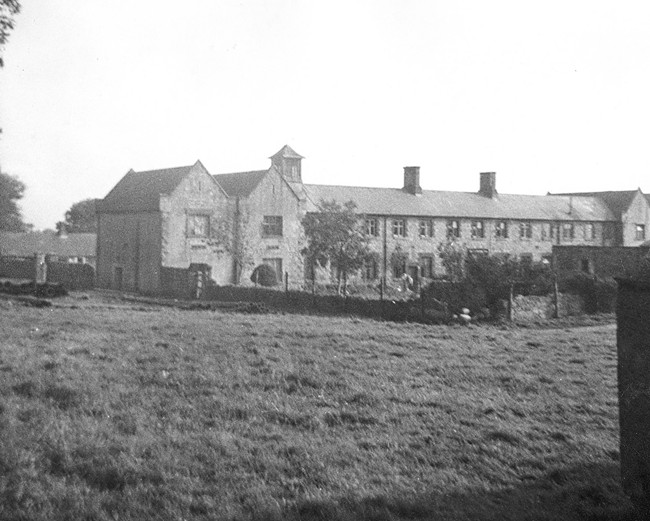
In 1845 the Great Famine had an impact on the Workhouse, leading to an increase in the number of the starving poor, but also accompanying fever cases. In 1847 a temporary fever hospital was built. Death rates were very high and land around the workhouse was used for burials.
After the number of inmates began to decline in the later 19th century, various parts of the Workhouse were put to a variety of uses including a base for the Royal Irish Constabulary and, during World War II, a Dr Barnardo’s home. Kilkeel Technical College was also housed there, and part of the building became the offices of Kilkeel (later South Down) Rural District Council.
After the dissolution of South Down Rural District Council in 1973, the Workhouse buildings were subsequently demolished. The Fever Hospital, which had become the Mourne Hospital in 1927, remained but eventually closed in 1996.
The Museum is currently offering free tours of the exhibition galleries on Wednesdays and Thursdays at 11.00 am. These must be booked in advance by calling our Education Officer at 0330 137 4422.
Newry and Mourne Museum is open Tuesday – Saturday 10.00 am – 4.30 pm. Please call 0330 137 4422 or email museum@nmandd.org for further information.
Write a comment
This Thursday is World Holocaust Day and to mark the occasion Newry and Mourne Museum have asked Lill Fanny Saether to tell the story of her family connections to Newry and their traumatic experiences during the second world war.
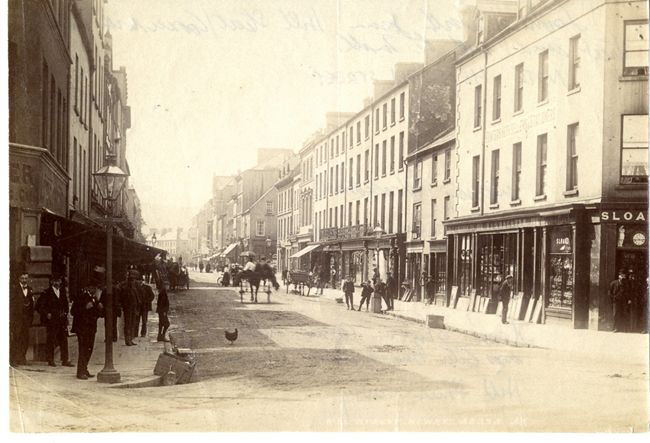
Lill Fanny Saether, who lives in Norway, recently gave an online presentation for Newry and Mourne Museum to mark World Holocaust Day, describing the experiences of her mother and her family during the Second World War and the German occupation in Norway. Her mother’s grandparents had emigrated from Lithuania to Ireland in 1890 and settled in Newry but Lill’s grandparents left Newry and went to live in Norway in 1911. Lill, who until her retirement worked in the Norwegian Ministry of Justice, spends part of the year in county Clare and has just a book written a book, ‘How My Mother Survived the Holocaust’, based on family diaries. The Museum Education Officer, Declan Carroll, invited Lill to share her researches on her family in a two-part article. In this first part Lill looks at her family’s arrival in Newry and their life in the town.
In the view of anti-Semitism and persecution of the Jewish people in Tsarist Russia, my mother’s maternal grandparents, Abraham Simon and Rhoda Yetta Freeman, escaped with their nine children from a ‘shtetl’ (a small village) in Kaunas in today’s Lithuania, then part of the Russian Empire, coming to Ireland and settling in Newry in 1890. They had intended to emigrate to America, but they were frauded by the captain of their boat and let ashore in Newry, and not in New York! It is unlikely that the emigrants knew what either of the cities looked like, or that they knew English, speaking only Russian and Jiddish. They probably didn’t have any money left to travel on to America and thus had to make the best out of the situation.

The family lived in Queen Street, then in Cecil Street and, thereafter, at 30 Mill Street. My great-grandfather was involved in the drapery trade and his daughter, Florence, called Florrie, my grandmother, attended Ballybot National School. My mother’s grandparents and seven of their children, including my grandmother, became British citizens in March 1903.
On 1st August 1906, my grandmother married Joseph Mendel, a draper from Canal Street in Newry, and my mother, Else, was born in 1909. Two of my mother’s siblings were also born in Newry. At the time they were living in Kilmorey Terrace and Joseph earned a living as a credit travelling drapery salesman. He and the three children became British citizens in January 1911. In August of that year the family left Newry for Norway, a move which was to seal the family’s fate in 1942.
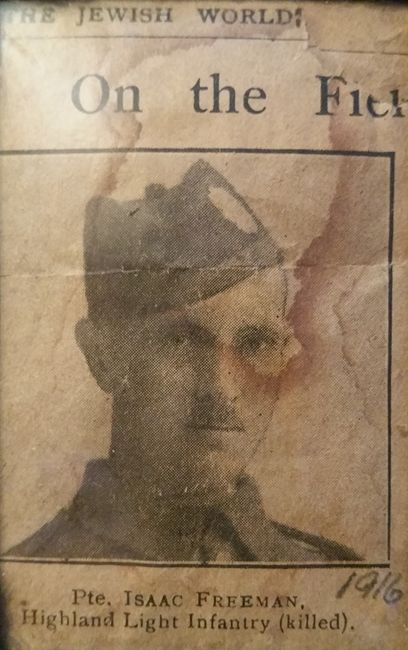
The family first settled in the town of Trondheim, living there until 1928. The two youngest children in the family were born in Trondheim, and my mother spent her childhood and all her school years there. During the First World War, 1914 to 1918, three of Florrie’s brothers enlisted as soldiers. One brother got a lifetime disability, and another brother, Isaac Michael, was killed in the Battle of the Somme in 1916. My mother’s oldest brother emigrated to USA in 1930.
Joseph and Florrie Mendel became Norwegian citizens in 1937. My mother and her sister, on the other hand, kept their British citizenships. This should prove to be a stroke of luck. The two youngest siblings, born in Norway became Norwegian citizens, which did not a protect them against arrest and deportation in 1942.
In next week’s article Lill Fanny Saether will reveal what happened to her mother and her family during the Second World War and German occupation in Norway, especially during the extensive persecution and deportation of the Jews in the autumn of 1942.
The Museum is currently offering free tours of the exhibition galleries on Wednesdays and Thursdays at 11.00 am. These must be booked in advance by calling our Education Officer at 0330 137 4422.
Newry and Mourne Museum is open Tuesday – Saturday 10.00 am – 4.30 pm. Please call 0330 137 4422 or email museum@nmandd.org for further information.
by Lill Fanny Saether
Write a comment
In last week’s article Lill Fanny Saether outlined how her family was one of a number of Jewish families which settled in Newry at the turn of the 20th century. Her family later went to live in Norway and this week Lill continues her story of her mother, and family members owed their survival in the Holocaust to the fact that having lived in Newry, they had British citizenship. An uncle and aunt of hers who hadn't lived in Newry and didn't have British passports were deported to Auschwitz and murdered.
After the German forces invaded Norway April 9th 1940, the Jews in Norway were subjected to special provisions. There were random arrests of Jewish men and properties owned by Jews were confiscated. From February 1942 all Jews had to have their ID-cards stamped with a “J”, and they had to fill in forms with all kinds of personal information.
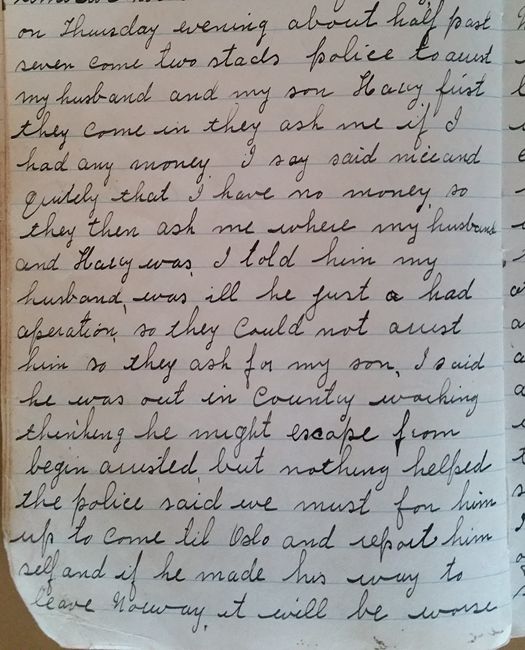
The real persecutions of the Jews started on October 26th 1942 when all male Jews were arrested. My mother’s youngest brother, Harry Isidor, was arrested the next day and was kept in prison until November 26th. My grandfather was recovering from a hernia operation and was given a respite of fourteen days.
When the Nazis and the Norwegian police came to arrest the women and children on the morning of November 26th, the four women in the family were at home. My mother told me many times that she said to the policeman, “My sister and myself are British subjects, so, you cannot arrest us”. She knew that some nationalities were exempt from the arrest order. My grandmother was not detained either, her husband being “terminally ill” in hospital. To make sure she would not flee, she was ordered to report to the local police station every day.
By that time, my grandfather had actually recovered and was in fact in hiding in the hospital from where my mother rescued him and another patient in the night of December 8th, 1942. Many of the staff in Norway’s hospitals did a tremendous job hiding Jews and thus saving their lives.
However, the Nazis took my mother’s youngest sister, Esther, with them. A ship was waiting in Oslo harbour and the women and children were transported there from all over Oslo. The men arrested in October, among them my mother’s brother, arrived from different prisons and camps.
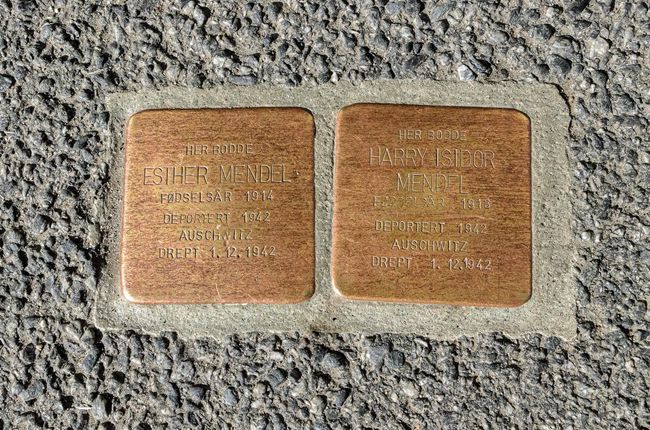
My mother’s two youngest siblings, Esther and Harry, were two of 532 people, 302 men, 188 women and 42 children on board. After arriving in the Polish town of Stettin after four days in horrendous weather, they were loaded on to cattle carts under massive harassment. On arrival in Auschwitz on December 1st both my mother’s siblings were taken directly to the gas chambers.
The rest of the family went into hiding until the nights of December 15th and 16th when they escaped to Sweden. There were several escape organisations helping people to flee, first and foremost to Sweden. They risked their own lives to save others. Many of the rescuers were women and it was my mother who had contact with the rescuers and arranged the escape for her family.
The 95-kilometre-long journey to the border in the night with old lorries on icy roads took about four hours. It was freezing cold, hazardous, nerve wrecking and an enormous physical strain on the refugees. They were let off quite close to the border and had to walk in total silence through the forest in the dark on a snow filled and icy path.
My mother left Sweden by air for Scotland in April 1943. She had got a position at the Norwegian Consulate in Glasgow. Based on her letters to the parents, we get a good insight into their lives as refugees. The correspondence between them continued until my mother returned to Norway in October 1945, after the liberation. My mother’s parents and sister returned home from Sweden to Norway in July 1945.
My mother, who was born in Newry, was an extraordinary woman who saved her own and several other peoples’ lives during the Second World War. She saved her life because she was a British citizen, and because some Norwegians risked their own lives to save others, and finally because Sweden was neutral and, at least from autumn 1942, received refugees from Norway unconditionally, including Jews. It is important to tell my mother’s story to make sure the Holocaust is never forgotten. Since most of the contemporary witnesses are now dead, those of us who were told of the events, and can document them, should convey the story as loud and often as we can.
The Museum is currently offering free tours of the exhibition galleries on Wednesdays and Thursdays at 11.00 am. These must be booked in advance by calling our Education Officer at 0330 137 4422.
Newry and Mourne Museum is open Tuesday – Saturday 10.00 am – 4.30 pm. Please call 0330 137 4422 or email museum@nmandd.org for further information.
by Lill Fanny Saether


 |
 |
 |