

 Write a comment
This year marks the 80th anniversary of the end of the Second World War, with Victory in Europe Day and Victory over Japan Day. The Chairperson of Newry, Mourne and Down District Councillor Pete Byrne has officially launched an exhibit of two Second World War artefacts and costumes at Newry and Mourne Museum which were used and worn by local men.
On display is a US Army 563rd Motor Ambulance Company Blouse and Cap c1943
Worn by Private First-Class James Quinn, originally from Tullyframe near Kilkeel. After emigrating to America, he served as an ambulance driver and mechanic with the US Army from 1943 to 1945 before returning to live in Kilkeel in 1950.
Visitors to the exhibit can see a suit made by Burton’s 1940s. Known as a demob suit, civilian clothing was issued to servicemen after their demobilisation from serving in the British armed forces. The outfit included: a felt hat or flat cap, a double-breasted 3-piece suit or a single-breasted jacket and trousers, two shirts and collars, a tie, shoes and a raincoat. Gloves, underwear and socks were also available, and men were given a special allocation of clothing coupons to buy any extra items they might need, as well as an extra cigarette ration, and a one-way rail warrant/ticket.
At the launch of the new display, Chairperson of Newry, Mourne and Down District Councillor Pete Byrne Councillor Byrne said, “the artefacts on display are a reminder that people from this area played significant roles during the Second World War at home and abroad and that life after the war was a challenging time for them as they adjusted back into civilian life.”
As well as the suits visitors can browse through the collection of mid-20th century collars, a clothing ration book, receipts from 1934 and 1945 from two gentlemen’s outfitters in Newry and a commemorative handbell which was made by the Buckinghamshire Die-Casting Co using aluminium alloy from a German aircraft which shot down during the Battle of Britain.
The VE Day and VJ Day Exhibit is currently on display at Newry and Mourne Museum and will run until November. The museum is open to the public from Tuesday – Saturday and from 10am – 4.30pm and admission is free. For more information phone 0330 137 4422.
Write a comment
The Quakers, a religious sect, were founded in England in 1652, by George Fox during ‘the greatest years of upheaval in English history’. Fox believed in spontaneous, non-hierarchical worship and a focus on individual experience of God. Quakers were also known as Members of the Society of Friends. Their lifestyle was strict, and they worshiped in silence in Meeting Houses, with no priests, sacraments, or statues. Meetings took place weekly, monthly quarterly and yearly.
William Edmundson an ex-Cromwellian soldier, who settled in Lurgan as a shopkeeper brought Quakerism to Ireland. The Richardsons who came to Bessbrook in the mid-19th century can trace their ancestors who converted to Quakerism to the mid-17th century. John Grubb Richardson founded Bessbrook Meeting House in 1864 and built a row of cottages, whose rents maintained the building.

Meeting houses were plain in design, both inside and outside. The strict practises Quakers adhered to isolated them from the indigenous Irish. Quaker schools were built to educate their children in Quaker beliefs from the age of two. Quakers dressed in plain clothes and spoke plainly using thee and thou and the days of the week were changed, for example, Sunday was known as First Day. Quakers are renowned for truthfulness, hard work, honesty, integrity, compassion for the poor in society, exceptional note keeping, temperance and the avoidance of debt among their fellow Quakers. Quakers were involved in prison reform, education and caring for the mentally ill.

Quakers tended to marry other Quakers, especially those involved in the linen industry. Marriage required parental consent, the marriage was simple, the couple attended the Meeting House, said they would love and care for each other and that was that. No celebrations occurred after. Marriage was important because these unions had a business component attached. For example, in 1867 James Nicholson III married Sarah Sophia Malcomson, whose father had his own cotton and weaving factory in Portlaw, Waterford.
In keeping with their faith, for those that could, they became doctors, scientists, engineers, merchants, shopkeepers and entered industry. One of the important industries Quakers went into in Ireland during the 18th and 19th centuries was linen manufacturing. The linen industry offered a choice of work, opportunities to make money and build businesses for family members. They tended not to integrate with other sections of the community other than for business reasons.
This was the context for the beliefs and way of life of the Richardson family. John Grubb Richardson and his father James Nicolson Richardson arrived in Bessbrook c.1845. They had been heavily involved in areas of linen bleaching for many years and owned mills in Belfast and Liverpool. They also had business contacts in New York during the 1830’s and 1840s.
John Grubb built Bessbrook Mill for spinning and later weaving of linen by 1853. He had assets, skills, vision and family connections. Bessbrook was an ideal location for his new venture, a few miles away from the town of Newry. However, Newry provided a plentiful supply of workers and Camlough lake supplied the water power to run the mill.
John Grubb soon began building a model village for the managers and workers. He wanted to create his little Quaker utopia. By 1890, 700 houses were built to facilitate the workforce of almost 3,000. He also built Bessbrook Town Hall, Post Office, recreational areas for workers and a Temperance Hotel for visiting managers. The hotel enforced Richardson’s Quaker ideals of no alcohol, believing if people avoided alcohol there would be no need for pubs, police or pawn brokers in his little utopia of Bessbrook. Other famous Quaker businesses followed his example, such as the Cadbury family in Birmingham who developed their Bournville Quaker community along the lines of Bessbrook Model Village.
The Mill remained in operation until 1972, when sadly new fabrics and a change in peoples tastes resulted in linen production falling into decline. However, the Richardson’s legacy lives on as Bessbrook remains a beautiful village to live in.
The Museum is currently offering free tours of the main exhibition galleries on Wednesdays at 2.00 pm. These must be booked in advance by calling our Education Officer at 0330 137 4422.
Newry and Mourne Museum is open Tuesday – Saturday 10.00 am – 4.30 pm. Please call 0330 137 4422 or email museums@nmandd.org for further information.
Please visit our website at www.visitmournemountains.co.uk
Write a comment
On Saturday the Eurovision Song Contest final took place in Basel, Switzerland. The first contest was held in Lugano, Switzerland, in 1956 when seven counties took part, each with two songs. The United Kingdom first entered the contest in 1957, while Ireland made its debut in 1965.

Ireland’s first victory came in Amsterdam on 21st March 1970 when 18-year-old schoolgirl Rosemary Brown performed “All Kinds of Everything” as Dana. At a meeting of Newry No 1 Rural District Council, held on Thursday 26th March 1970, it was proposed by Councillor J Matthews, seconded by Mr ET Brady, that the housing estate at Rostrevor Road, Hilltown should be named “Dana Place”. A special reception was held at the Ardmore Hotel, Newry and the INF Hall, Hilltown, was packed when Dana performed there. It was at the Ardmore Hotel reception that Dana first met the hotel’s managing director, Damien Scallon. In October 1978 they were married and for a time they lived at Rostrevor.
As a result of Dana’s victory, Ireland was the host for Eurovision in 1971. The UK entrant was Clodagh Rodgers, who recently passed away on 18 April at the age of 78. Clodagh grew up in Warrenpoint and was a pupil at St Mary’s High School, Newry. Her family owned a drapery shop in Warrenpoint, while her father, Louis, was a theatrical agent and dancehall show promoter who brought English and American artistes over to venues across Ireland. Among the big acts he brought to Ireland in the 1950s and 1960s were Eddie Calvert, Alma Cogan, Hank Locklin and Tom Jones, as well as Joe Frazier, the world heavyweight champion, who played a number of concerts with his band, “The Knockouts”. Thanks to her father’s connections, from the age of twelve Clodagh began to appear as a supporting act for more established stars such as Michael Holliday and Jim Reeves.

In 1962 Clodagh signed with Decca Records and moved to England to pursue a career in music. She made her BBC television debut on the “Adam Faith Show” in September 1962 and appeared in 1963 musical films “Just for Fun” and “It’s All Over Town”. In 1968 she married John Morris, who became her manager, and collaborating with producer and songwriter Kenny Young her singles “Come Back and Shake Me” and “Goodnight Midnight” were both Top 5 hits, making Clodagh the best-selling female singles artist of 1969.

Following this success, Clodagh was chosen by the BBC to represent the UK at Eurovision. Early in 1971 she performed six songs on the “It’s Cliff Richard” show, from which “Jack in the Box” was selected. Clodagh’s sister, Lavinia, accompanied her to the Eurovision final, held in the Gaiety Theatre, Dublin, where she was one of Clodagh’s backing vocalists. Watching the programme on television in her Newry home in Aileen Terrace was Clodagh’s 86-year-old grandmother, Mrs Roseanne Mulvey.
Appearing for Ireland in the 1971 contest was 19-year-old chemist’s assistant, Angela Farrell, from Portadown, who sang “One Day Love”. Angela’s singing talent had earlier been recognised in Newry, when she won top Junior Prize at the Killeavy “Spot the Star” Contest held in Cloghogue Parochial Hall in 1967. At Eurovision, though, she finished in eleventh place, while Clodagh ended up fourth. Clodagh continued recording and touring, and appeared in musical theatre, television shows and pantomimes, for instance, she was “Cinderella” to Ronnie Corbett’s “Buttons” at the London Palladium.
In 1986 Newry band, Luv Bug, became the first Northern group to represent the Republic of Ireland in Eurovision. The five-piece group included Newry siblings Hugh, June and Max Cunningham, along with Ricky Meyler from Omagh and female drummer, Majella Grant, also from Newry. The band which had been established in 1977 was accompanied to the Eurovision final in Norway by their manager Michael Magill from Warrenpoint. As with Clodagh, the Luv Bug song,“You Can Count On Me”, ended up in fourth place.

As well as performers, the compositions of Newry songwriters have also appeared at Eurovision, representing Ireland. In 1998 Gerry Morgan’s “Is Always Over Now?” was sung by Dundalk hairdresser, Dawn Martin, while in 2001 Newry Ulsterbus worker, Pat Sheridan, penned the ballad “Without Your Love” which was performed by Gary O’Shaughnessy.
Write a comment
The Cronin family came to Newry in the 1870s, when William’s father, Patrick, a native of Cork took up employment as manager of Carville Brothers, timber merchants in the town. William was born in 1875 and was educated by the Christian Brothers. At the age of 19 he joined the office staff of Carville Bros., rising through the ranks until at the age of 33 he was elected to the position on Town Clerk of Newry Urban District Council in November 1908.

He played a major role in delivering many schemes that greatly benefited the town and its people, particularly in relation to industry, housing, public health, maternity and welfare schemes. He worked tirelessly for the sick and the poor, advocating for free milk, meals and books for school children and devising a scheme under which the Council referred those who could not afford to pay for medical treatment to Newry General Hospital.

His duties were carried out through two World Wars, and he was instrumental in setting up Air Raid Precautions in the town during the Second World War. In recognition of his services, he was awarded an MBE in the New Year Honours List in 1946. Addressing a Council meeting he said that on working for the best interests of the people of Newry, he “acted on the basis of the greatest good for the greatest number”. In a nod to the esteem by which he was held, congratulations came from all classes and creeds and from far beyond the town.
Over the years Mr Cronin developed an unsurpassed knowledge of local government procedures and legislation and was frequently sought after for advice and guidance from other organisations and public bodies. He was noted for his industry and perseverance and his enthusiasm, energy and efficiency were unmatched. He took his first holiday since the First World War in 1947.
In addition to his role as Town Clerk, he served on a multitude of public bodies, the list of which is long and varied, stretching well beyond the boundaries of the town. He was Chairman of Down County Council and the Carlingford Lough Commission and was active in many roles relating to health and welfare and was Honorary Secretary of Newry General Hospital.
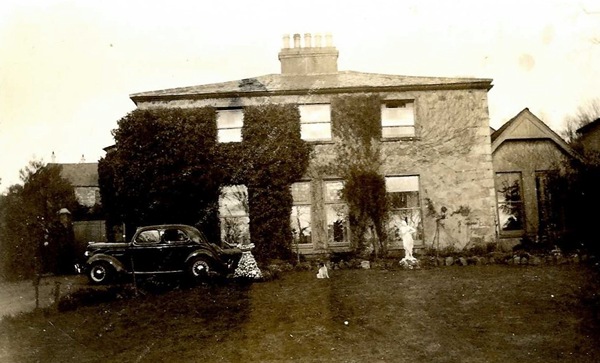
A sports enthusiast, he was elected captain of the Greenore Golf Club in 1921 and for many years was the Honorary Secretary of the Club. He was a member of Newry Rowing Club and part of the team that competed at the Henley Regatta in 1903. He was instrumental in organising a successful bazaar for the purchase of boats and the building of the Boat House as the Club headquarters. He was also a prominent member of the Glenside Tennis Club, Dromalane.
After almost four decades in the public life of Newry as Town Clerk, William Cronin resigned due to ill health in November 1947. He died a few months later in March 1948, aged 72. In tribute to Mr Cronin, at a meeting of Newry Urban Council after his death, he was described as the most capable Town Clerk in the whole of Ireland. He was succeeded in the role by his nephew Gerald Cronin. In 1956 the Council named Cronin Park on Boat Street in his memory.
The Museum is currently offering free tours of the main exhibition galleries on Wednesdays at 2.00 pm. These must be booked in advance by calling their Education Officer at 0330 137 4422.
Newry and Mourne Museum is open Tuesday – Saturday 10.00 am – 4.30 pm. Please call 0330 137 4422 or email museums@nmandd.org for further information.
Visit their website at www.visitmournemountains.co.uk
1 Comment
The Newry place name has created an international footprint and can be found in four countries across the globe. The most northern and oldest was founded in Ireland in 1144 as a settlement around a Cistercian abbey. The name has followed its inhabitants as they have moved across America, Canada and Australia. This article will look at the Newrys in America, which has the most towns and townships named Newry spread across seven states.

The name of Newry in South Carolina and Pennsylvania can each be accredited to a prominent benefactor. In contrast, Newry in Maine is an example where a group of settlers played that role.
The Newry Historic District in South Carolina encompasses lands and a textile mill village. Bought in 1893 by William Ashmead Courtney (1831-1909) and investors in The Courtney Manufacturing Company. William’s father Edward Courtney had emigrated to Charleston from Newry in 1791. William served in the Confederate army in the American Civil War and following the post-war destruction of the confederacy had to rebuild his career in business. He succeeded and served as mayor of Charleston in 1879 and 1887. Part of his success included the purchase of land along the Little River in Oconee County. Believed to remind him of his ancestral home he called the town Newry.

He created a mill and village in the traditional New England textile factory design, attributed to W.B.S. Whaley. The workers homes are a typical ‘salt box’ design for two family habitation, larger single-family residences for mill supervisors, a Neoclassical residence for Courtney himself. The rest of the village consisted of a boarding house, a company store, a church, a school, a company office and the mill complex, most of which still stand today. The mill closed in 1975 leading to population and village decline, however, since 2020 many buildings have undergone renovation and redevelopment. In 1993 Newry celebrated its centennial with many events including the publication of a local cookbook, which is in the Newry and Mourne Museum collection.
The development of the Borough of Newry, Pennsylvania is attributed to Patrick Cassidy, born in 1738 in Newry. He travelled to America, aged fourteen, in the service of a British Officer but left that employment to train and work as a surveyor. He joined Ashmead’s Company and fought as an American soldier in the War of Independence. Following the war, Patrick moved his family and bought 300 areas of land in Blair County. He constructed a small town naming it Newry after his hometown. Documents list Newry as one of the oldest towns in the region. To support the towns development in 1781 Patrick gifted land enabling the building of St. Patrick’s Catholic Church and the Newry Lutheran Church and their cemeteries. Newry’s town population was 245 in the 2000 census. Lucy Wolf states that the town retains many of its older buildings suggesting an ‘era lost in time’.

Newry, Oxford County, Maine, initially called the Sunday River Plantation was settled in 1781 by three Barker brothers from Massachusetts alongside Ithiel Smith of Cape Elizabeth and subsequently abandoned following an attack in 1782. The land was purchased in 1794 and known as the Bostwick Plantation. However, in 1805 the plantation was renamed by settlers that came from Newry and a petition was submitted to rename the area. Farms were established, alongside a sawmill and grain mill. Ithiel Smith and his family are buried in a section of the cemetery known as ‘Newry Corner’. Newry is now best known as the home of the Sunday River Ski Resort. It is also the site of the Artists Covered Bridge/Sunday River Bridge built in 1872, named as it is the most photographed and painted of the traditional covered bridges in Maine.
The Museum is currently offering free tours of the main exhibition galleries on Wednesdays at 2.00 pm. These must be booked in advance by calling our Education Officer at 0330 137 4422.
Newry and Mourne Museum is open Tuesday – Saturday 10.00 am – 4.30 pm. Please call 0330 137 4422 or email museums@nmandd.org for further information.
Visit their website at www.visitmournemountains.co.uk
Write a comment
Originating in the 17th century as information sheets for merchants, newspapers became an essential element to everyday life by the 19th century. Although with the introduction of the internet in the early 21st century, there has been a decline in the production of physical copies as most news is available on digital format. Newspapers are a vital source of information with an amazing ability to reach a large number in the population as well as providing a primary source of their time for any historian.
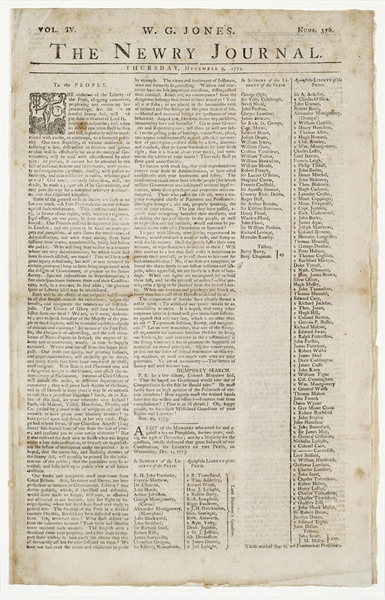
One item in the museum collection showcasing the value of the press is the 1773 cover of the Newry Journal. The cover is a list of Members of Irish Parliament who were for, and against, liberty of the press. This local newspaper was launched by Robert Jones in 1760 and was in circulation for a short period of time. This paper was considered one of the first newspapers published in Newry with the Newry Chronicle owned by Joseph Gordon, produced at his printing works in Market Street shortly following. The Newry Recorder which was published in 1814 came next.
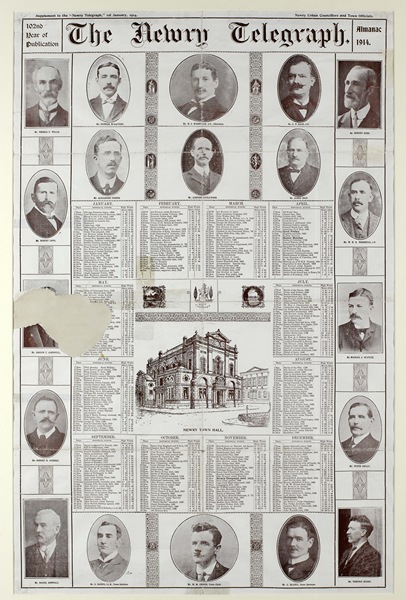
Another item in our collection is a newspaper supplement from 1914 which is an almanac published by the Newry Telegraph. Almanacs which list anniversaries of historic events and religious festivals were popular publications in the late 19th century and early 20th century. The almanac on display in Newry and Mourne Museum features the Councillors and officials of Newry Urban District council, many of whom were also businessmen in the local area. The Newry Telegraph was bought by Alexander Fisher in 1916 with the aim of using it as a tool for recruitment for the first world war since ill health prevented him from enlisting. The Newry Telegraph (continuing from The Newry Commercial Telegraph which operated from 1812.) ended its run on Saturday the 20th 1970 with volume 157 due to the rising costs of production.
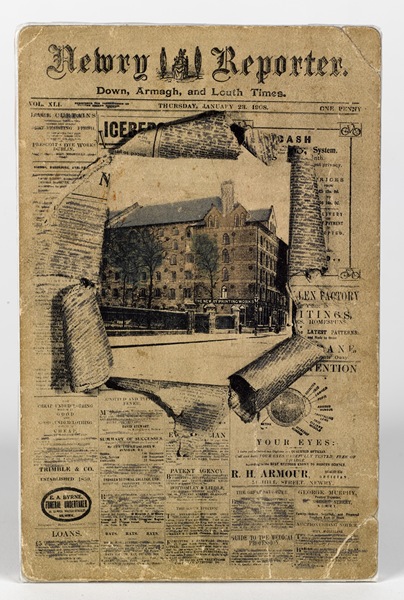
While Newry can boast of the many papers printed in the area, such as the Newry examiner (1830-1844), the Newry Herald (1858–64), and the Frontier Sentinel (1904-1972) two of them are still in operation to this day: The Newry Reporter and the Newry Democrat. Established in 1867 by James Burn with the first paper published on Saturday 16th November, the Newry Reporter has been in operation for over 155 years. For most of its production the paper was owned by three generations of the Hodgett family (who also owned the Newry Telegraph at the time of its closing.) The reporter was due to publish their last ever edition on the 26th of January 2023 but was saved when British multimedia company National World bought the paper.
Circulating since 1967, the Newry Democrat was merged with the Down Democrat in 2010, the company was then sold by their owners, Thomas Crosbie Holdings (TCH) for an undisclosed sum. TCH owned a total of 14 newspapers including the Irish Examiner, Waterford News and The Irish Post. The Democrat was bought by the Alpha Newspaper Group, owned by former Unionist MP John Taylor, now Lord Kilclooney, and his family.
The Museum is currently offering free tours of the main exhibition galleries on Wednesdays at 2.00 pm. These must be booked in advance by calling our Education Officer at 0330 137 4422.
Newry and Mourne Museum is open Tuesday – Saturday 10.00 am – 4.30 pm. Please call 0330 137 4422 or email museums@nmandd.org for further information.
Visit their website at www.visitmournemountains.co.uk
Write a comment
Before the 1690s, Britain and Ireland lacked standing armies, relying on temporary accommodations like taverns and private homes for troops. Newry had a military presence in May 1571, when Nicholas Bagenal commanded 50 cavalry men, possibly stationed in Bagenal’s castle. Following the Williamite-Jacobite War, Irish Protestants, fearing future rebellion, supported a permanent military presence. In 1698, the Irish Parliament approved 12,000 Williamite troops, requiring purpose-built barracks. For Newry’s Irish Protestants, recalling past expulsions in 1641 and the town’s burning in 1689, the military presence was reassuring. Irish Catholics, however, likely saw it as an occupying force enforcing a new political and land order that marginalised them.

A 1706 lease shows Richard Skeffington granting land near Boat Street and Carricknelligan to the Trustees of Barracks. Carricknelligan may be an anglicisation of Carraig na Lochán ('rock of the small lakes/ponds'). This land had originally been leased from Sir Nicholas Bagnall in 1698, and a formal lease in 1699 (49 years) permitted the construction of an infantry barracks with a foot barrack, kitchen, coalyard, hayshed, "shout yard" (likely a drill yard), and house of office. Likely completed by the early 1700s, it appears in the 1703 Neville Survey close to Kilmorey Street. The premises measured 100 yards by 40 yards and were bounded by the Highway to Rostrevor (East), Newry River (West), Quay (North), and a park owned by Richard Skeffington (South).
Maps by Senex (1712) and Moll (1714) confirm it was an infantry barracks housing one company of troops, largely recruited from Britain due to laws stemming from the Treaty of Limerick (1691) which restricted Irish enlistment. Fears of Catholic uprisings and Jacobite invasions reinforced British-led recruitment, though Protestants in Ulster were occasionally enlisted in times of crisis. Despite restrictions, attempts were made to circumvent these laws to enlist Irishmen. By 1749, the Thomas Jefferys map labelled the barracks as a cavalry barracks, implying modifications such as stables.
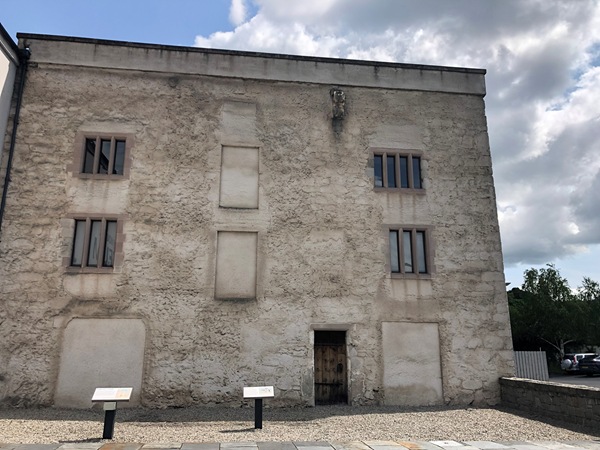
By 1768, Newry’s barracks had likely fallen out of use, reflecting the declining threat of Jacobitism. However, the absence of garrison left the town exposed to agrarian unrest, including movements like the Oakboys. A major riot in 1763 saw 4,000–5,000 people from County Armagh descend on Newry. Amid the chaos, Captain Grant allegedly wounded Mr. Warneck, who later died, before he threatened to burn every house in town.
In response, local guard rooms gained prominence. The Custom House had a guard room, likely established when the barracks ceased operation, while the Market House on Market Street housed guards until its demolition around 1785. Guard rooms in the 18th-century served as military accommodation, holding cells, military offices, and court-martial spaces, filling a security void.
Thomas Kitchin’s 1777 map shows no barracks in Newry, but unrest in the 1780s–90s led to new barracks at Corry Place (now Corry Square), likely the infantry barracks in Rocque’s 1790 map. A 1783 lease between Edward Corry and Joseph Scott records the area as a new street, though whether the barracks were purpose-built or repurposed remains uncertain. By 1797, rising security concerns prompted a letter to Lord Downshire, praising the Cavan Regiment and noting that 24 townsmen had volunteered as constables for nightly patrols. Tensions flared when a man arrested for insulting Captain Goddard later made seditious claims, whilst also accusing others of United Irishmen affiliation. The Cavan Regiment and 22 Dragoons detained the suspects and transferred them to Armagh Gaol.

In 1800, the government bought Newry’s Linen Hall (built 1783) for £14,000, converting it into a barracks. In 1808, the Old Barracks near Merchant’s Quay was listed for lease, though military occupation continued. The 1817 Military Register confirmed its use, and the Ordnance Survey (1829–35) recorded it as a cavalry barracks, 95 × 41 feet, 33 feet high, with a cellar. In 1856, it became a constabulary barracks, serving this purpose until 1866, when police relocated to Queen Street, and it became a private residence.
The Museum is currently offering free tours of the main exhibition galleries on Wednesdays at 2.00 pm. These must be booked in advance by calling our Education Officer at 0330 137 4422.
Newry and Mourne Museum is open Tuesday – Saturday 10.00 am – 4.30 pm. Please call 0330 137 4422 or email museums@nmandd.org for further information, or visit their website at www.visitmournemountains.co.uk
Write a comment
In the collection of Newry and Mourne Museum there are a range of estate maps, surveyors’ drawings and documents relating to Downshire Road, one of Newry’s most historic areas and home to many iconic buildings which played a role in the business, educational, religious and residential life of Newry.
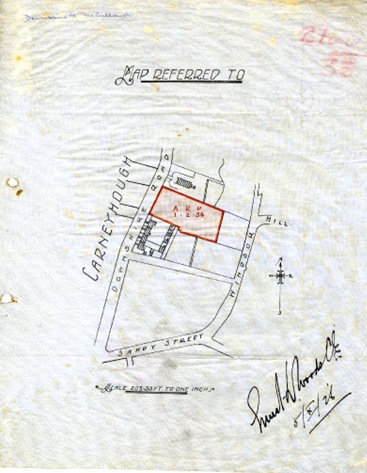
The Downshire Road area was first developed at the beginning of the nineteenth century and named after Arthur Hill, 3rd Marquis of Downshire who had begun laying out the modern centre of Newry. An entry from the Parishes of Co Down, Ordnance Survey 1836 described “2 new houses are just completing on the Downshire Road. Most of the houses on Downshire Road are of a very late date. They are all built of stone”
The Marquess of Downshire built Downshire House in the early nineteenth century, on what was then the west side of Belfast Road. It was later bought by the Orange Institution, who renamed it after Henry Thompson, a prominent MP who was born in the house. The house was demolished in 1980 and a replacement hall built.
In 1844 the Downshire Road Presbyterian church opened. It was renovated in 1885 which included a new pulpit made of pitch pine, yellow pine and American walnut.
In the mid-1890s Newry Intermediate School moved to a new building on Downshire Road, changing its name to Newry Grammar School in 1948. By 1953 the school had 350 pupils and the premises were cramped. The school merged with Ashgrove Secondary intermediate school to become Newry High School and pupils moved between the two buildings until 1973 when the Downshire Road site closed. The building became Newry Teachers Centre.
In an 1880 provincial directory, Newry Mineral Water is first listed as operating from premises from Downshire Road. The water was “procured from a great depth from the primitive rock” on the Downshire Road site and was said to be “free from all leaden or other impurities”. As well as producing mineral water drinks, the company also bottled beer and stout on site. The factory operated from between the Court House and the Presbyterian Church until the late 1970s when it was demolished to make way for the extension of New Street.
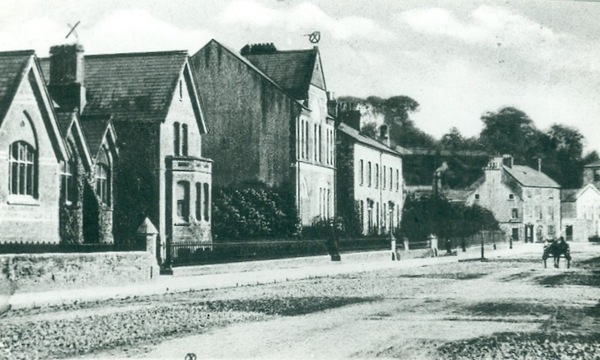
One of the most defining characteristics of the area is the Corry Monument on the corner of Downshire Road and Sandy Street. The granite obelisk was dedicated to the memory of Trevor Corry, a leading magistrate. The recreation grounds around the monument were opened to the public in 1877 and paid for by a public subscription.
The area also has many beautiful private homes. The 1886 Co Down Directory details Downshire Road as having “many private residences of a most substantial sort, some of them being very elegant”. Many of the residences were designed by celebrated architect Thomas Duff, with his private clients being the merchant classes who commissioned the large houses on Downshire Road. Duff himself lived at 45 Downshire Road in the middle house of Paternoster Rd that he designed himself.
More modern developments include the building of the BT telephone exchange, which opened in 1958, and a large Tesco Supermarket which opened in 2013.
The Museum is currently offering free tours of the main exhibition galleries on Wednesdays at 2.00 pm. These must be booked in advance by calling their Education Officer at 0330 137 4422.
Newry and Mourne Museum is open Tuesday – Saturday 10.00 am – 4.30 pm. Please call 0330 137 4422 or email museums@nmandd.org for further information.
You can visit their website at www.visitmournemountains.co.uk
Write a comment
The first postcard, with a similar shape of that of today’s, was sent by the public postal service in Austria on 1st October 1869. It stemmed from the desire for a cheaper and more practical method for shorter, more efficient communication. With the founding of the General Postal Union (later the Universal Postal Union) in 1874, a standard postal rate was set, therefore it became easier to send cards abroad.
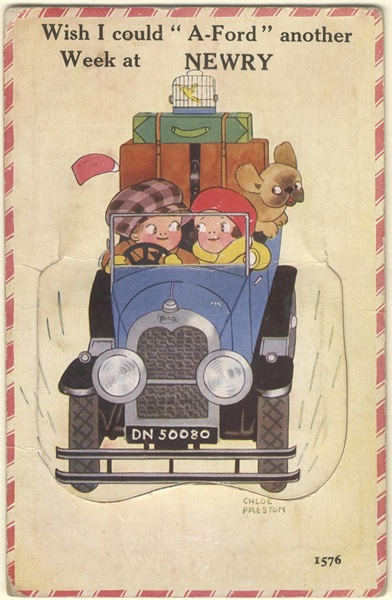
Postcards originally had space for the address on one side and the message on the other. The boom in photography and cheaper, high quality printing methods meant that pictures began to be introduced on the message side in the 1890’s, and from 1902 onwards, space was authorised on the address side to write text.
Between 1895 and 1920 the purchasing, sending and collecting of picture postcards became a trend in Ireland as well as many other countries. Their visual appeal also made them suitable as souvenirs, gifts and collectables.
Newry and Mourne Museum hold many postcards in their collection. A postcard date stamped 1950, was sent to Mr. and Mrs. P. Duffy, 87 Church Street, Newry. It featured a colour image of Pope Pius XII, sent from Vatican City, it simply stated “In my thought at Rome, Mary.”
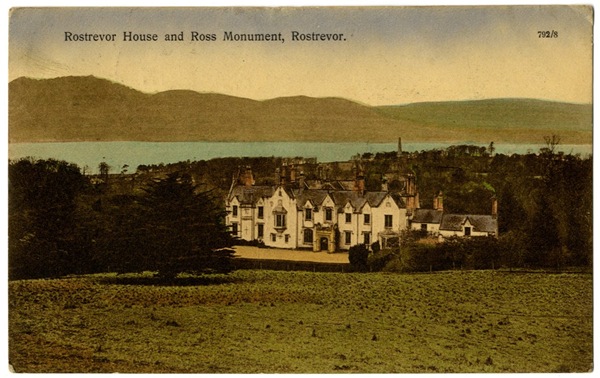
M. Bethell sent a postcard from the Valentine Series to Miss W. Harold 24 Chestnut Grove, Higher Tremere, Birkenhead in the early 20th century. The image shows the Mourne Hotel and Woodside, Rostrevor. The message reads, “Dear Miss Winnie, this is the most delightful spot, a quaint little village of rustic villagers. The children go to school at 10 o’clock and leave at 2 o’clock. They wear no shoes or stockings, which is a great saving considering the stones and small pebbles they have to walk over. Hoping to hear from you soon. Yours sincerely, M. Bethell.”
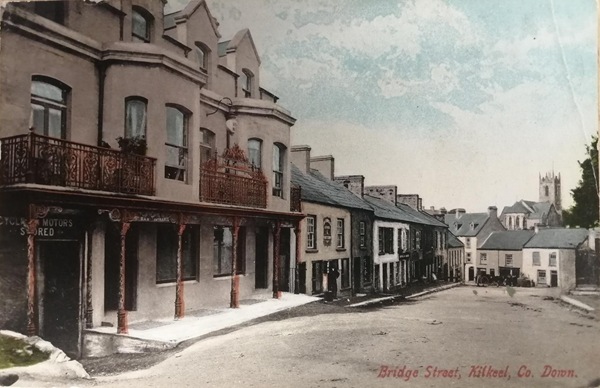
Another postcard from the Valentine Series was addressed to Dr Sinclair, Sick Asylum, Hendon, London. The image on the front is of Trevor Hill, Newry. The message on the reverse, “Just a line to let you see an old favourite. Hope you are well, from Och.”
The Murray Collection housed in Newry and Mourne Museum, includes numerous postcards. From Acton, near Poyntzpass, Charles Murray joined the Royal Air Force in 1936. He initially trained in England but, by early 1939, was in Palestine where he spent the early years of the Second World War. However, by 1943 Sergeant Murray was being stationed at various RAF Stations in Britain and Northern Ireland. He was killed on the night of 30 August 1944 when the Lancaster Bomber, on which he was a Flight Engineer, was shot down during a bombing raid on Stettin in Poland. Charles sent a postcard to his sister Annie dated 5th November 1938 with the image of the HMT Neuralia. He wrote “Dear Annie, I sail at 2 o’clock today, I will write as soon as possible, give my love to all the family. Yours, Charles”.
The Museum also has a number of postcards from the Lawrence Series, the single most significant collection in the early development of postcards in Ireland, beginning in 1865.
The Museum is currently offering free tours of the main exhibition galleries on Wednesdays at 2.00 pm. These must be booked in advance by calling their Education Officer at 0330 137 4422.
Newry and Mourne Museum is open Tuesday – Saturday 10.00 am – 4.30 pm. Please call 0330 137 4422 or email museums@nmandd.org for further information.
Visit their website at www.visitmournemountains.co.uk


 |
 |
 |