

 Write a comment
Newry Town Hall stands as one of the most recognisable buildings in Newry. Commissioned by the Newry Town Commissioners and completed in 1893, it served as the heart of local government under their authority, and subsequently under Newry Urban District Council, until 1973. Throughout its existence, the Town Hall has played a significant political, cultural, and artistic role in Newry’s history. With major plans for its further development underway, we will take a brief look at its history over two articles.

Although the need for a purpose-built town hall had been discussed at a public meeting in the summer of 1887, it wasn't until March 1890 that the Commissioners announced an architectural competition for its design. From 1889 public business had been conducted in the town's Assembly Rooms, located in the Savings Bank on Bank Parade (Sean Hollywood Arts Centre).
Two competitions were held for the building's design. In 1890 William Sterling of Dublin won the first. He was praised for his design's architectural merit, modest cost, and the potential to incorporate much of the existing Savings Bank into the new structure. However, these plans were shelved. A second competition followed in spring 1891, and this time, William Batt of Belfast’s design was chosen. Unusually, Batt’s proposal placed the hall on the new three-arch bridge, then under construction and named the Armaghdown Bridge.
In July 1890, the Commissioners opted to erect the new hall over the Clanrye River rather than utilise the Savings Bank site. They considered it more economical to widen the bridge to accommodate the new building than to demolish the bank. The decision to build over the river is widely attributed to a desire to prevent rivalry between townspeople in County Down and those in County Armagh, as Newry straddles both counties. The Clanrye River marks the old county boundary, so building the Town Hall over it ensured it would be in both counties at once.
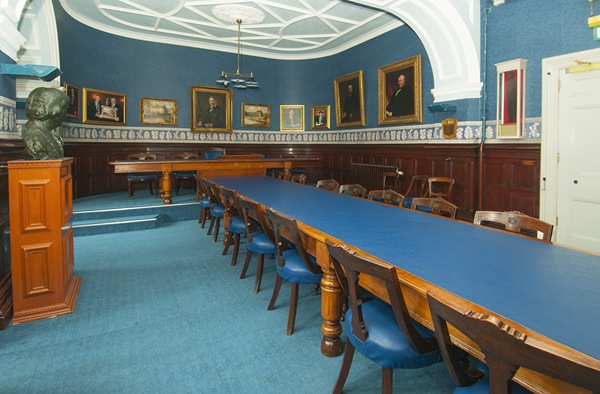
The building was officially opened by the Earl of Kilmorey in March 1894. It featured a fire station at the rear, complete with a belfry for a hand-operated alarm bell, along with a spacious auditorium and a board room. In 1895, Batt was asked to propose adding a tower to make the clock more visible and the bell more clearly heard, but the plan was never realized. A Minor Hall was added in 1913.
The Town Hall served as the seat of local government from 1894 until 1973, initially under the Town Commissioners and then the Newry Urban District Council, following the reforms of the Local Government (Ireland) Act 1898.

The board room was the venue for regular meetings of elected councillors, where local policies were debated, budgets approved, services managed (such as sanitation, lighting, local roads, and public health), and the day-to-day running of the district overseen. The building also housed the various departments and officials responsible for executing council decisions, including the Town Clerk, engineers, and finance officers.
Following the major reorganisation of local government in Northern Ireland in 1973, the Newry Urban District Council was abolished, and its functions absorbed into the larger Newry and Mourne District Council with the establishment of new offices at Monaghan Row.
While the Town Hall might not have been the sole administrative headquarters for the entire new district, it continued to play a significant role. It acted as a venue for certain council functions or public-facing services, including the registration of births, deaths, marriages, and civil partnerships.
Further local government reform occurred in 2015 when Newry and Mourne District Council merged with Down District Council to form Newry, Mourne and Down District Council. In late 2017, the Town Hall underwent extensive refurbishment works. There are now further plans to upgrade the building, along with the Sean Hollywood Art Centre, incorporating a new theatre conference facility, including the construction of a new auditorium with a capacity of 255 seats.
Newry and Mourne Museum is playing a role in these changes. Several portraits that have hung in the boardroom have been transferred to Bagenal’s Castle for storage until renovations are complete. These include the image of John Moore, the first chairman of the Town Commissioners of Newry; the picture of Michael J. McCartan, the first Chairman of Newry Urban District Council (1899-1901); and the portrait of Hugh John McConville, Chairman of the Urban District from 1909-1922 and again from 1929-1937.
In the next article we will look at some of the major events and activities that have taken place in the Town Hall that highlight the important role this building has played in Newry’s history.
Newry and Mourne Museum is open Tuesday – Saturday 10.00 am – 4.30 pm. We currently offer free tours on Wednesdays at 2.00 pm. These must be booked in advance by calling 0330 137 4422 or email museums@nmandd.org for further information
Please visit our website at www.visitmournemountains.co.uk
Write a comment
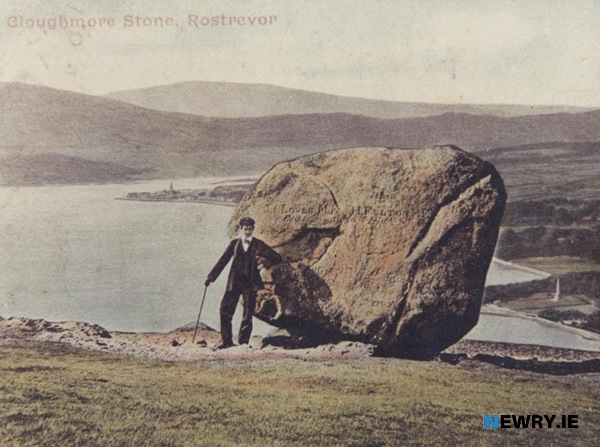
Believed to be name after Edward Trevor’s wife Rose, the village of Rostrevor is known for its sights and sounds, which is apt with the Fiddler’s Green Festival taking place this week. The festival is in its 37th year and continues to grow in numbers and events and this year runs to Sunday 20 July.
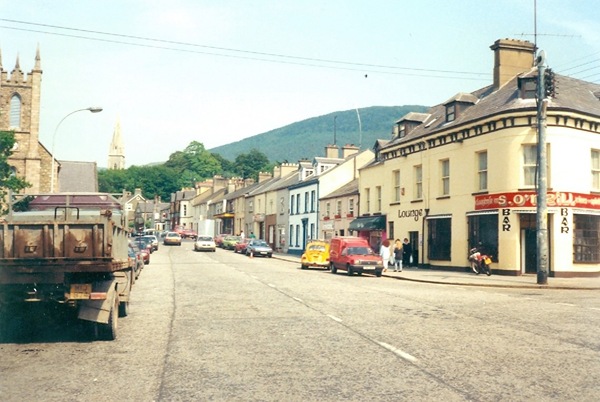
It began as a one-night event in 1987 and has grown to several days and nights of entertainment with over two hundred artists performing, drawing audience members from as far as Canada, Australia and Denmark. The festival is named after the Fiddler’s Green area in Rostrevor (in legend the Fiddler’s Green is considered a place in the afterlife where sailors can rest in peace while a violin plays for their amusement) which is where the performers and audience gather to mark the opening of the festival. The event encompasses musical performances, art, nature, wellness, musical workshops and Ceili dancing. Another highlight is the Duck Derby which has been held at the Fairy Glen since the 1980s.
Aside from the events held, the festival also highlights the contributions made by artists in music, literature and art. There are two awards given each year. The Hall of Fame Award for an individual or group who has made an outstanding contribution to Irish Music and Tradition and the Creative Arts Award (established in the year 2000) which acknowledges achievement in the Arts & Literacy field. The Hall of Fame Award was hand carved by local artist Jim Sherry and was first awarded to legendary fiddle player Sean Maguire before being given to acts such as The Dubliners, The Clancy Brothers, The Sands Family, De Dannan and Clannad. The Creative Arts Award trophy was crafted by Irish Sculptor Carolyn Mulholland and was first awarded to the late Nobel Laureate Seamus Heaney.
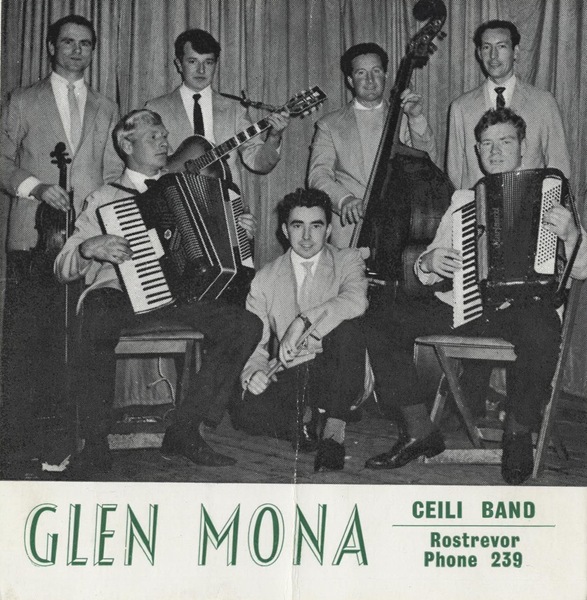
One of the famous groups associated with the festival is the Sands family. Also known as the Sands Family Folk Group, the band consists of Tommy, Anne, Colum and Ben Sands who lived just outside of Mayobridge. The band went from performing in their home to playing in New York in 1971 as well performing on a St Patrick's Day in Carnegie Hall. The Sands family continue to support the festival to this day.
The festival has had many highlights over the years including the 1989 festival when renowned Irish Folk Musician Tommy Makem flew in from America to join in the events. The 1995 festival saw Dolores Keane winning the Hall of Fame Award and part of the festival appearing on the BBC for an episode of “Anderson on the Road” hosted by popular presenter Gerry Anderson. Dolores’ brother Seán Keane will be receiving the Hall of Fame Award this year.
Newry Museum is currently offering free tours of the main exhibition galleries on Wednesdays at 2.00 pm. These must be booked in advance by calling their Education Officer at 0330 137 4422.
Newry and Mourne Museum is open Tuesday – Saturday 10.00 am – 4.30 pm. Please call 0330 137 4422 or email museums@nmandd.org for further information.
Visit their website at www.visitmournemountains.co.uk
1 Comment
Whitework, an embroidery technique in which the stitch and the linen are of same colour, became associated with County Down and County Armagh in the 19th century when an interconnected system of industry and trade developed around the manufacture of table linen and handkerchiefs.
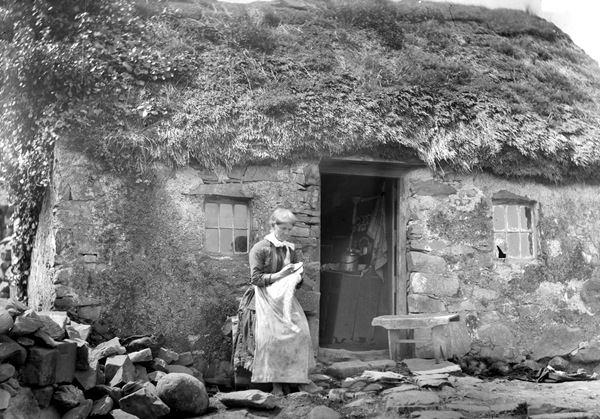
The technique includes openwork such as scalloped edges and drawn thread work and the related cutwork, producing an open, lacy effect. Floral forms are typical of whitework embroidery, and the craft was known locally as flowering. It has been described as “simultaneously decorative and plain”.
In the late 18th century, whitework embroidery featured on garments of the fashionable elite. During the 19th century, it was produced at a lower cost to lace and the manufacture of pieces decorated with whitework took on an industrial scale.
Thousands of women were employed as outworkers in the industry in County Down producing “small luxuries” which were traded through the Belfast linen markets. The application of the sewing machine in the 1850s meant the industry underwent a centralisation of production. However, mechanisation was an uneven process, and whitework was carried out by hand in the region well into the twentieth century. Sewing and embroidery were considered womanly accomplishments, and so it was possible for women to hide the time spent on paid work. Also, home-workers were not associated with the coarse and immoral behaviour attributed to factory workers.
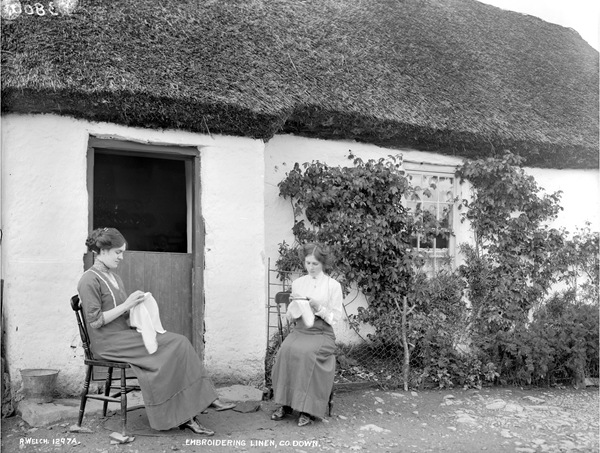
In the countryside materials were distributed through agents who were usually small shopkeepers. One such agent was Theresa Mallon, known as Teasy, who had had a shop in Mayobridge. Wilson’s on the Newry Road in Kilkeel employed flowerers from Glasdrumman and Ballinran. After the goods were examined, all work was paid by the piece, and deductions were made for any flaws, stains or late deliveries. The piece-rate was set by the manufacturer and clearly stated on an invoice dispatched with each order and agents generally received 10% commission on all the goods completed. Manufacturers included the Irish Linen Mills of Belfast, who specialised in the initialling of gentlemen’s handkerchiefs.
Schools for teaching needlework skills were set up by the District Boards and convents, but most girls learned from their mothers or sisters. The motif to be worked was stamped on the linen by the manufacturer, but sometimes a simple pencil trace on paper was given out by agents for the women to copy. A dozen small napkins could be completed in a day, and a bedspread took nearly a week to finish.
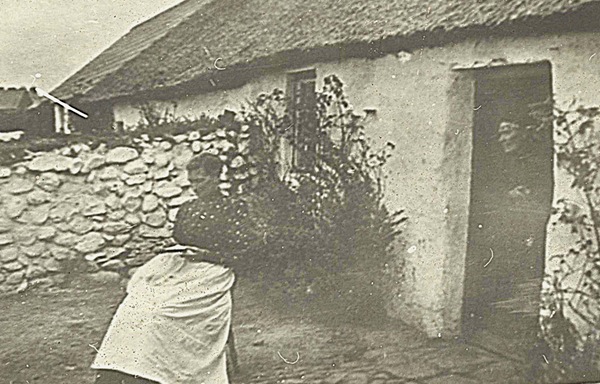
In 1845, reports from the Mournes boasted of ‘plenty of employment for “junior females” in flowering and needlework, earning between four pence and one shilling per day, which keeps them comfortably clothed”. The following year, the Master of the Kilkeel Workhouse handed over £4.5s. (about £260 today) to the Guardians for flowering done by inmates. In the 1850s and 1860s, the weekly earnings for embroidery ranged from 2s.6d. (£10) for young girls to 5s (£20) for an adult but could be as low as 2d (70p) a day.
Home-workers throughout the region were paid under the truck system with earnings recorded in an account book or on a ticket which could only be redeemed in the agent’s shop. Although prices were much higher than elsewhere, women could not risk taking their trade to another shop – they might not receive the best paid work, or any work at all. Home-workers were often obliged to buy articles they did not want or to make excessive purchases and gradually pay off their debt with their earnings. This gave the agent control over home-workers and women might have to take work which was not well paid.
By the 1960s the home-working system had been better regulated and County Down flowerers were working for the luxury goods market. Women were able to command 2 shillings (£2.50 today) per dozen for dots and 3s 6d (£4) for initials. They were also able to lay aside their earnings to purchase special items such as material for a wedding dress.
Newry & Mourne Museum is developing a new display of whitework and embroidery from the local area that will open in spring 2026 and would love to hear from readers with any information about this rich local heritage.
Write a comment
Some of the earlier examples of miniatures date back to Egypt when miniature items of possessions were buried with the dead. They gained popularity in Europe with the introduction of doll houses which began to be massed produced during the industrial revolution and now miniatures are available in a wide variety and with a range of uses. This week the Newry and Mourne Museum has decided to showcase some of the models and miniatures in our collection starting with the miniatures of the Connemara and the Retriever made c.2002 by Frank Maginnis from Kilkeel.
The S.S. Retriever was a small steam collier owned by the Clanrye Steamship Company in Newry. Built in 1897, the Connemara was one of three steamers ordered by the London and Northwestern Railway Company for the Greenore - Holyhead service. On the 3rd November 1916, the two ships collided in a storm at the mouth of Carlingford Lough with the loss of ninety-four lives with only one survivor, James Boyle, a crew member on the Retriever.
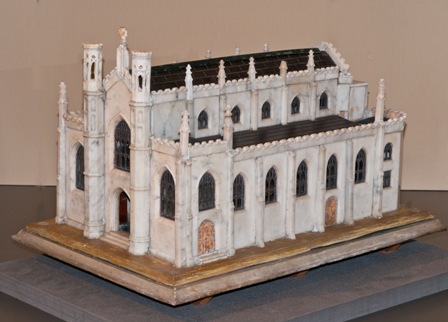
Another miniature in our collection is the model of the Newry Cathedral. The model was made by the Toman family who lived in Francis Street, Newry. It depicts the cathedral as it appeared toward the end of the 19th century, before the transepts, bell tower and sanctuary were added. Gerry Toman was interviewed in January 1959 and recounted that his grandfather, who was a fireplace fitter by day and a pastime marble worker by night, set out to make a marble model of the cathedral. He did not live to see his work completed, and Gerry, who as a young man worked in the local spade mill, took up the task to finish the model. The model measures 76 cm in length and 46 cm wide and 30 cm in height, it is very detailed with a slated roof that lifts off and glazed windows. It was once lighted by battery to show the interior features including miniature seats, altar, gallery and staircases.
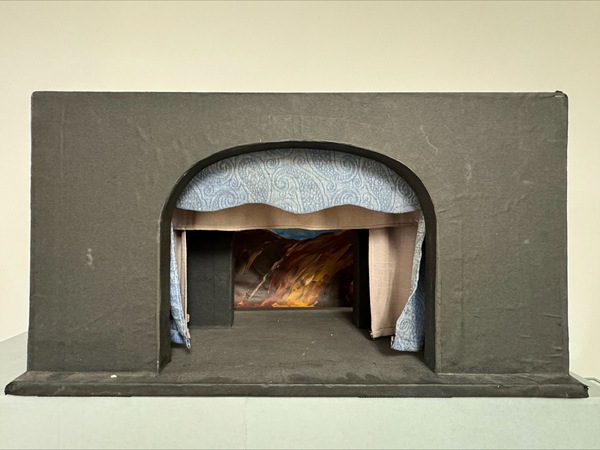
The museum also holds a model of the stage of Newry Town Hall, which was made by Mary McKee who designed sets and scenery for the Newry Musical Society productions. Maquettes (a term for a mock up an artist makes of their sculpture), or model sets, were placed in this model stage to test ideas and visualise designs for upcoming performances. A new backdrop had been painted for the model by Anna Savage, an artist who previously worked at Newry and Mourne Museum and depicts a scene from Oklahoma! which was performed by the Newry Musical Society in 1973.
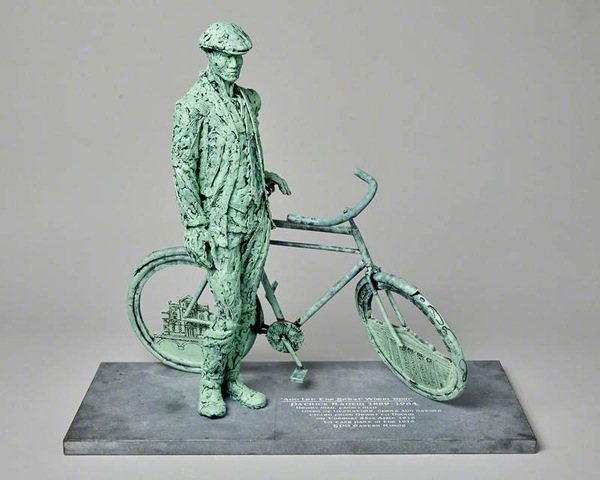
Aside from our models and miniatures the museum also has a sculpture maquette in the collection. It consists of the figure of Patrick Rankin with his bike. It was created by Barry Linnane to commemorate the 100th anniversary of the Easter Rising and Rankin’s determination to be involved that he cycled the 65 miles to Dublin.
The Museum is currently offering free tours of the main exhibition galleries on Wednesdays at 2.00 pm. These must be booked in advance by calling our Education Officer at 0330 137 4422.
Newry and Mourne Museum is open Tuesday – Saturday 10.00 am – 4.30 pm. Please call 0330 137 4422 or email museums@nmandd.org for further information.
Visit their website at www.visitmournemountains.co.uk
Write a comment

In the last article, The Rich History of Newry Town Hall we reviewed the development of Newry Town Hall, from its initial construction over the Clanrye River, through to its central role as the seat of local government until 1973. In this article, we will look at some of the significant political and cultural events that have taken place over the last 132 years. We will also look at some of the new features we can expect when the new Theatre and Conference Centre opens.

The Town Hall was the venue for important political events. On 27 September 1907, a branch of the National Union of Dock Labourers was founded at a meeting held in Newry Town Hall, presided over by James Fearon and addressed by James Larkin.
Eamon de Valera was scheduled to address a meeting at the Town Hall on 25 October 1924, despite being banned from entering the North. He was on his way to the stage when he was arrested, and police were forced to draw their guns to remove him from the hall and place him into an armoured car to take him to Canal Street barracks.
On 8 February 1927, Sir James Craig, Prime Minister of Northern Ireland, visited Newry and the Town Hall as part of a ten-day tour to various parts of Northern Ireland. The tour designed to encourage political accommodation and reconciliation at a time of tremendous political conflict in Northern Ireland after Partition.
August 16 1971, at the height of the Civil Rights movement, a mass meeting was held at Newry Town Hall where speakers called for a civil disobedience plan to 'smash the state.' The People's Democracy (PD) outlined a campaign consisting of a boycott of public authorities and a rates strike. Some councillors were on the platform, and Pat McMahon, then Council Chairman, announced his "100 percent" support for the campaign, subsequently resigning.

Throughout the 20th century, the Town Hall was a hub for arts, drama, culture, and music in the area. It hosted lectures, concerts, plays, dances, and even boxing matches. Renowned acts like baritone Andrew Black (1903), violinist Tavidar Nachéz (1906), and even U2 (1980) made appearances.
During the Second World War, artists such as George Formby, Glenn Miller, and Larry Adler performed there in support of the American troops stationed in the area. Highly popular variety shows were held under the direction of Pat McKevitt, and the 1950s saw the emergence of showbands, which evolved from dance bands, played here.
The Town Hall is also synonymous with festivals and organisations that have significantly contributed to promoting drama and music throughout the district. These include the Newry Drama Festival, Newry Musical Feis, the Newry Musical Society, Newpoint Players, and, of course, the generations who took part in the annual pantomime.
New plans are underway to develop the Town Hall into a multi-functional theatre and conference facility, boosting cultural activity. The project includes renovating the Town Hall and constructing a new building at the Sean Hollywood Arts Centre site. A glazed atrium will connect the two, creating a single venue, a concept echoing Sterling's 1890 original design for the Town Hall, which would have incorporated the former Savings Bank.

This project will create a new theatre and conference facility featuring a 255-seat auditorium equipped with state-of-the-art audio-visual systems. It will also offer high-quality, multi-use rooms for various events like music performances, conferences, and banquets, alongside planned public outdoor performance spaces.
The Town Hall has witnessed many political upheavals and social changes, yet it has continued to be a central focus of civic life for Newry. The new construction will provide opportunities for a wide range of performances and festivals set in a high-quality public venue for many more years ensuring that the Town Hall remains a unique venue on a truly unique site.
Newry and Mourne Museum is open Tuesday – Saturday 10.00 am – 4.30 pm. We currently offer free tours on Wednesdays at 2.00 pm. These must be booked in advance by calling 0330 137 4422 or email museums@nmandd.org for further information
Visit their website at www.visitmournemountains.co.uk
Write a comment
Catherine Byrne, born circa 1843, was the daughter of Michael Byrne, a Catholic spirit dealer and baker based on Water Street in Newry. She grew up alongside her siblings Edward Aloysius, Mary Catherine, and Anne. In the 1860s, she married Henry Butterfield, a spirit merchant operating on Monaghan Street. Following her father's passing in 1865, Catherine inherited £100. Widowed by 1872, Catherine became administratrix of Henry’s estate and continued the spirit trade at No. 1 Monaghan Street. She was listed as a spirit dealer there between 1877 and 1880. In 1882, she sold the license and moved in with her brother Edward, a baker and undertaker on Water Street.
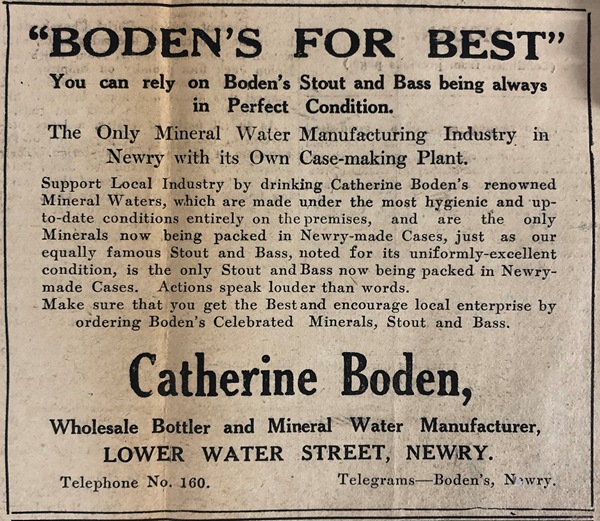
In 1883, she applied for a new spirit license at No. 19 Water Street. Sometime before 1890, she married Mr. Boden and resumed trading under the name Catherine Boden, with premises at Lower Water Street. In 1901, she was recorded living with her daughter Mary Rose Butterfield then aged 27 and her stepson, Peter Joseph Boden aged 19 (b.1882), who also happened to be a bookkeeper. By 1895, her business had expanded to Hill Street with her branding appearing on porter boxes and advertisements,
"BODEN’S STOUT IS UNDOUBTEDLY THE BEST ON THE MARKET. 61, HILL STREET AND 19, LOWER WATER STREET, NEWRY."
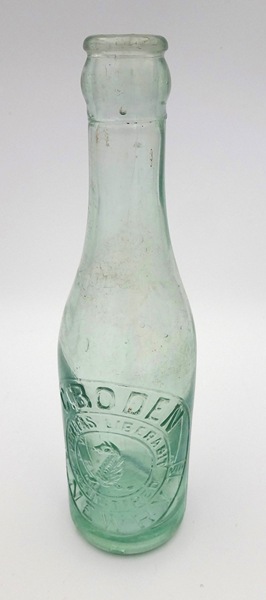
The 1901 census shows her as a successful businesswoman, employing four domestic servants: a housemaid, cook, grocery shopman, and apprentice. She supported local causes, donating plants to civic events and contributing regularly to the Christian Brothers from 1903–1905. In 1903, her solicitors, Carroll & O’Hagan, bought Drumalane House in trust for her for £1,150 from the Garland family.
Her daughter Mary Rose married Thomas Garland, son of Jane Garland, in January 1905 at Killean Church. The bride was given away by her uncle Edward Byrne, with bridesmaids including Mabel and Gertrude Garland and Lily Boden. Peter J. Boden served as best man. A large reception followed at Drumalane House before the newlyweds departed for their honeymoon in southern England.
Catherine’s brother Edward died in September 1906, aged 63, after a five-week illness. That December, she auctioned several properties, including Drumalane House, 61 Hill Street, 6 and 8 William Street, 23 Lower Water Street (with yard and out-offices), and two villas in Warrenpoint—Marino and Belmont. Though around 63 herself, Catherine had no plans to retire.
In February 1910, she purchased the Whitecross Hotel (now the Shelbourne Restaurant) at 11 Margaret Street, Newry, and applied for a publican’s license by September. The 1911 census records her living at Bridge Street with her daughter Mary Rose, son-in-law Thomas Cardwell Garland, and grandchildren Catherine (5), Jane Nora (3), and Richard Gerard (1). Both she and Thomas were listed as wholesale bottlers. Her stepson, Peter Joseph Boden (29), served as Secretary of the Wholesale Beer Bottlery Ltd. Co., lived nearby with his wife Anna-Claire and son Peter Cyril, and worked as a spirit dealer by 1914—suggesting Catherine had brought both men into the business.
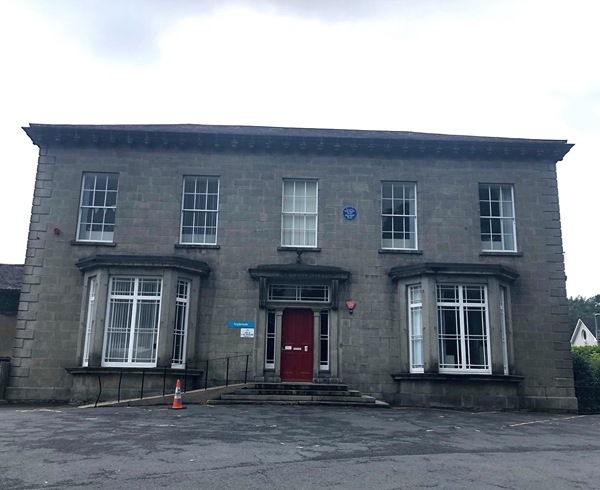
Tragedy struck in June 1913 when Thomas died suddenly at the bottling store on Lower Water Street. Dr. Thomas Cronin attributed the cause to heart failure due to alcoholic poisoning. He was buried on 3 June in the Old Chapel Cemetery. Catherine died the next day at her home, 65 Bridge Street. Mary Rose, grieving the loss of both husband and mother, inherited her mother’s estate. She dissolved Boden’s Ltd, took over the business, and expanded it, diversifying into mineral water production. Mary Rose preserved the family legacy through prominent local advertising
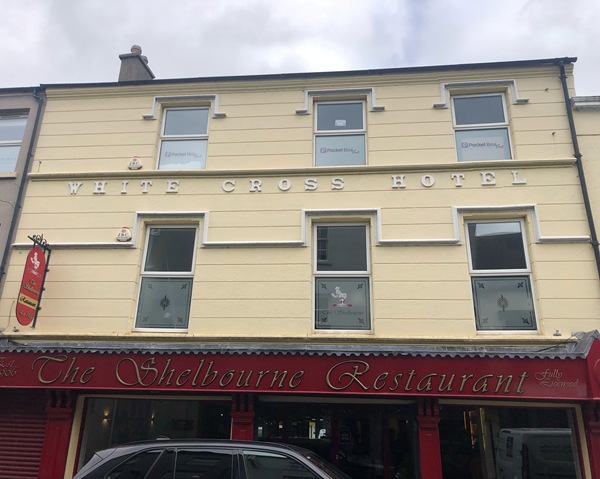
that kept the Boden name alive in Newry. Peter Joseph Boden moved to Dublin where he became an accountant for the firm of Coyle and Co. tea merchants. His sons Eric and Nial Boden became well-known broadcasters with Radio Eireann in the 1930’s, 40’s and 50’s.
The Museum is currently offering free tours of the main exhibition galleries on Wednesdays at 2.00 pm. These must be booked in advance by calling our Education Officer at 0330 137 4422.
Newry and Mourne Museum is open Tuesday to Saturday 10.00 am to 4.30 pm. Please call 0330 137 4422 or email museums@nmandd.org for further information, or visit their website at www.visitmournemountains.co.uk
Write a comment
There has been a fair in Hilltown for hundreds of years. The Northern Whig newspaper in October 1886 reported the following: ‘Hilltown - this important fair was held yesterday. As usual, there was a large show of stock of all kinds, the greater portion of which were of prime quality. The attendance of dealers was numerous and included a good number of English and Scotch dealers.’
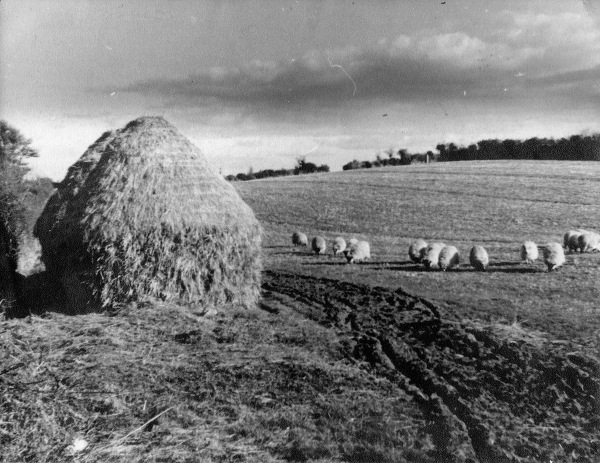
The street fair at Hilltown was one of the best of its kind in the north of Ireland. Flocks of sheep were brought to Hilltown Fair from Donegal, Antrim, Derry and Tyrone, as well as from all parts of Down and Armagh. The event usually started at about ten o’clock in the morning and continued to four o’clock in the afternoon. There were cattle, sheep, pig and horse markets, with donkeys and goats also for sale. This was a social occasion and, when business was completed, people stayed well into the night to make new and old acquaintances; dice were thrown, music played, and ballads sung.
In the late 1940s there had been a call to abolish street fairs and for them to be removed to fair greens. According to the Frontier Sentinel of 22nd December 1949, at a previous meeting of Newry No.1 Rural District Council, a letter from Reverend E. H. Ferguson of The Manse, Hilltown had been submitted, protesting the condition of the railings and church entrance during the fair. A memorial signed by fifty-two residents of Hilltown and district called for the continuance of the event stating that holding the fair was a practice which had been followed since 1612 when a Royal Charter was granted to the Prince of Iveagh, an historical name for the Magennises of Rathfriland, to hold a monthly fair there. Mr. S. Murphy moved that no action be taken, but that a concrete footpath be laid from the Manse to McCracken’s entry.
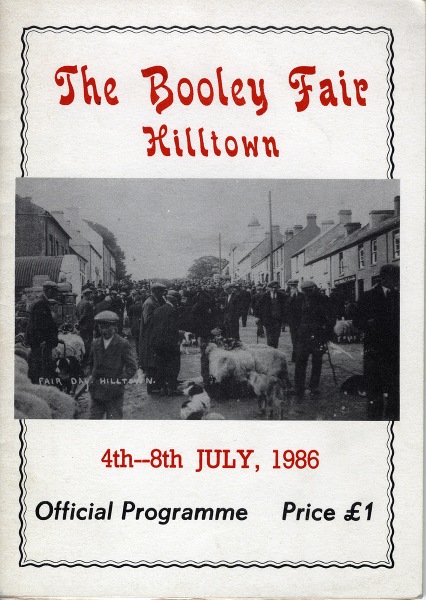
The Booley Fair festival was launched in the summer of 1986 as a celebration of rural traditions and to revive bygone days for everyone to enjoy. The Newry Reporter reported on the origin of its name: ‘In parts of Sixteenth Century Ireland, cattle were the principal form of wealth among the poorer farming people. In the summertime the cattle were driven to pasture in the hills and moors, where people built cabins of sods, roofed with heather. These were known as Booley huts. Everyone looked forward to summer in the mountains because there was little to do except herd cattle, and there was plenty of time for enjoyment. Any festivities they would have engaged in would have been known as “Booleying”. In the Hilltown area, cattle gave way to sheep in the early part of the Nineteenth Century’.

Skills such as blacksmithing, stone cutting and butter making were on show, and there were competitions involving rope twisting, tossing the sheaf, and jam and bread making. There was plenty of socialising with singing, poetry, music and dancing. And of course, there was an open livestock fair. From the Irish News 10th July 1986 ran the following ‘Down village comes alive with the past. Not since the coming home of the victorious Down team in 1960, has the market town of Hilltown seen such crowds and excitement as that of the Booley Fair which ended last night.’ The festival was revitalised a few years ago and is now known as ‘Back from the Booley’ which takes place this year from 21st to 26th August.
The Museum is currently offering free tours of the main exhibition galleries on Wednesdays at 2.00 pm. These must be booked in advance by calling Education Officer at 0330 137 4422.
Newry and Mourne Museum is open Tuesday – Saturday 10.00 am – 4.30 pm. Please call 0330 137 4422 or email museums@nmandd.org for further information.
Visit their website at www.visitmournemountains.co.uk
Write a comment
As September draws closer many families will be preparing to send their children back to one of the over 120 schools in the Newry & Mourne area. This week, the Museum will be exploring the items in our collection connected to education.
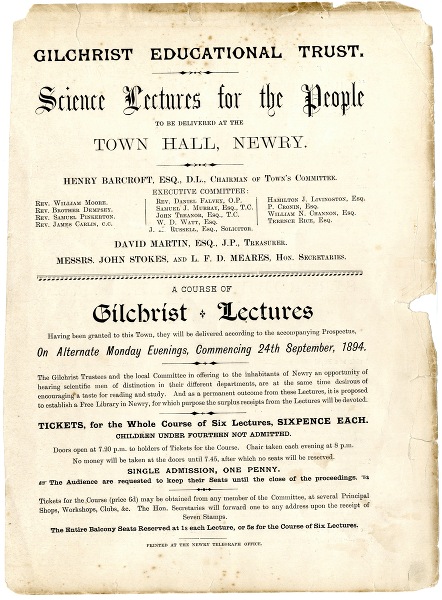
The Gilchrist Educational Trust was set up in 1865 to provide education for people with little or no access to opportunities for learning and to make financial help available for new educational projects. In 1867 the Trust established the Gilchrist Lectures which ran until 1939. Given by prominent academics and scholars and attracting large audiences, the lectures were held in many towns and cities in Britain and Ireland. The Gilchrist Lectures that were held in Newry in 1894 were to encourage “a taste for reading and study” along with the aim of establishing a Free Library in the town. A surplus of £48 from the entrance fees to the lectures went towards the opening of Newry Free Library in 1897 to further enhance education in the area.
The museum holds several schoolbooks in its collection including a grammar book sold by James Stevenson, a stationer in North Street in Newry. One of the most famous individuals when it came to exercise books was Vere Foster (1819 – 1900). He was a Belfast philanthropist who developed the Vere Foster Copy Books and Exercise Books to improve the teaching of handwriting. He was also the first president of the Irish National Teachers' Organisation, which was founded in 1868 and is the oldest and largest teachers' trade union in Ireland.
Another item in the collection is a recipe book from the early 1910s, compiled by a student at Newry Municipal Technical School. Even though rationing was not introduced until 1918, there were fears of food shortages in the early years of the First World War. The book contains a recipe for a “War Cake” using “war flour”, which was composed of wheat and a percentage of other grains.
Perhaps the most prominent element for returning to school is the uniform and we have several examples in the collection. Typically designed by the school and its governing bodies, the standard uniform for those in secondary education consists of shirt, jumper, blazer (complete with school crest), trousers or skirt.
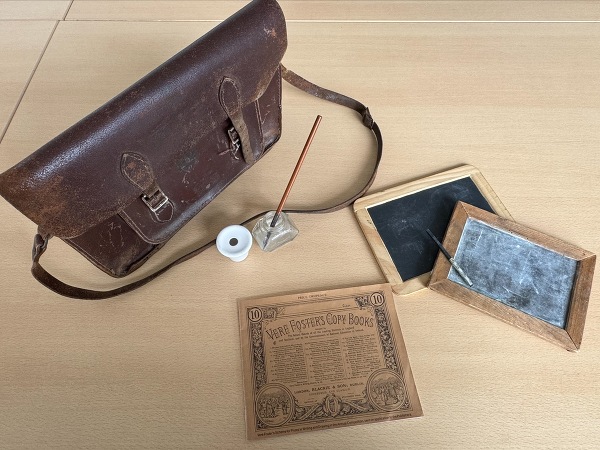
In terms of school material, stationery is a staple for the school year. The museum holds several examples of writing material, from the slate (writing slates were used in schools by young children until the 1930s) to the inkpots and pens which were used by older school children up until the 1960s when ball point pens became more popular. Other school supplies in our collection include a Casio Personal-I calculator from the 1970s. In September 1965, Casio released the 001, the world's first electronic calculator with a memory function and by December 2006, Casio had sold one billion calculators. These items all appear in the museum’s reminiscence boxes which are available for free to the public.
The Museum is currently offering free tours of the main exhibition galleries on Wednesdays at 2.00 pm. These must be booked in advance by calling their Education Officer at 0330 137 4422.
Newry and Mourne Museum is open Tuesday – Saturday 10.00 am – 4.30 pm. Please call 0330 137 4422 or email museums@nmandd.org for further information.
Visit their website at www.visitmournemountains.co.uk
Write a comment
For centuries, the people of Newry and Mourne have enjoyed games of skill, chance, and dexterity. In the 18th century, coffee houses and gaming houses featured billiard tables which had first appeared in France in the 1340s, evolving from an outdoor croquet-like game to an indoor pastime. By 1733, the Dublin Journal noted tables at a bowling green in Dublin, though the game’s link to gambling often drew criticism. One of Newry’s first coffee houses, recorded in 1758 and likely located on Water Street under a Mr. Davis, probably offered billiards to attract customers.
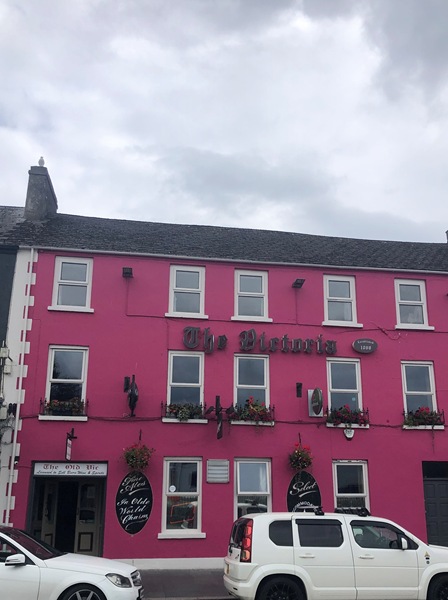
By the 19th century, taverns and hotels had taken over as the main venues. In the 1840s, Newry merchants such as John Reynold’s of Hill Street, were supplying another cue game—bagatelle. Invented in 1777 in France, it was tied to gambling and required a license from 1845. Still, it spread widely: the Victoria Hotel in Warrenpoint had a stone table in 1855, and folding versions became common by the 1860s. Bagatelle paved the way for later pinball machines, though mechanical amusements were rare at this time apart from travelling dioramas and panoramas. In 1843, Newry’s Assembly Room on Hill Street hosted a Diaphorama, blending music, painting, and mechanical effects—a spectacle that predated cinema.
Other games soon appeared. In 1865, a skittle alley was recorded on Monaghan Street in James Madden’s alehouse, with another built for soldiers at the Linen Hall barracks in 1868. By 1894, a new Soldiers’ Home on Sugar House Quay included a recreation room with a ‘harmonium, bagatelle table, and draughts boards.’ Recreation facilities expanded in the early 1900s. In 1908, a recreation room with a billiard table opened for Protestant youths in Rostrevor, while Kilkeel had one in its Old School House. By 1926, snooker—developed in Jubbulpore India in 1875, was being played in Newry’s Catholic Working Men’s Club. The sport grew quickly, marked by a 1934 exhibition at the Hibernian Hall by billiards champion Ruth Harrison.
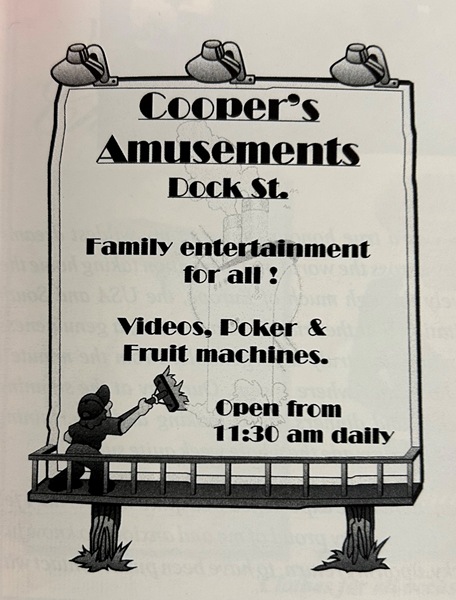
The 20th century brought new amusements. Inspired by Barry’s in Portrush (1925) and Dublin’s Grafton Arcade (1927), Cooper’s Amusements opened in Warrenpoint in the early 1940s. Advertisements in the Newry Reporter show it offered air guns and shooting galleries during the war years. Its rival, the Alexandra Arcade beside the Alexandra Hotel, reopened in 1948 with “up-to-date amusement devices” most likely skeeball and mutoscopes. Its shooting gallery remained popular until the hotel was converted into flats in the 1960s.
Video gaming emerged in the late 1950s with experimental titles like Tennis for Two (1958) and Spacewar! (1962), leading to the first commercial arcade cabinets, Computer Space (1971) and Pong (1972). Locally, a milestone came on 4 May 1978 with the opening of Slots O’ Fun on Church Street, Warrenpoint, promoted as 'Ireland’s Newest and Best Amusement Arcade.' Beginning with automatic 'pongo' (bingo), it soon added cabinets such as Space Invaders, Galaxian, Super Breakout, and Asteroids. In the 1980s, hits like Track and Field (1984) and Outrun (1987) drew crowds, and the arcade became a social hub, remembered for classics including Street Fighter II, Toki, and Pang. Its layout reflected the industry’s dual appeal—skill games at the front, gambling machines at the back. Meanwhile, Newry saw the opening of the Cue Club on Basin Walk in 1987, followed by American-style 10-pin bowling with the Olympia Superbowl at Sheepbridge (Aug 1989) opened by Newry Celebrity Pat Jennings, followed by a second alley on Upper Edward Street (Apr 1990).
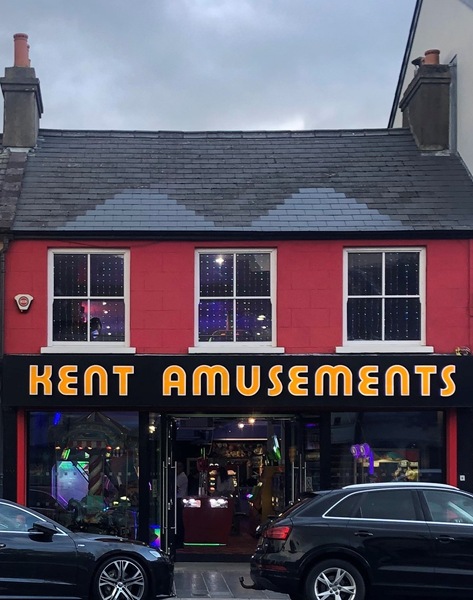
The early 1990s brought new arcades to Warrenpoint, including Coins Amusements (later Raymie’s Seafood Bar & Grill) and Jack Pots (now Lady T’s Boutique) on Duke Street. Yet by the mid-1990s, the rise of cheaper home consoles like the Sega Mega Drive, Nintendo 64, and PlayStation meant fewer reasons to visit arcades. By the 2000s, most had closed or reinvented themselves. During the Covid-19 lockdowns, nostalgia for retro gaming revived interest. Reflecting this resurgence, Kent Amusements opened on Church Street, Warrenpoint, on 15 June 2023.
The Museum is currently offering free tours of the main exhibition galleries on Wednesdays at 2.00 pm. These must be booked in advance by calling their Education Officer at 0330 137 4422.
Newry and Mourne Museum is open Tuesday – Saturday 10.00 am – 4.30 pm. Please call 0330 137 4422 or email museums@nmandd.org for further information.
Visit their website at www.visitmournemountains.co.uk


 |
 |
 |