

 Write a comment
During the early 1800s, the Mill Street area in Newry saw significant development, with 16 building lots advertised along the river in 1804. One of the mills powered by the Race was the Newry Flour Mill, located on Mill Street. It had two undershot water wheels, one 20 feet in diameter and the other 18 feet, both four feet broad, with a nine-foot waterfall. A 1959 article in the Newry Reporter recalled the use of the Mill Race by the local dyeing industry, specifically Keating’s and O’Hagan’s businesses, which discharged blue dye into the water. The Mill Race and Canal water were also used to clean the town’s streets.
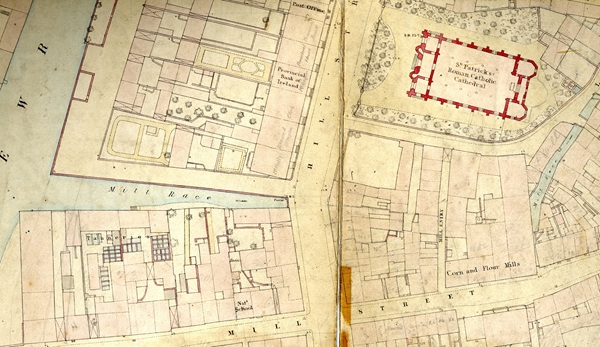
Despite its utility the Race was dangerous. In 1809, a woman’s body was found at the foot of the Mill Race, likely having fallen into the water in an unlit area. Efforts to cover the Mill Race were already underway by 1815, with £463 of the required £499 raised for the project. The estimated costs included £366 for arching, filling, and paving, £22 for curb-stone work, and £60 for pumps, among other expenses. Prominent contributors included Lord Kilmory and businessmen Dennis Caulfield and David Scott. It is unclear when work began, but additional efforts to cover the race took place in 1838–1839 as part of road-widening near Sugar Island Bridge.
By 1861, only a few open sections remained, including one near the Cathedral, another behind the Newry Corn and Flour Mills, and finally an open area where O’Hagan Street is now. In 1869, repairs were carried out on the Mill Race walls near Newry Courthouse in Trevor Hill, and in 1874, the construction of O’Hagan Bridge further enclosed the waterway, significantly altering its’ appearance.
Despite ongoing efforts to cover the Mill Race, it remained a persistent danger with various fatalities in the water street area in 1851, 1877 and 1889. By 1888, complaints from ratepayers in the Mill Street area had increased. A memorial was proposed to have the race fully enclosed, though not all town commissioners agreed on the necessity. The Mill Race at this time was also used as a sewer and the smell during the summer months was foul. That same year the Newry Reporter mockingly dubbed it the "Newry Blackstaff" and a "reeking abomination" that needed to be hidden from sight. Advertisements appear to have been made for the remaining parts of the race to be covered that year. Work was probably completed between then and 1895 when O’Hagan Street first appears to have gotten its name.

In January 1912 Mr. Kerr raised that Newry Urban Council take control of the Race, gradually filling it in and constructing new sewers as funds allowed. At the next meeting, discussions expanded to include structural failures, with the Council held responsible for repairs. Flooding in Downshire Road, Needham Place, and Hill Street that year reinforced the urgency of addressing the Race’s ownership as well as its ongoing instability. The arches and bridges had a history of collapse, with breaches recorded in 1875, 1883, and 1896. By 1915, the Urban Council’s clerk Cronin emphasized the need to close the Mill Race, but plans were delayed due to the First World War. In 1921, Rev. D. Grant of the Catholic Cathedral agreed to transfer interest in the Race to the Council in exchange for extending Water Street through to Mill Street, which was duly agreed. Work on a new sewer to replace the Race began in September 1923. By early 1924, nearly all work was completed, with house connections made and the Race filled in. In 1956 the old archway of the Mill Race which crossed Trevor Hill had to be broken down to enable pipes to be laid, but it appears to have been partially repaired and filled in.
The Museum is currently offering free tours of the main exhibition galleries on Wednesdays at 2.00 pm. These must be booked in advance by calling the Education Officer at 0330 137 4422.
Newry and Mourne Museum is open Tuesday – Saturday 10.00 am – 4.30 pm. Please call 0330 137 4422 or email museums@nmandd.org for further information, or visit their website at www.visitmournemountains.co.uk/museums/newry-and-mourne-museum
Write a comment
Newry and Mourne Museum contains numerous notebooks in the collection. The information that each collate range significantly, giving an insight into the lives and experiences of the authors.
Charles Murray, from Acton, near Poyntzpass, joined the Royal Air Force in 1936. He initially trained in England but, by early 1939, was in Palestine, where he spent the early years of the Second World War. However, by 1943 Sergeant Murray was being stationed at various RAF Stations in Britain and Northern Ireland. He was killed on the night of 30 August 1944 when the Lancaster Bomber, on which he was a Flight Engineer, was shot down during a bombing raid on Stettin in Poland. One of the booklets is an RAF Observer’s and Air Gunner’s Flying Logbook, containing details of flying exercises in Palestine from January 1939 to December 1941. Two others are training notebooks containing pencil and ink drawings and diagrams of aircraft parts.
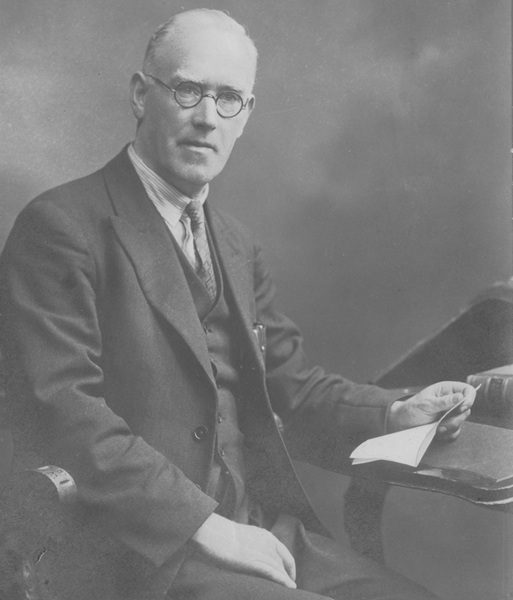
There are several notebooks in the extensive Hugh Irvine Collection. Born in Belfast in 1930, the son of a Presbyterian minister, Hugh Irvine came to Kilkeel in 1953 when he was appointed as a history teacher at the newly opened Kilkeel High School. He became Vice-Principal of the school in 1962 and was Principal from 1987 until his retirement in 1993. After settling in Kilkeel, he developed a keen interest in the history, archaeology, architecture, genealogy and folklore of the area around Kilkeel, the Mourne Mountains and Rostrevor. A number of school jotters contain Hugh Irvine’s own hand-written notes and research on various topics, such as, ‘Old families of the Mourne Country’ with newspaper cuttings from the Mourne Observer from 1956, notes on the Moore, Walmsley and McIlwaine families of Mourne, transcriptions of gravestones in Kilkeel, and a compilation of fairy stories in the Mourne area collected by Mr Irvine. A notebook titled ‘O Biology’, contains notes and details of bird spotting in the Mournes from 1984 to 1996. Several notebooks relate to Reverend Alexander Savage, one of which is a sermon handbook from the 1850’s, with handwritten notes by Reverend Savage, minister of Ballenon Reformed Presbyterian Church near Poyntzpass.
The Museum’s collection contains several handwritten recipe books. One was compiled by a student at Newry Technical School from 1914-1916, during the early years of the First World War, when fears of food shortages were growing. A recipe for ‘War Cake’ is included along with recipes in which ‘war flour’, which comprised of wheat and a percentage of other grains, was used.
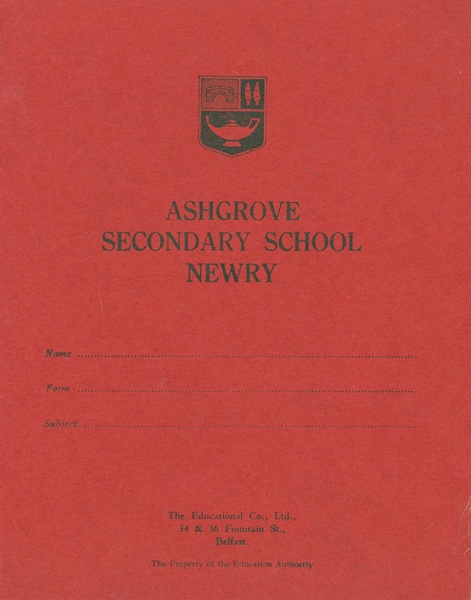
School exercise books are also included, such as a blank jotter from Ashgrove Secondary School, Newry and a book belonging to Edward Devlin of Ballymacdermott, a pupil in the VI Class at Cloughoge Primary School, 1911-1912. Inside the front cover are labels relating to Devlin family history.
Write a comment
Finnis Souterrain, an important and unique archaeological site located in Finnis, south of Dromara, County Down, has officially reopened to the public following over a year of extensive repairs and improvements carried out by Newry, Mourne and Down District Council.
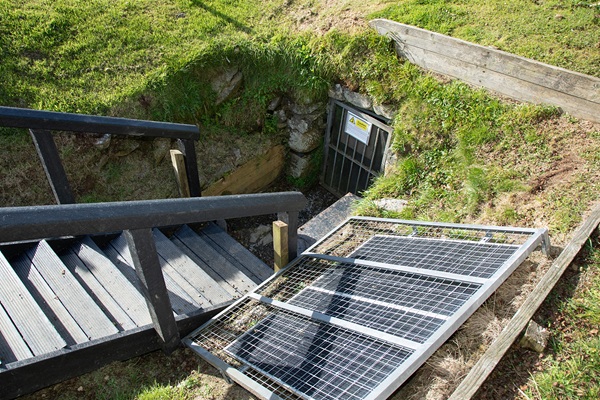
Access into the souterrain was restricted for more than 12 months to facilitate essential upgrades. The work was completed in September last year and the site was then closed to the public during the winter months. Funded by the Northern Ireland Environment Agency through the Environment Fund, these improvements included the replacement of the entrance steps, the installation of new lighting and sensors, the addition of solar panels, the construction of stockproof fencing along the entrance path, the placement of new information panels at the entrance gate and the erection of a wooden sign to guide visitors from the main road. The site will remain open from April to the end of September and the improvements made will make it better for visitors to explore this souterrain and learn about its fascinating history.

Newry, Mourne and Down District Council Chairperson, Councillor Pete Byrne said, “Exploration of the Finnis Souterrain offers a special experience for visitors, as these structures are often not accessible to the public or buried and forgotten with time. The upgrades mark an important moment in the preservation and public engagement with Northern Ireland's archaeological heritage. Visitors can now once again explore this fascinating historical site, which offers a rare glimpse into the life of the Early Christian period.”
Dating back to the Early Christian period (6th to 10th century AD), souterrains are relatively common but their dark, confined nature often makes them unsuitable for public access. Therefore, Finnis Souterrian, known locally as Binder’s Cove, gives a unique opportunity for people to visit one of these hidden places.
The site at Finnis is a well-preserved underground granite structure featuring three passages. The main passage runs approximately 29 meters from east to west and features large stones near the base, giving way to smaller stones as the passage narrows inward. Two smaller side passages extend from the central corridor, each measuring around 6 meters long and having low lintels at the entrance. The passages vary in height, with some areas requiring visitors to bend or crouch to navigate through them.
They were likely built as places of refuge during a time of civil unrest, with the threat of Viking raids and inter-tribal conflict. While their precise purpose remains debated, it is widely believed they were used both as places of refuge and for storage on a day-to-day basis.
The site has a long history of discovery. It has been known for at least 200 years and was first cleared and surveyed by archaeologists in 1977-1978, although formal excavation did not take place at that time. In 2003, with the support of Banbridge District Council, funding from Environment and Heritage Services Built and Natural Heritage, the Northern Ireland Tourist Board, and assistance from the Mourne Heritage Trust, the site was officially opened to the public for the first time.
Visitors can now explore this captivating historical site once more, gaining a rare insight into life during the Early Christian period. Check in advance if the site is open by emailing: visitorservices@nmandd.org or contact Visitor Services and Attractions on +44 (0) 330 137 4046. For more information: www.visitmournemountains.co.uk
Write a comment
Easter is the most important date in the Christian calendar, with Good Friday marking the Crucifixion and death of Jesus, while Easter Sunday celebrates his resurrection. For this reason, the cross is the main symbol of the Christian religion. When Christianity came to Ireland in the 5th century, the Celtic cross, featuring a circular ring around the arms and stem of a Latin cross, became a prominent symbol of Irish Christianity.

Richly carved high crosses began to appear in Ireland in the 9th century. One local example can be found in the graveyard of Donaghmore Parish Church, outside Newry. The name Donaghmore comes from the Irish “Domnach Mór”, meaning “great Sunday”. Place names incorporating Domnach are traditionally associated with St. Patrick and denote an important ecclesiastical site. St. Mac Erc is said to have founded the first church, becoming the first bishop of Donaghmore in the middle of the 5th century. Carved from Newry granite, the high cross is known as St. Mac Erc’s cross. Dating from the late 9th century, it is a composite of two crosses, pointing to the possibility that there may have been more than one cross on the site. According to tradition it was toppled in the 17th century, possibly by Cromwellian or Williamite forces, and the shaft broken into two pieces. Although the original site is unknown, it was re-erected in 1891 by the Rev. Joseph Davison Cowan, with the help of the Belfast Naturalists’ Field Club.

The cross is known as a scriptural cross and contains carvings of Biblical characters and scenes. Around a third of high crosses in Ireland are scriptural crosses and they were thought to be a means of teaching the Bible. The Donaghmore cross is notable for the number of carvings, especially of Old Testament images, of which there are believed to be seven, plus two New Testament images, which both appear at the head of the cross. Centuries of weathering have made it difficult to interpret and identify the images. However, scenes from the Book of Genesis can be found on the west face of the shaft, with Adam and Eve clearly identifiable, along with the Tree of Life. Above the tree are four fishes and Noah’s Ark.

The central theme of nearly all scriptural crosses is the Crucifixion, which is found on the west face of the head of the cross, where in good light, the figures of Christ and the two thieves can be seen. The ring of the cross surrounds this scene, leading to the theory that it represents the universe, with the Crucifixion seen as the most important event in history. On the east side, which is badly weathered and more difficult to see, is The Last Judgement.

While high crosses were sculpted out of stone, Celtic crosses were also inscribed onto stone. The Promise Stone, a stone slab featuring a carved cross was built into the wall of Campbell’s shop on Castle Street in Newry. When the shop was demolished in the 1960s, the stone was moved to its current location in the former premises of McCann’s Bakery, which is now Newry and Mourne Museum.
The stone was originally a grave slab dating from the 12th century and stones of this type frequently marked the graves of local dignitaries and important officials. The estimated age of this particular example suggests that it may have originally stood in the cemetery adjoining an earlier monastery at Newry prior to the foundation of the Cistercian abbey in 1153.
First mentioned in the Irish Annals in the year 957, the era of high cross production came to a close in the 12th century. The Gaelic revival in the late 19th and early 20th centuries saw the Celtic cross regain prominence as a symbol of Irish identity.
The Museum is currently offering free tours of the main exhibition galleries on Wednesdays at 2.00 pm. These must be booked in advance by calling their Education Officer at 0330 137 4422.
Newry and Mourne Museum is open Tuesday – Saturday 10.00 am – 4.30 pm. Please call 0330 137 4422 or email museums@nmandd.org for further information.
Visit their website at www.visitmournemountains.co.uk
Write a comment
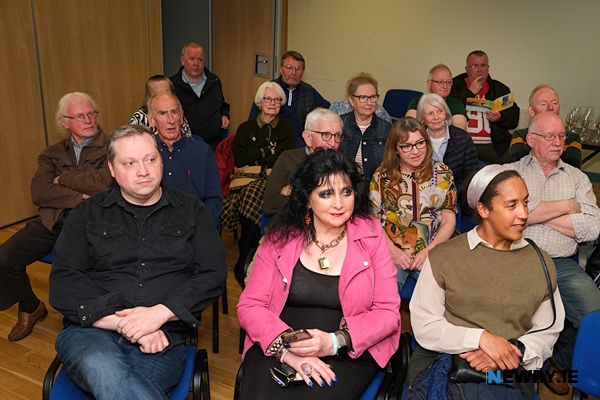
The eighteenth edition of “Before I forget...”, the journal of the Poyntzpass and District Local History Society, was launched at a function in The Meeting Place, Community Centre in Poyntzpass on 10 April.
This popular journal, which has established a reputation for excellence, lives up to all expectations and, as usual, has been produced to the highest standards. The contents are based on the texts of talks given to the Society in the recent past and show to great advantage the meticulous research of the various contributors.
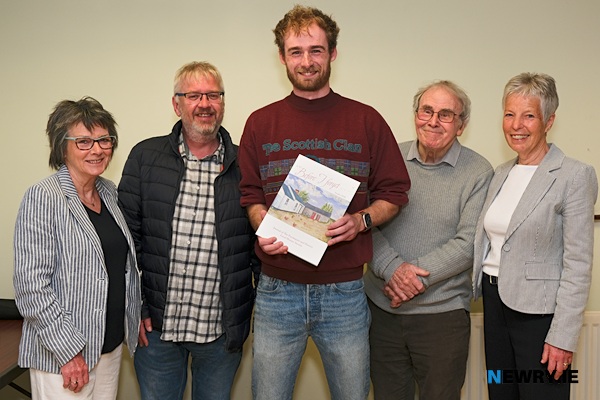
Since its first publication back in 1987, the Society’s aim has been to present well-researched local history articles to the wider public, in a form that was both informative and accessible. This they have managed to achieve over the years and this edition of “Before I forget…” will certainly meet those aims for here there is a wealth of interesting information and an enjoyable read in equal measure.
This edition, includes such a rich mixture of articles, that even readers with only a passing interest in local history, are sure to find something of interest in its 125 pages.
There is the poignant story of the local young women and girls who sailed to Australia in the middle of the nineteenth century as part of the 'Earl Grey, Female Orphans Scheme' and the, hitherto unknown, local connection with the village of 'Point Pass', South Australia.
The history of Poyntzpass Silver Band, and how 70 years ago founders made the brave decision to lay aside their flutes and take up instruments which none could then play, is retold by current members.
The turbulent history of The Railway Hotel and the rise and fall of the Searight Dynasty makes for interesting reading, as does the affectionate history of the ancient townland of Shaneglish.
'A Railway man' relates how the coming of the railways in the 1840's impacted the local community and influenced the fortunes of one family in particular while there is a fascinating walk along the River Cusher at Clare village where 1,500 years of history seem just like yesterday.
The impact of a local community activist, William John Hanna, 'The Miller Hanna of Ballydougherty' on local life in the 19th and early 20th centuries, has been largely overlooked but an article here rightly records his outstanding contribution to the struggle for tenants' rights and local government.
This edition includes extracts from the contrasting Memoirs of two local ladies and, to mark the 50th birthday of the Society there is a look back through the Minute book to see how thing have changed, but have largely remained the same.
In keeping with recent practice there is included an up-to-date recording of the headstone inscriptions at St Patrick's, Ballyargan, which will surely provide for nostalgic browsing for many and useful information for family tree researchers.
In his introduction the Society's Chairman , Robert Morrow, writes, “To whoever is reading this, in whatever year, in whatever country, I hope you find in these pages the warmth and comfort of home.” - We hope you will.
Get your Copy at:
Poyntzpass
Trainors SPAR
Poyntzpass Pharmacy
TPM Credit Union
Tandragee
Garden Fresh
SPAR
TPM Credit Union
Newry
Fiveways
Banbridge
Walsh's Newsagents
Loughbrickland
Lakeview Stores
Fegan's Farm Shop
SPAR
Markethill
Hunter's Supermarket
Fane Valley Stores (Eleven Lane Ends)
Write a comment
John Francis Small was born in Newry on 11 October 1852 to Arthur John Small, a local grocer and publican based on Margaret Street, and Mary Small (née O’Callaghan), the daughter of Patrick O’Callaghan of Ballymacnab, Co. Armagh. He was baptised at Newry Cathedral by Rev. Patrick O’Neill. John had two sisters: Mary Josephine (born 1854) and Helena (born 1862).
His early education began at Patterson’s Academy on Corry Square, Newry. According to Edward A. Lamb, both he and Small later attended a private school on William Street around 1864. Not long after, he continued his studies under the guidance of the Very Rev. Father Finnigan, President of St. Colman’s College, Violet Hill. From a young age, John was regarded as a precocious and studious child, with a strong passion for Greek and Latin literature. His intellectual interests were further enriched through extensive travel across the continent. By his teenage years, he had already distinguished himself academically, winning the Silver Medal of the Incorporated Law Society for placing first in his preliminary solicitor’s examination.

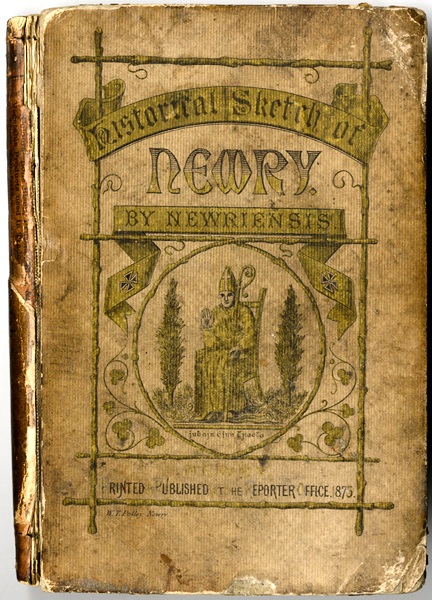
He was then apprenticed to Joshua M. Magee, a leading solicitor in Newry who also held the roles of Crown Solicitor for County Armagh and Coroner for its Southern Division. Small was admitted to the High Court of Judicature in Ireland in 1874, at just 22 years old. As he was too young to begin formal legal practice immediately, he devoted this period to writing Historical Sketch of Newry, which he published under the pseudonym ‘Newriensis’ in 1875. Probably the first major historical study of the town, the book demonstrated both his literary skill and deep local knowledge. That same year, he attended the funerals of noted Protestant nationalists John Mitchel and John Martin. The following year, he was elected a member of the Newry Literary & Scientific Society, an organisation previously presided over by William Haslett Mitchel, brother of John Mitchel.
In the years that followed, Small’s political and civic engagement deepened. In 1876, he formally began practicing as a solicitor at 26 Hill Street. In 1877, he and his father were instrumental in founding an Irish Home Rule organisation for Newry at the Imperial Hotel. These activities reflect an early and earnest commitment to Irish nationalism, a stance likely influenced by his mother’s earlier connections to Dublin’s literary circles and the Young Ireland movement.
In 1882, possibly inspired by his mentor Joshua Magee, Small stood for election as Coroner for the Southern Division of County Armagh. He was elected by 581 votes to Dr. Anderson’s 532, and the role tasked him with investigating unexplained or sudden deaths throughout the area.
A year later, in 1883, Small was elected Parnellite MP for Wexford in the British Parliament. The news was met with great celebration in Newry: at nine o’clock that evening, around 5,000 people gathered. The Monaghan Row and Church Street Fife and Drum Bands assembled at Ballybot Courthouse, then led a jubilant procession through King Street, Hill Street, Margaret Street, Water Street, Kildare Street, and back again to Margaret Street, where they stopped in front of Small’s family home. There, music played, and cheers were raised in his honour. Following boundary changes in 1885, Small’s seat in Wexford was dissolved, but he was soon elected MP for the newly created constituency of South Down, a position he held until 1886.
In 1887, following the civic-minded example of his father, who had served as a Town Commissioner from the late 1850s, Small became a Town Commissioner for Newry, a role he held for many years. After the 1899 reforms to local government, he was elected to the newly formed Newry Urban District Council. He also served on the Newry Board of Guardians, the Newry Port and Harbour Board, and the Newry Technical Instruction Committee. John Francis Small died at his Hill Street residence on 5 July 1923, aged 71, and was buried at St. Mary’s Roman Catholic Cemetery.
The Museum is currently offering free tours of the main exhibition galleries on Wednesdays at 2.00 pm. These must be booked in advance by calling our Education Officer at 0330 137 4422.
Newry and Mourne Museum is open Tuesday – Saturday 10.00 am – 4.30 pm. Please call 0330 137 4422 or email museums@nmandd.org for further information, or visit their website at www.visitmournemountains.co.uk
Write a comment
Newry and Mourne Museum is hosting a special commemorative talk next month to mark the 80th anniversary of the end of the Second World War. Victory in Europe Day (8 May 1945) and Victory over Japan Day (15 August 1945) marked the formal cessation of global hostilities. To mark this significant milestone the Museum's talk will explore how these historic moments were celebrated across County Down.
Guest speaker Michael Burns, Research Officer at the Northern Ireland War Memorial (NIWM), will visit the Museum on Thursday 8 May at 2pm. Michael curates the NIWM’s extensive oral history collection and will share vivid recollections of street parties, parades, bonfires and dances in places like Banbridge, Crossgar and Newtownards, offering an evocative window into life in Northern Ireland in 1945.
Newry, Mourne and Down District Council, Chairperson Councillor Pete Byrne said, “This 80th anniversary is a time for both remembrance and reflection. The end of the Second World War was a defining moment in world history, and it is important we continue to honour the stories of those who lived through it. Events like this not only commemorate victory but help us understand its cost and the resilience of those who endured those difficult years. I encourage everyone to come along and engage with this powerful history.”
While these moments of joy brought communities together in celebration, they were also marked by sombre reflection. Post-war anxieties began to surface as the world learned more about the horrors of the Holocaust and the devastating aftermath of the atomic bombings in Japan. As we commemorate 80 years since the end of the war, this event provides a meaningful opportunity to reflect not only on victory, but on the cost of conflict.
Alongside the talk, the Museum will display a number of poignant wartime artefacts, including the uniform of PFC James Quinn, a local man from near Kilkeel, who served in the Allied advance into Germany after the D-Day Landings, and a Burton suit belonging to James Murphy, also of Kilkeel, who served in North Africa with the Royal Army Ordnance Corps.
The talk will take place at Newry & Mourne Museum, Bagenal’s Castle, on Thursday 8 May at 2pm. Entry is free of charge.
To book or for more information, please email Declan.Carroll@nmandd.org
Write a comment
This year marks the 80th anniversary of the formal acceptance of Germany's unconditional surrender of its armed forces to the Allies of World War II on Tuesday, 8th May 1945. Originally, it was going to be named Ceasefire Day, but Winston Churchill suggested Victory in Europe Day to reflect the ongoing war in the Far East.
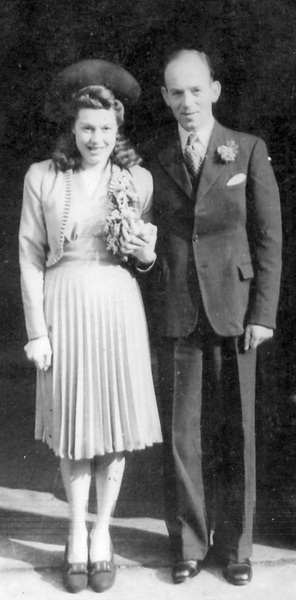
The people of Newry had waited more than 5 years for this moment. They had watched their young men and women lose their lives and had suffered the hardships of war at home. The houses of Unionists were decorated with the flags of the allies and schools were closed. The Town Hall hosted a united service of thanksgiving, and a large crowd assembled at Trevor Hill to listen to loudspeakers broadcasting Prime Minister Winston Churchill’s speech in the afternoon and King George VI’s address that evening. Later the Hunter Moore Pipe Band headed a large procession culminating in a huge bonfire in the Intermediate School grounds on Hill Street where “an excellent effigy of Hitler” was burned. Celebrations continued into the early hours of Wednesday morning with dances at the Town Hall, Drill Hall and Orange Hall.

For many the celebrations were bittersweet. Servicemen and women were still fighting in the Pacific and would not return until after VJ Day, when victory in Japan was declared on August 15th. Some would not return at all.
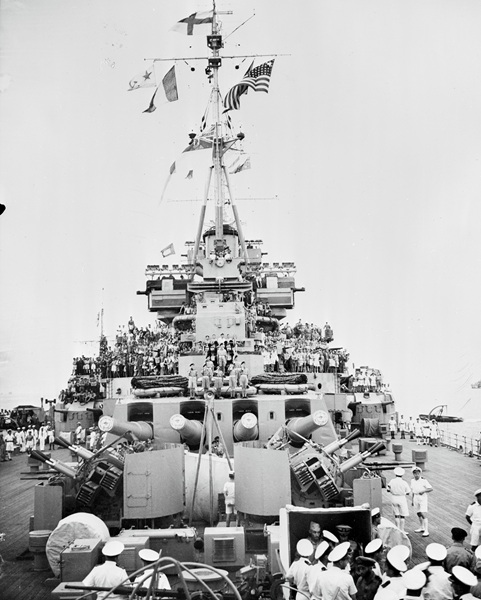
Seventeen Royal Naval Ratings from Northern Ireland celebrated VJ Day aboard the flagship HMS Duke of York in Tokyo Bay, including Thomas Grattan, aged 19, from Rathfriland. VJ Day celebrations in Newry were less exuberant and although the Council set aside £100 towards suitable events (about £3,500 today), the money was paid to local charities. August 15th, 1945, saw a large gathering of over 5,000 members of the Ancient Order of Hibernians from across the border counties at Keady, in south Armagh, with many Newry residents following the St Catherine’s Silver & Reed Band. The Newry Reporter commented “Rejoicing at the great Allied Victory did not enter into it, but despite many Roman Catholic bunting, there were quite a number of Union Jacks”.
After their demobilisation from the British armed forces servicemen were issued with civilian clothing. Known as a demob suit, the outfit included: a felt hat or flat cap, a double-breasted 3-piece suit or a single-breasted jacket and trousers, two shirts and collars, a tie, shoes and a raincoat. Women who were demobilised from the armed services were simply given clothing coupons.
One of the main suppliers of demob suits was Burton’s, founded by Montague Burton, and it’s thought that that the phrase the full monty, meaning "everything" originally referred to a full set of demob clothes supplied by the firm. By the end of 1945, around 75,000 demob suits were being made each week. Although the fit was often the butt of jokes, the quality was high, and many men continued to use their demob suits for special occasions.
To mark the 80th anniversary of VE Day, Newry & Mourne Museum is displaying a 1940s Burton suit, originally owned by James Murphy. Born in 1916 in Kilkeel, County Down, James worked for a time on the building of the Silent Valley Reservoir. During World War II he joined the Royal Army Ordnance Corps and served in North Africa.
Also on display is a “Victory Bell”, a handbell bearing the heads of the allied leaders Churchill, Roosevelt and Stalin in low relief. During the war, many German aircraft crashed over the UK. Their aluminium was recycled in new aircraft and in 1941 the Buckinghamshire Die-Casting Co used remnants to cast hand bells to raise money for the RAF Benevolent Fund. They were sold for around £1 (about £36 today). A battle souvenir associated with the loss of life is perhaps not so acceptable to modern sensibilities, but it is something that has long been a part of war.
Guest speaker Michael Burns, Research Officer at the Northern Ireland War Memorial (NIWM), will give a talk at the Museum on Thursday 8 May at 2pm. Michael will share recollections of celebrations in Banbridge, Crossgar and Newtownards, offering an evocative window into life in Northern Ireland in 1945.
The Museum would love to add to its collection of photographs, newspaper cuttings or other memorabilia of VE Day and VJ Day celebrations in Newry and Mourne. If readers have any material they would like to share, please contact the Curator.
The Museum is currently offering free tours of the main exhibition galleries on Wednesdays at 2.00 pm. These must be booked in advance by calling our Education Officer at 0330 137 4422.
Newry and Mourne Museum is open Tuesday – Saturday 10.00 am – 4.30 pm. Please call 0330 137 4422 or email museums@nmandd.org for further information.
Please visit their website at www.visitmournemountains.co.uk
Write a comment
Drawing is the most democratic form of art, requiring simply a plain surface and a pencil, a piece of chalk, a brush, or even a stick. Throughout history artists have used drawing as part of the creative process and while painting and sculpture have often been influenced by prevailing style and the art market, drawing has always offered much more freedom.

It was not until around 1500 that relatively inexpensive drawing paper as we know it became available, and the concept of sketching was born. The sixteenth century was a time of dramatic change with the rediscovery of classical art, a new interest in science, and the development of the role of the artist, driving the huge expansion in the concept of drawing. It became a tool for design and experiment with artists such as Leonardo Da Vinci making drawings of nature and human anatomy and using drawing to design architecture and machinery.
During the sixteenth century, drawing training was formalised, and students were asked to copy classical statues and living models to develop their skills, but by the 19th century artists began to move away from simple observation to drawings that are about personal expression and feeling. Today a drawing can mean almost anything and can even be made on a digital device.

Newry and Mourne Museum holds drawings created by artists and designers for a range of purposes, from preparatory sketches to portraits, from plans and technical drawings to observations of nature and the landscape.
In January this year, the Museum acquired a portrait sketch by Newry artist Margaret Clarke. This beautiful pencil and charcoal drawing is typical of a preparatory study, perhaps for an oil painting, but also a subtle and charming work in its own right. It probably dates from the 1930s when a critic noted that Clarke produced "remarkable drawings in which individuality is caught in a few swift economical lines”.

Local architect and engineer Samuel Wilson Reside oversaw the design and installation of the Dean Swanzy memorial stained-glass window, St Mary’s Parish Church in 1936. The Reside Collection in the Museum includes a watercolour sketch of the initial design by Abbot & Co, a firm making stained glass and church furnishings based in Lancaster and London. The company was established in1860 by the plumber and glazier William Abbott and the business continued under his sons and grandsons. Their work was influenced by the stained-glass artists of the Arts & Crafts Movement, and many examples of work produced by Abbot & Co can still be seen in churches, hospitals, town halls, pubs, and country houses across the UK and beyond.
Also in the collection, an intimate charcoal study of Charles Murray in his RAF uniform, possibly by one of his fellow airmen, shows the immediacy of drawing.
Murray from Acton, near Poyntzpass, joined the Royal Air Force in 1936 and was killed when the Lancaster Bomber, on which he was a Flight Engineer, was shot down during a bombing raid over Poland in 1944. The Museum holds a collection of his papers including training notebooks containing his own pencil and ink drawings and diagrams of aircraft parts.
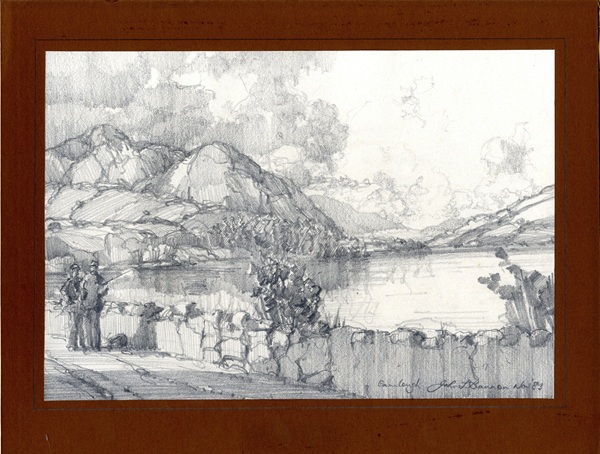
Camlough by John T Bannon is another example of drawing as a preparatory sketch. Bannon specialises in rural and urban landscapes, working mainly in oils. This drawing is one of several works by this Irish artist in the Museum’s collection.
On Saturday 17th May the Museum will be celebrating Drawing Day by holding free workshops with local artists. If you have been inspired, why not come along and try your hand at sketching a still life or figure study?
The Museum is currently offering free tours of the exhibition galleries on Wednesdays and Thursdays at 11.00 am. These must be booked in advance by calling their Education Officer at 0330 137 4422.
Newry and Mourne Museum is open Tuesday – Saturday 10.00 am – 4.30 pm. Please call 0330 137 4422 or email museum@nmandd.org for further information.


 |
 |
 |